Ludwig drums | Every range explained (2026)
Every Ludwig drum kit and snare in 2026, from the Accent beginner kit to Classic Maple, Vistalite and the Supraphonic, and which are made in the USA.
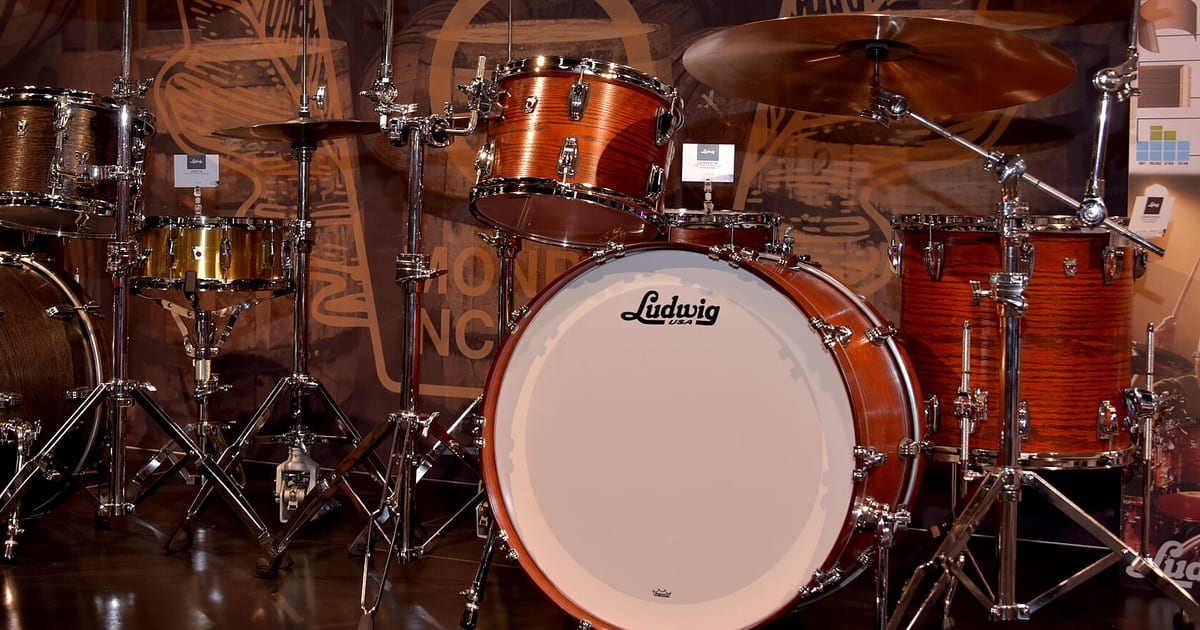
Few names in drumming carry as much history as Ludwig. It is the kit Ringo Starr played on The Ed Sullivan Show, the amber acrylic kit John Bonham played in The Song Remains the Same, and the badge on what is probably the most recorded snare drum of all time.
It is also a company that sells a complete starter kit with cymbals in the box and a hand-built American maple kit that costs as much as a used car. That is a lot of ground, and the range names (Classic, Legacy, Element, Evolution, Phonic) don’t make it easy to work out what is what.
So here is every Ludwig drum kit and snare in the line-up at the time of writing, what each one is made of, where it is made and who it is for. Let’s find out which Ludwig is right for you.
A very short history of Ludwig
William F. Ludwig and his brother Theobald founded Ludwig & Ludwig in Chicago in 1909. Their first product was not a drum but a bass drum pedal. Theobald died in the 1918 flu epidemic, and by the 1920s the company was making the brass snare that would become known as the Black Beauty.
The story then gets complicated. William sold Ludwig & Ludwig to C.G. Conn during the Depression, set up a new company under his own initials, WFL, in 1937, and bought the Ludwig name back from Conn in 1955. (His grandson’s boutique brand, WFL III Drums, uses the same initials.)
Then 1964 happened. Ringo Starr played his black oyster pearl Ludwig on The Ed Sullivan Show, and Ludwig became the most famous drum company in the world almost overnight. The Supraphonic snare, the Vistalite acrylic kits (1972) and John Bonham’s long run with Led Zeppelin cemented the reputation.
The family sold the company to Selmer in 1981, and in 1984 production moved from Chicago to Monroe, North Carolina, where Ludwig’s USA drums are still made. Today Ludwig sits within Conn-Selmer, part of Steinway Musical Instruments.
Which Ludwig drums are made in the USA?
This is the question most people actually want answered, so here it is up front.
Made in Monroe, North Carolina: Classic Maple, Classic Oak, Legacy Maple, Legacy Mahogany, NeuSonic, Vistalite, the limited Stainless Steel reissue, and the Phonic family of metal snares (Supraphonic, Black Beauty, Acrolite and friends).
Made in Asia: Accent, Element Evolution, Breakbeats and the Pocket Kit. Ludwig doesn’t make a song and dance about this, but every kit at these prices from every major brand is built in Asian factories, and there is nothing wrong with that.
The quick rule: if the badge is the brass keystone that says “Monroe, NC, USA”, it was built in America.
Ludwig’s beginner and intermediate kits
Accent
The Accent is Ludwig’s “everything in the box” starter kit, and it was refreshed for 2025 with new finishes and the keystone badge. You get a 5-piece kit with 5-ply hardwood shells, a hardware pack that includes a throne, and a 3-piece cymbal pack.
There are two configurations:
- Drive: 22”x16” bass drum, 10” and 12” toms, 16” floor tom and a 14”x5” snare.
- Fuse: 20”x14” bass drum, 10” and 12” toms, 14” floor tom and a 14”x5” snare.
Finishes are the sparkly “Dust” family: Jade Dust, Moon Dust and Snow Dust. It is the cheapest way into a full-size Ludwig, though prices vary a lot between shops and bundles, so compare before you buy. As with any complete kit at this price, the cymbals are there to get you going and will be the first thing you replace.
Element Evolution
The Element Evolution is the step up: Ludwig calls it an intermediate kit, and it comes with double-braced hardware and Remo Pinstripe heads. Retailers list it with poplar shells, and the full kits are sold with cymbal packs that vary by country and shop, so check the listing.
Finishes at the time of writing are Caramel Sparkle, Crimson Sparkle, Atlantic Sparkle and Prosecco Sparkle. It sits in the same space as the Pearl Export, and it is worth hearing both before you buy.
The Pocket Kit by Questlove
A genuinely small drum kit for children aged four to ten, designed with Questlove. It has a 16” bass drum, 10” tom, 13” floor tom and a 12” snare, plus all the stands, a throne, sticks and two cymbals. For more on choosing a first kit for a child, see our parents’ guide.
Breakbeats by Questlove
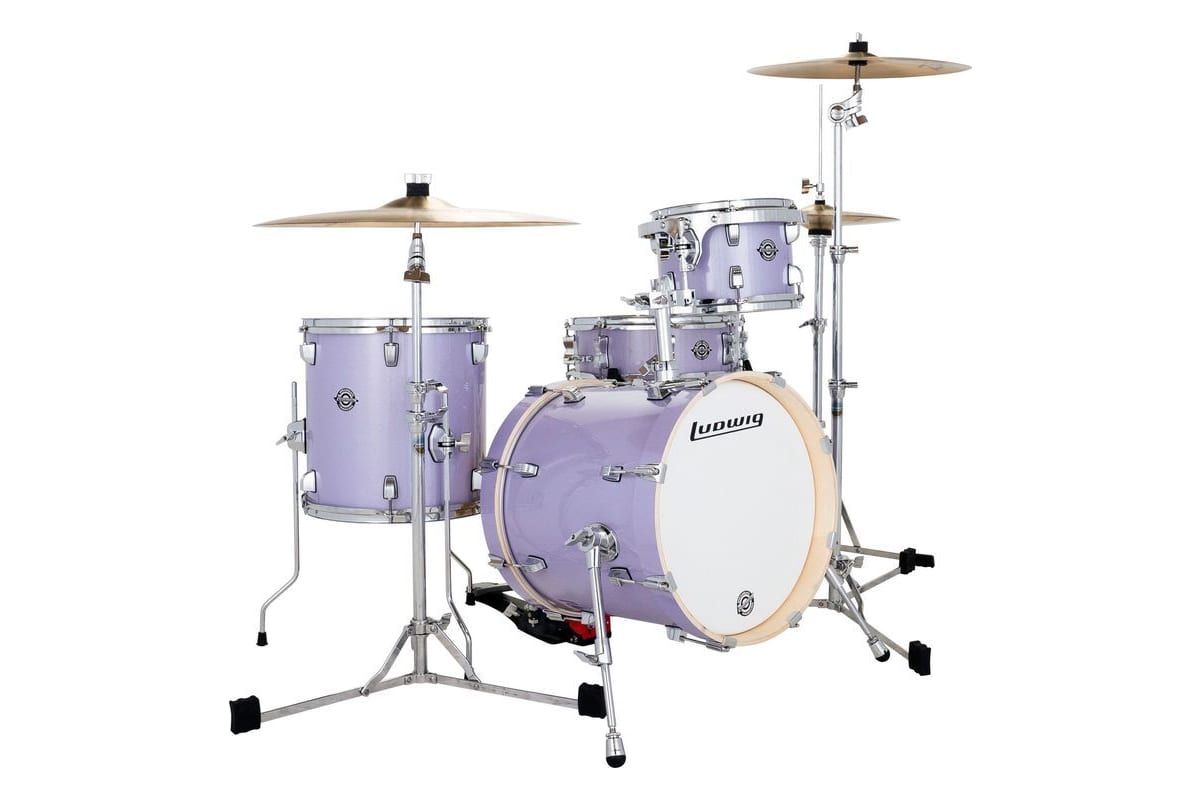
Breakbeats is the one we would buy for a flat. Designed with Questlove and launched in 2013, it is a 4-piece shell pack with a 14”x16” bass drum, 7”x10” tom, 13”x13” floor tom and a matching 5”x14” snare, all in 7-ply hardwood. The bass drum sits on a riser so the beater hits the middle of the head.
It fits in a cab, it sounds like a real drum kit rather than a toy, and with the right tuning it does a very convincing old-school hip-hop impression. Current finishes are Lilac Sparkle, Deep Blue Sparkle and Frosted Sparkle, and at the time of writing the shell pack sells for around $500 in the US, with UK prices a little higher.
Ludwig’s USA professional kits
This is where Ludwig really lives. All of these are built in Monroe, and all of them can be ordered as standard outfits or specified drum by drum through Ludwig’s “Outfitter”.
NeuSonic
NeuSonic is Ludwig’s most affordable American kit. The current version has a 7-ply, 5.5mm shell with four plies of maple outside and three of cherry inside, a single 45-degree edge, and Evans heads (G1 Coated on the toms, an EQ4 on the kick) as standard.
Outfits include the Downbeat (20” kick), Fab (22”) and Pro Beat (24”) three-pieces, plus four-piece Mod2 and “Rapid” Mod2 configurations with shallower toms. If you want USA-made Ludwig without Classic Maple money, start here.
Classic Maple
Ludwig’s professional workhorse since 1998: a 7-ply, 6mm all-maple shell with 45-degree edges, formed in bladder moulds that date back to the late 1960s. It has a bright attack and a lot of sustain, and it comes in more sizes and finishes than almost any kit on sale.
We have a full Ludwig Classic Maple guide covering sizes, finishes and the Ringo and Bonham connection.
Classic Oak
Classic Oak is Classic Maple’s darker, punchier sibling. The shell is a 5-ply, 6.5mm “cross-over” design: a 3-ply maple core with American red oak inside and out, finished with a dual 45-degree edge. Ludwig describes it as aggressive attack with dark tone and quick decay, which makes it a good fit for loud rooms and rock.
Legacy Maple and Legacy Mahogany
The Legacy kits revive Ludwig’s classic 3-ply shells, the ones behind most of the records that made the company famous.
- Legacy Mahogany is mahogany, poplar and mahogany with solid 1/4” maple reinforcement rings and a rounded 30-degree edge. It is the shell recipe Ludwig used for decades, and the sound is warm, woody and dark. Nate Smith plays one.
- Legacy Maple swaps the outer plies for maple. Ludwig used this recipe from 1968 to 1976, and it has a brighter, more focused voice with a big low end.
If you want “that” 1960s and 70s Ludwig sound, these are the kits that get closest. The trade-off is less sustain and a narrower tuning range than Classic Maple, which is the point.
Vistalite
The see-through acrylic kits that launched in 1972, with 6mm acrylic shells made in the USA. Amber is the famous colour (thank you, Mr Bonham), alongside Blue, Yellow, Clear and new Teal. Our Ludwig Vistalite guide has the full story.
Stainless Steel (2026 only)
A limited 50th-anniversary reissue of the rolled stainless steel kits from the 1970s, with 1mm steel shells. It comes as a Pro Beat 3-piece or the 4-piece “Zep” pack with a 26” kick, and Ludwig says it is orderable in 2026 only. If you want one, don’t wait.
Continental (Europe)
In Europe you may also see the Continental and Continental Club kits. When they launched in 2023 they were sold as EU exclusives, with hybrid maple and hybrid cherry shells respectively and prices from around £1,200. They are not listed on Ludwig’s US site, so check with a European dealer.
What happened to Keystone?
The Keystone X arrived in 2016: a USA-made kit with a maple core and American red oak inner and outer plies. It is no longer on Ludwig’s main US product pages, and Classic Oak, which uses the same kind of oak-and-maple cross-over shell, has effectively taken its place. Used Keystones are well worth a look on Reverb.
Ludwig snare drums
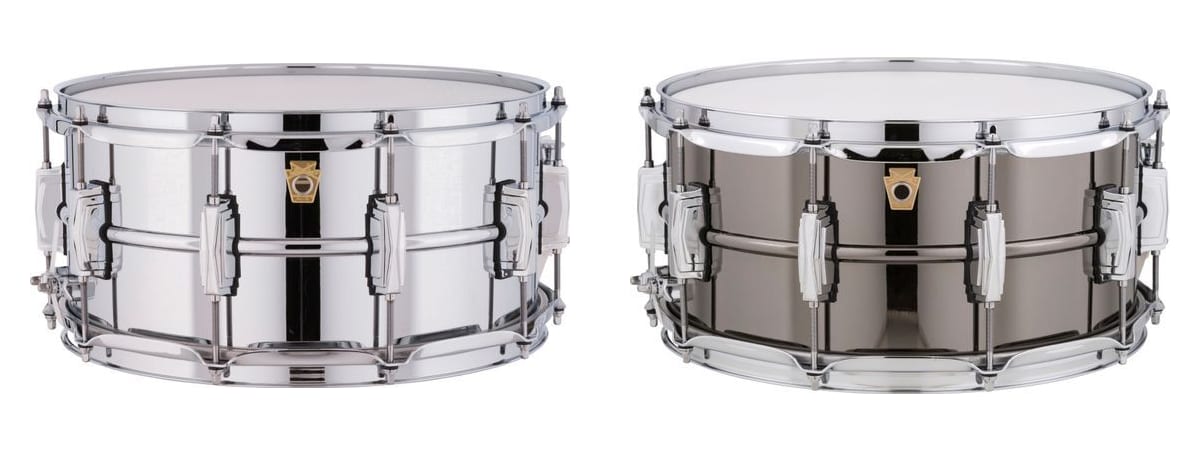
If Ludwig’s kits are the history, its snares are the reason it is still in every studio. The metal snares share one platform, which Ludwig calls the “Phonic” family: a seamless, beaded metal shell, ten lugs, 2.3mm triple-flanged hoops and the P88AC throw-off. Change the metal and you change the drum.
- Supraphonic. Chrome-plated aluminium, in 14”x5” (LM400) and 14”x6.5” (LM402). Bright, dry and crisp, and often called the most recorded snare in history.
- Black Beauty. Black-nickel-plated brass. Warmer, darker and more sensitive, and roughly twice the price. If you are torn between the two, read our Supraphonic vs Black Beauty head-to-head.
- Acrolite and the Acro series. The Acrolite started in 1963 as a student drum with a brushed aluminium shell and became a pro favourite. The Acro series adds copper, brass and bronze versions with ten twin lugs.
- Chrome Over Brass, Raw Brass Phonic, Hammered Brass, Copper Phonic and Bronze Phonic. The other metals. Chrome Over Brass is a reissue of the 1960 Super Ludwig, the Supraphonic’s predecessor.
- Supralite. A 1mm beaded steel shell with tube lugs, made to a much lower price. It is one of the best-value snares going, and it gets a mention in our snare drum buying guide.
- Wood snares. Classic Maple, Legacy, the Jazz Fest and the Universal series cover the wooden side.
- Signature snares. At the time of writing there are signature models for Carl Palmer, Jon Theodore and Nate Smith.
Which Ludwig should you buy?
- Your first kit, on a budget: Accent.
- Your first serious kit: Element Evolution, or a used USA kit if you can find one.
- A small kit for a flat or a coffee-shop gig: Breakbeats.
- Your first American kit: NeuSonic.
- One kit for everything: Classic Maple.
- The vintage sound: Legacy Mahogany or Legacy Maple.
- Something nobody else has: Vistalite.
- One snare for everything: a Supraphonic. It is the safest buy in drumming.
Still not sure? Ask our Gear Guru, and see how Ludwig compares with Pearl, Tama, Yamaha and the rest in our best drum brands guide.
Where can I buy Ludwig drums?
Most big music shops stock the beginner kits and the snares. The USA kits are often made to order, so ask your dealer about lead times before you get your heart set on a finish.
The right shop depends on where you are: Guitar Center in the Americas, Gear4music in the UK, or Thomann for Europe and the rest of the world.
Ludwig has made millions of drums since the 1960s, so the used market is huge. Browse used Ludwig drums on Reverb and check the Reverb price guide, and read our guide to buying used drums online first.
Final thoughts
Ludwig is one of the few drum companies whose history you can still buy new. The Supraphonic on the shelf today is the same idea that has been on records for sixty years, and the Legacy kits put the 1960s shell back in production.
The honest caveat is that the magic is mostly at the top. The Asian-made kits are good, but they are not what made the name. If you can stretch to a USA kit or a Supraphonic, that is where Ludwig is at its best.
Explore our Ludwig hub for every Ludwig item in the Rig Vault, and see the kits on John Bonham’s rig and Ringo Starr’s rig.
Header photo: Ludwig drums at NAMM 2020 by Glenn Francis, CC BY-SA 4.0, via Wikimedia Commons.
Ludwig drums FAQs
- Are Ludwig drums made in the USA?
- The professional ranges are. Classic Maple, Classic Oak, Legacy Maple, Legacy Mahogany, NeuSonic, Vistalite and the metal snares such as the Supraphonic and Black Beauty are built at Ludwig's factory in Monroe, North Carolina. The cheaper kits, such as Accent, Element Evolution, Breakbeats and the Pocket Kit, are made in Asia, like almost every kit at those prices.
- Is Ludwig a good drum brand?
- Yes. Ludwig has been making drums since 1909 and its USA-made kits and snares are among the most respected in the world. The Supraphonic is often called the most recorded snare drum ever made. The budget kits are solid rather than special, so the brand's real strengths are its professional kits and its metal snares.
- What is the best Ludwig drum kit for a beginner?
- The Accent is Ludwig's complete starter kit, with hardware, cymbals and a throne in the box. If you can spend more, the Element Evolution is the intermediate step up with better hardware and Remo heads. See our beginner drum kit buying guide for how they compare with other brands.
- What is the difference between Ludwig Classic Maple and Legacy Maple?
- Classic Maple is a 7-ply, 6mm all-maple shell with 45-degree edges and no reinforcement rings, launched in 1998. Legacy Maple revives Ludwig's 1968 to 1976 recipe: three plies of maple, poplar and maple with solid maple reinforcement rings and a rounded 30-degree edge, for a warmer, more vintage sound. Read our Classic Maple guide for the full picture.
- Who owns Ludwig drums?
- Ludwig is part of Conn-Selmer, the band-instrument business within Steinway Musical Instruments. The Ludwig family sold the company to Selmer in 1981, and production moved from Chicago to Monroe, North Carolina, in 1984.
Keep reading
All Our Buying Guides
Best drum brands (2026) | Every budget ranked
The best drum kit brands in 2026, from Yamaha, Pearl and Tama to Ludwig, DW, Gretsch, Sonor, Mapex and PDP, with the right pick for every budget.
DW Collector's Series
DW Collector's Series | Guide (2026)
DW's Collector's Series explained: the pure woods, SSC shell options, curated Jazz and Santa Monica shells, finishes, prices, and who it is really for.
DW Drums
DW drums | Every series explained (2026)
DW drums explained: Design, Performance, Collector's and DWe kits, the 5000 and 9000 pedals, where they are made, and what Roland owning DW means for you.