Questlove | The Roots' drummer who changed feel
Questlove drums for The Roots, runs the Tonight Show band and won an Oscar. His Dilla-inspired feel, his Ludwig and Zildjian kit, and where to start listening.
Most drummers spend their careers trying to play more accurately. Questlove spent his working out how to play less accurately, on purpose, and in doing so changed how a whole generation of musicians hears time.
He is also a bandleader, a producer, a DJ, an author, a professor and — since 2022 — an Academy Award winner.
Here is how a kid from Philadelphia became one of the most influential drummers of the last thirty years, without ever playing anything you would call a chop.
Who is Questlove?
Ahmir Khalib Thompson was born on 20 January 1971 in Philadelphia.
His father was Lee Andrews, of the doo-wop group Lee Andrews & the Hearts, and Questlove spent his childhood on the road with his parents’ act — playing in the band as a young teenager, which is an education you cannot buy.
At the Philadelphia High School for Creative and Performing Arts he met a rapper called Tariq Trotter — Black Thought. In 1987 they started busking together as the Square Roots.
They became The Roots: a hip-hop group with a live band, at a moment when that idea sounded like a novelty.
The Roots
The catalogue is deep — Do You Want More?!!!??!, Illadelph Halflife, Things Fall Apart (1999), Phrenology, Game Theory, Rising Down, How I Got Over, undun — and Things Fall Apart remains the record most people start with.
Then, in 2009, the band took what looked like a strange gig: house band for Late Night with Jimmy Fallon. When Fallon moved up in 2014, The Roots moved with him to The Tonight Show, where they have been ever since.
It turned out to be the best possible showcase. Five nights a week, a different genre every guest, and one of the tightest bands on television.
The thing he actually changed
In 2000, Questlove played drums on D’Angelo’s Voodoo, and something odd happened to popular music’s sense of time.
Producers had been chasing the feel of J Dilla’s beats — programmed drums that were deliberately not quantised, with the snare landing fractionally late and the hi-hat fractionally early, so the groove seems to stumble and lurch.
Questlove worked out how to play that on a real kit. Not sloppily — deliberately, note by note, holding a wide, uncomfortable gap between the hands and the bass line and never letting it collapse.
That feel is now everywhere: neo-soul, modern R&B, a large slice of contemporary pop and hip-hop, and a whole cottage industry of drum lessons trying to teach it.
It is much harder than it sounds. Playing late is easy; playing consistently late, in a way that grooves rather than drags, is one of the hardest things on the instrument.
What Questlove actually does behind the kit
He plays quietly. The kit is low-tuned, heavily muffled, and struck with far less force than a rock drummer would use. It is designed to sit like a sample.
He does not fill. Whole songs go by with nothing you could call a drum fill. The interest lives in tiny variations in hat placement and ghost notes.
He treats the kit as a loop. Two bars, repeated, with micro-changes — the discipline of a programmer applied to human hands.
His cross-stick is a lead voice. On the quieter Roots material the rim click carries more of the song than the snare does.
He listens like a producer. Which is what he is: Voodoo, Erykah Badu, Common, Al Green, Amy Winehouse and the whole Soulquarians orbit ran partly through him.
Summer of Soul
In 2021 Questlove directed his first film. Summer of Soul (…Or, When the Revolution Could Not Be Televised) was built from footage of the 1969 Harlem Cultural Festival that had sat unseen in a basement for fifty years.
It won the Academy Award for Best Documentary Feature and the Grammy for Best Music Film, and it was the basis of Drumeo’s R&B/Hip-Hop Drummer Of The Year award for 2021. He won the category again in 2023.
Questlove’s drum kit
His setup is famously small, which is the whole point.
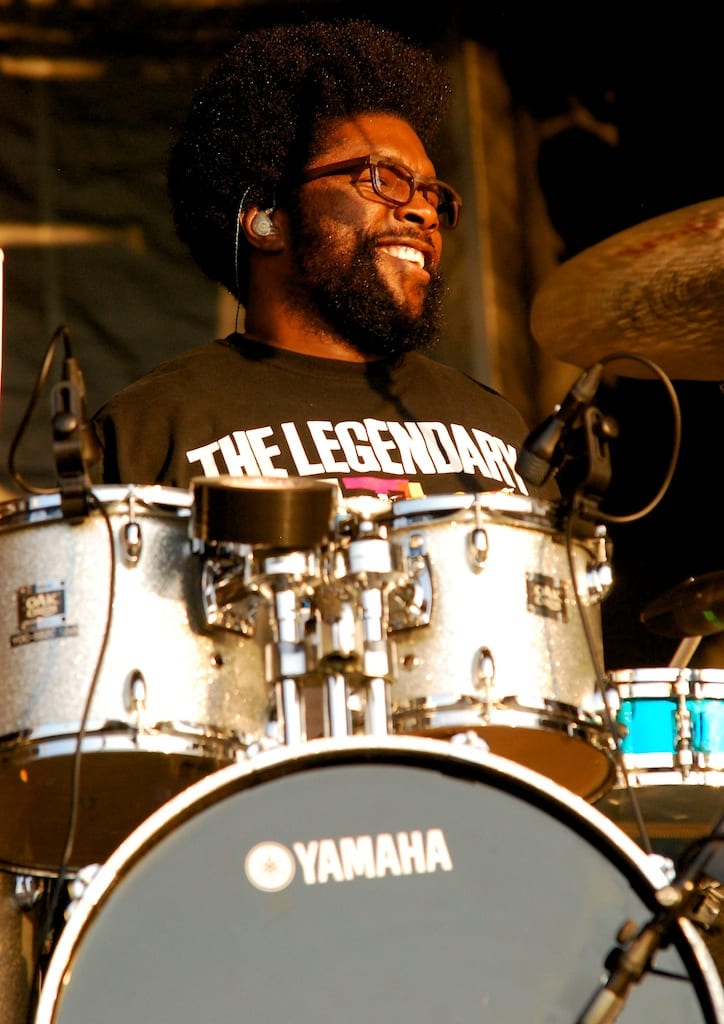
- Drums — Ludwig. He is closely associated with the brand, and has two signature products with them: the Breakbeats by Questlove compact kit — a 16” kick, 10” and 13” toms, small enough for a flat, a cab and a coffee shop — and the Questlove Pocket Kit aimed at young beginners. On television he plays full-size Classic Maple.
- Cymbals — Zildjian. Dark and dry: K Constantinople hi-hats, a K Light Ride, and the enormous 20” Oriental Crash of Doom for the trashy accents.
- Heads and tuning. Low, with plenty of muffling — the drums are meant to thud, not ring.
Every era, with buy links, is on Questlove’s Rig Vault page.
Want the sound without the rig?
This is one of the cheapest sounds in drumming to get close to, and one of the hardest to actually play.
Buy a small kit — an 18” or 16” kick makes the feel happen almost by itself. Tune everything low, put a folded tea towel on the snare and a pillow in the kick. Then get a dark, washy ride and stop hitting the crash. Our cymbal buying guide explains what “dark” actually means when you are buying one.
The last 90% is time spent with a metronome deliberately playing behind it. The Gear Guru will handle the shopping list; the feel is on you.
Where to start listening
- D’Angelo — “The Root” / Voodoo (2000). The record that reset the clock.
- The Roots — “You Got Me” (1999). The drum-and-bass outro, played by hand.
- The Roots — “The Seed (2.0)” (2002). Him playing rock, sort of.
- Erykah Badu — “Didn’t Cha Know” (2000). Space, and almost nothing else.
- Any Tonight Show sit-in. Genre-hopping on no rehearsal is its own discipline.
Final thoughts
Questlove is the strongest argument going against the idea that drumming is a sport. There is nothing on his records you could not physically play within a month of starting lessons — and almost nobody can make it feel like he does.
He is also proof that a drummer can be the most musically literate person in the building. The band, the shows, the records he produced, the film: all of it is one long argument that rhythm is a way of thinking, not a set of limbs.
See Questlove’s full rig in the Rig Vault, or read about Steve Jordan — another drummer whose entire value is feel.