Vic Firth drumsticks | Every range explained
Vic Firth drumsticks explained: American Classic, Extreme, American Custom, Heritage, the jazz lines and signature sticks, and what 7A, 5A, 5B and 2B mean.
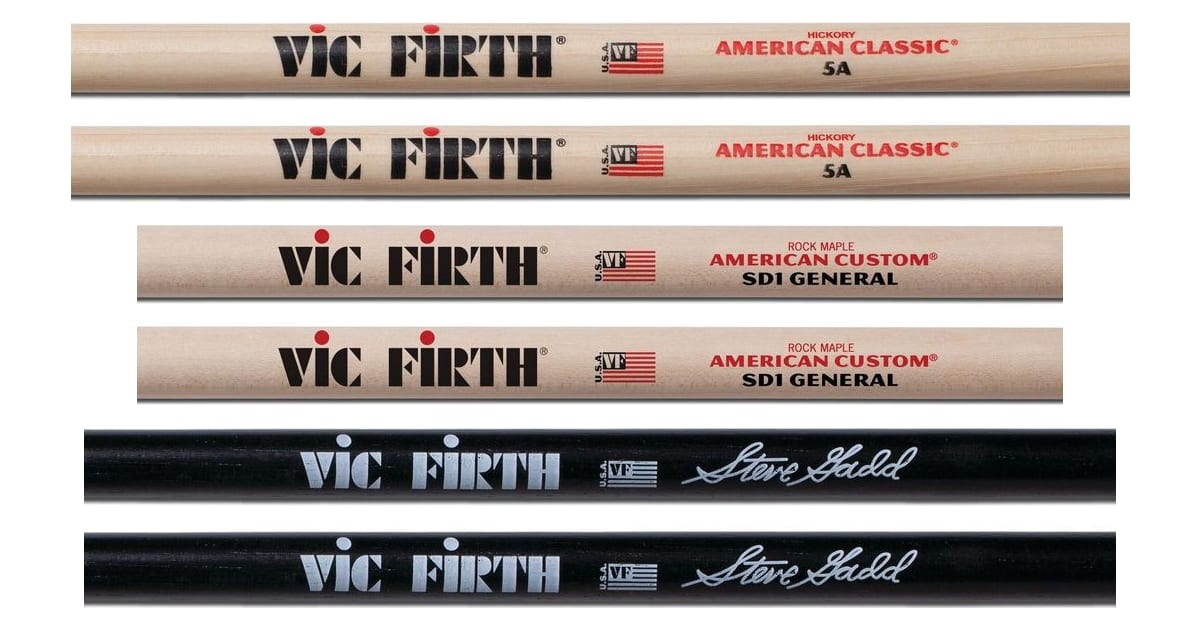
There is a good chance the first pair of drumsticks you ever held said Vic Firth on the side. For a lot of us, those black letters on pale hickory simply are what drumsticks look like.
But Vic Firth makes far more than one stick. There are hickory ranges, maple ranges, extra-long sticks, jazz sticks, dozens of signature models and a catalogue of mallets that most drum kit players never see.
So what is in each range, what do the numbers mean, and which pair should you buy? Let’s find out.
Who was Vic Firth?
Vic Firth was a working musician first. As Principal Timpanist with the Boston Symphony Orchestra, he was not happy with the sticks and mallets he could buy, so he started making his own in his garage in the late 1950s and early 1960s. Sometimes, the company says, he whittled them by hand.
Other players wanted them, and the company grew from there. Today it makes sticks for drum kit, marching and orchestral players, plus mallets, brushes, practice pads and headphones.
In 2010 Vic Firth merged with Zildjian, the cymbal maker, and it is now part of the Avedis Zildjian Company’s family of brands. The company says the move was part of Vic’s vision for the business beyond his lifetime.
Where are Vic Firth sticks made?
In Maine. Vic Firth says its sticks and mallets are made at its factory in Newport, Maine, alongside Zildjian’s cymbal factory in Norwell, Massachusetts.
Hickory makes up about 90 per cent of its sticks, and Vic Firth says the wood comes from the Tennessee valley. It is dried for straightness, turned using centreless grinding, and every pair is weight-matched and pitch-paired. That last bit is the promise in Vic Firth’s “the perfect pair” slogan: two sticks that weigh the same and sound the same when you tap them together.
The company also says it reclaims 90 per cent of the water used in grinding and reuses its sawdust and waste wood. A nice detail.
What do 7A, 5A, 5B and 2B mean?
These are the sizes, and they are the first thing to understand before you buy any sticks.
The rule of thumb is that the higher the number, the thinner and lighter the stick. Historically the letter told you the job: A for orchestra, B for band. That stopped meaning much a long time ago.
Here are the four you will see most, with the typical diameters and lengths:
| Size | Diameter | Length | Feels like |
|---|---|---|---|
| 7A | 0.540” | 15.5” | Light, quick, quiet. Jazz and low volume |
| 5A | 0.565” | 16” | The all-rounder. Start here |
| 5B | 0.595” | 16” | A bit more weight for louder music |
| 2B | 0.630” | 16.25” | Heavy. Rock, metal and practice for strength |
Vic Firth also makes in-between sizes such as the 55A and 85A, and 8D and 3A models. Every maker’s 5A is slightly different, too. Our drumstick size guide goes into the details, and the best 5A drumsticks comparison shows how much three brands’ 5As differ.
American Classic: the one everyone knows
American Classic is Vic Firth’s core range, and the one that hangs on the wall of every drum shop. The sticks are turned from select hickory, which Vic Firth describes as dense, with little flex and a pronounced sound. The tips are deeply back-cut for a stronger cymbal sound.
The American Classic 5A is the headline model, and Vic Firth calls it the world’s most played drumstick. It is 0.565 inches across and 16 inches long with a tear drop tip. At the time of writing it is $14.99 a pair on Vic Firth’s US shop, and usually around £11 to £14 in the UK.
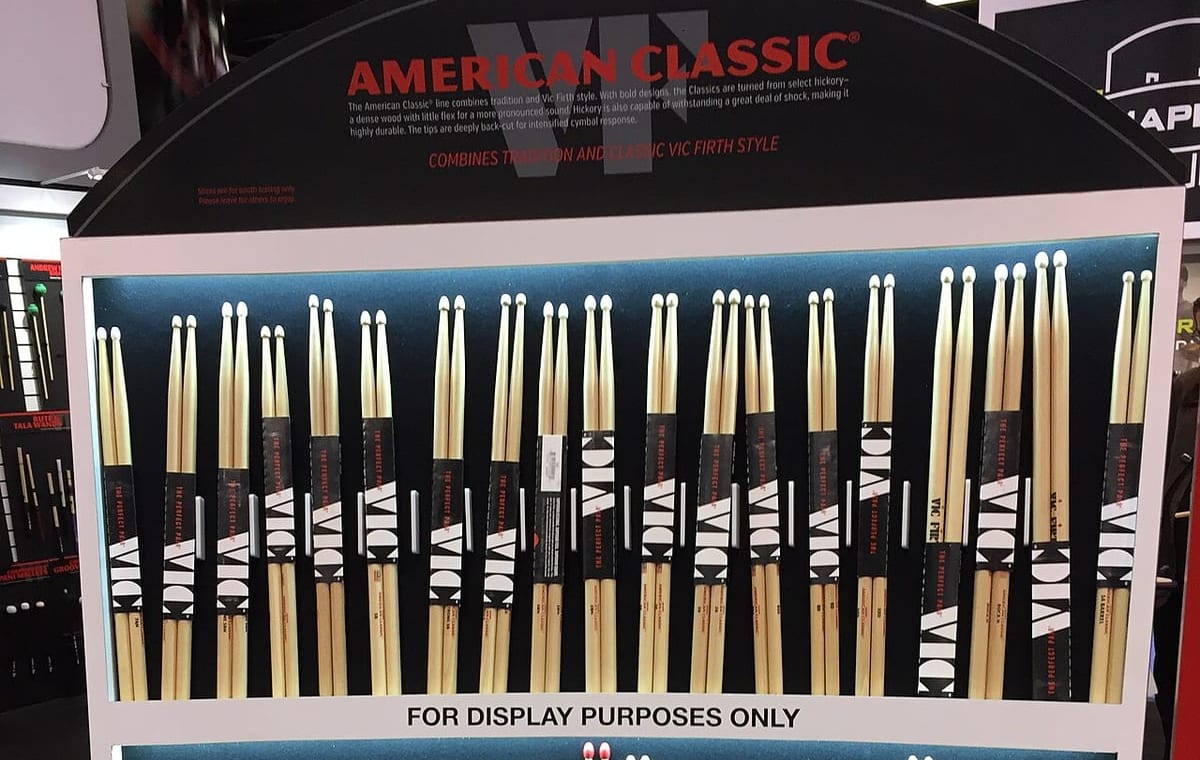
The range is huge. Beyond the standard 7A, 5A, 5B and 2B, it includes:
- Rock, which Vic Firth describes as a 2B with a little more reach and leverage, with an oval tip.
- Nylon tip versions of most sizes, for a brighter cymbal sound and a tip that does not chip.
- Extreme models (see below).
- Terra Series versions in wood and nylon tip, plus black, white and pink sticks.
- Kidsticks, made for young drummers.
- A Metal model, in wood and nylon tip.
- Grip options, including DoubleGlaze, which adds an extra coat of lacquer, and Vic Grip, with a grip coating.
What are Vic Firth Extreme sticks?
Extreme sticks are American Classics with an extra half an inch of length. Vic Firth says players kept asking for longer versions of popular models, and Extreme was the answer.
The extra length puts a little more stick out in front of your hand, so you get more reach around the kit and more power from the same stroke. If you love the feel of a 5A but find yourself reaching for the ride, an Extreme 5A (X5A) is worth a try. There are Extreme 5A, 5B, 55A, 55B and 8D models, among others.
American Concept Freestyle: even longer
Freestyle sticks go further. They are 17 inches long with an extra-long taper, which Vic Firth says more than doubles the area where you can place your fulcrum. Move your grip and the same stick feels heavier or lighter.
There are Freestyle 7A, 5A, 5B, 55A and 85A models. We have a full guide to the American Concept Freestyle drumsticks.
American Custom and American Heritage: the maple ranges
Not everyone wants hickory. Maple is lighter and a little more flexible, and it gives a softer, warmer sound on cymbals.
American Custom is Vic Firth’s rock maple range, with the SD models. The SD1 General is described as a round-tip stick for orchestral work, rock and band, and “a legendary practice stick”. Others include the SD2 Bolero, SD4 Combo, SD5 Echo, SD9 Driver, SD10 Swinger and SD11 Slammer, plus Swizzle versions with a mallet on the other end.
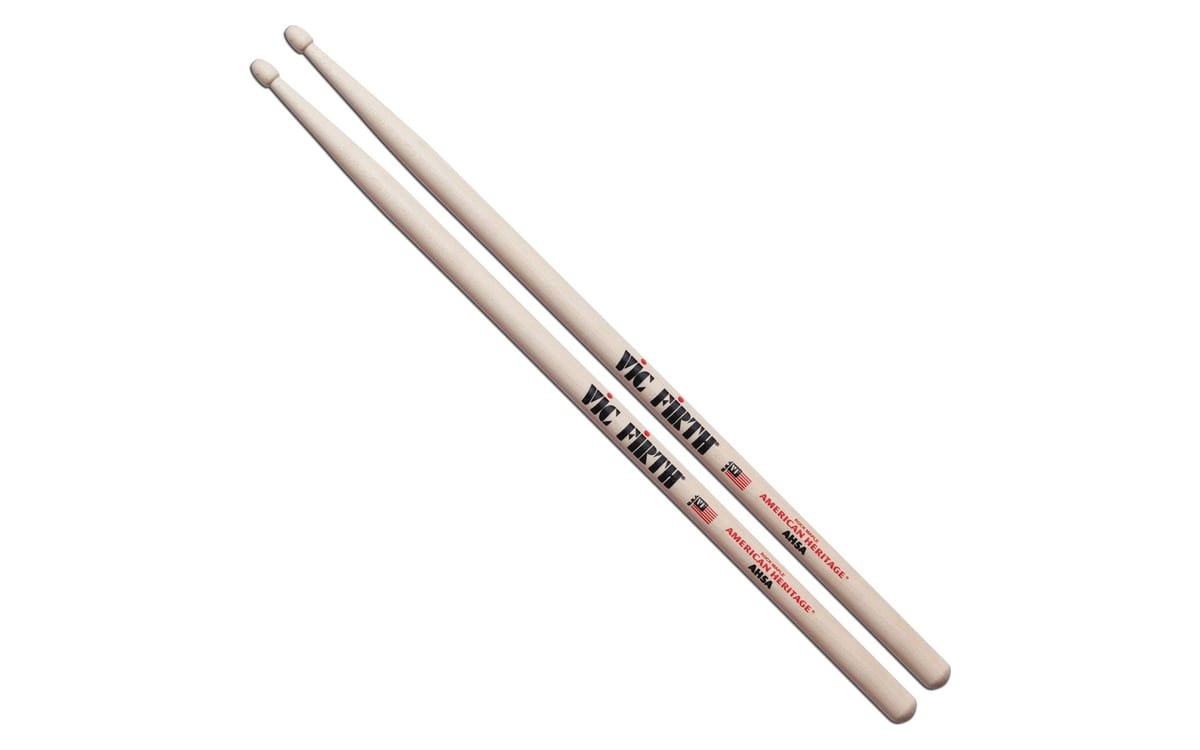
American Heritage takes the familiar sizes and makes them in maple. There is a 5A, 7A and 5B. Vic Firth describes the 5A as for “the 5A player looking for the weight and distinctive sound of a maple stick”.
If you are not sure whether maple is for you, our drumstick wood guide explains how hickory, maple and oak change the weight, durability and sound.
The jazz ranges: American Jazz and Modern Jazz Collection
Vic Firth has two ranges built for touch.
American Jazz has six numbered models. Vic Firth says they are designed for “ultimate rebound”, with a long taper, a neck thick enough for dark cymbal sounds and a small tear drop tip.
The Modern Jazz Collection has five models, which started life as prototypes in Vic Firth’s back room. The MJC4, for example, is maple with a 5B diameter, a long taper and a small barrel tip. Despite the name, Vic Firth says they work in almost any style.
There is also American Sound, a smaller range of 5A, 7A and 5B sticks with round tips for bright, articulate cymbals.
Signature Series: sticks designed with the drummers
Vic Firth’s artist list is one of the deepest in drumming, and the Signature Series has dozens of models. At the time of writing they include sticks for:
- Steve Gadd, in natural, black and nylon versions.
- Benny Greb, Nate Smith and Matt Garstka.
- Danny Carey, Steve Jordan and Tony Royster Jr.
- Legends such as Buddy Rich, Charlie Watts and Keith Moon.
- Peter Erskine, Dave Weckl, Questlove, Jojo Mayer and many more.
A signature stick is just a stick designed with one player. If you like how your favourite drummer plays, it costs a pair to find out whether their stick suits you. You can see who carries which sticks in the Rig Vault: Steve Gadd’s rig, Danny Carey’s rig and Tomas Haake’s rig all list Vic Firth signature sticks.
In fact Vic Firth is the stick brand that turns up most often across our Rig Vault.
What else does Vic Firth make?
Plenty that most drum kit players never notice:
- Marching sticks in the Corpsmaster range.
- Concert sticks and mallets, including the Symphonic Collection and timpani mallets. That is where the company started.
- Keyboard mallets, including the Balter range.
- Timbale sticks in the World Classic range.
- Brushes, rods and kick beaters.
- Practice pads, stick bags and isolation headphones. Our practice pads guide covers the best pads.
Is Vic Firth better than Promark or Vater?
Not better. Different, and mostly in shape. All three use American hickory, all three make their sticks in the USA, and a standard pair costs about the same.
What Vic Firth has is ubiquity. You can find a pair of American Classic 5As in almost any shop in the world, which matters when you snap your last stick before a gig.
Our Vic Firth vs Promark vs Vater head-to-head goes through the differences, and our best drumstick brands guide ranks the wider field. For the other big name, read our Promark drumsticks guide.
Which Vic Firth sticks should you buy?
- Not sure? American Classic 5A.
- Lighter, quieter music: American Classic 7A, or American Heritage 7A in maple.
- Loud bands: American Classic 5B, or 2B if you hit hard.
- More reach: Extreme 5A, or Freestyle if you want to experiment with your fulcrum.
- Jazz: American Jazz or the Modern Jazz Collection.
- Sweaty hands: DoubleGlaze or Vic Grip.
Then buy a second pair of something different. Sticks are the cheapest experiment in drumming. Give each pair a week on a pad with our rudiment trainer, and your hands will tell you which is right.
Where can I buy Vic Firth sticks?
Absolutely everywhere, which is part of the appeal. Buying a “brick” of several pairs usually works out cheaper per pair if you have found your size.
The right shop depends on where you are: Guitar Center in the Americas, Gear4music in the UK, or Thomann for Europe and the rest of the world.
Final thoughts
Vic Firth earned its place on every drum shop wall. The sticks are consistent, the range covers every style and size, and the American Classic 5A is still the sensible first pair for almost anyone.
Our honest caveat is that the range is so big it can be bewildering. Ignore most of it to start with. Buy a 5A, then let your hands tell you whether to go lighter, heavier, longer or maple.
Everything else we have on Vic Firth lives on the Vic Firth hub, and the rest of our stick coverage is in the drumsticks section.
Vic Firth drumsticks FAQs
- What is the most popular Vic Firth drumstick?
- The American Classic 5A, which Vic Firth itself calls the world's most played drumstick. It is hickory, 16 inches long and 0.565 inches across, with a tear drop tip. If you do not know where to start, start there. Our best 5A drumsticks comparison puts it against Promark and Vater.
- What do 7A, 5A, 5B and 2B mean on drumsticks?
- They are sizes. The number roughly tracks thickness, and a higher number means a thinner, lighter stick: a 7A is around 0.540 inches across, a 5A 0.565, a 5B 0.595 and a 2B 0.630. Historically the letter described the use, with A for orchestra and B for band, but today it is just part of the size name. Our drumstick size guide explains more.
- What is the difference between Vic Firth American Classic and Extreme?
- Length. Extreme models are part of the American Classic range, and each one is half an inch longer than the standard model, for more reach and power. So an Extreme 5A has the feel of a 5A with extra length out in front of your hand.
- Who owns Vic Firth?
- The Avedis Zildjian Company. Vic Firth merged with Zildjian in 2010, a decision the company says was part of Vic's plan for the business beyond his lifetime. The sticks are still made at the Vic Firth factory in Maine.
- Are Vic Firth sticks made in the USA?
- Yes. Vic Firth says its sticks and mallets are made in its factory in Newport, Maine, with Zildjian's cymbals made in Norwell, Massachusetts. Hickory makes up about 90 per cent of its sticks.
- Are Vic Firth maple sticks lighter than hickory?
- Yes. Maple is lighter and has a little more flex, so it suits lighter playing and faster hands. Vic Firth's maple ranges include American Custom, American Heritage and the Modern Jazz Collection. Our drumstick wood guide compares the woods properly.
Keep reading
All Our Buying Guides
Best drumstick brands (2026) | Nine compared
The best drumstick brands in 2026: Vic Firth, Promark and Vater, plus Zildjian, Meinl, Ahead, Los Cabos, Wincent and Innovative Percussion.
Promark Drumsticks
Promark drumsticks | Every range explained
Promark drumsticks explained: Classic Forward and Attack, Rebound, FireGrain, ActiveGrip, Shira Kashi oak and the 747, plus who owns Promark today.

Promark Drumsticks
Promark FireGrain | Heat-tempered sticks
Promark FireGrain drumsticks are heat-tempered hickory built to last longer. How it works, which models exist, what they cost and who should buy them.