Promark drumsticks | Every range explained
Promark drumsticks explained: Classic Forward and Attack, Rebound, FireGrain, ActiveGrip, Shira Kashi oak and the 747, plus who owns Promark today.
Promark is the other name on the stick wall. If Vic Firth is the default, Promark is the brand drummers move to when they start caring about how a stick is balanced, what it is made of, or how long it lasts.
It has a good story too. A Houston drum teacher, a box of Japanese oak sticks from a travelling salesman, and a company that grew into one of the biggest stick makers in the world.
So what is in each Promark range, and which one suits you? Let’s find out.
Who makes Promark drumsticks?
Promark was founded in 1957 by Herb Brochstein, a drummer and drum shop owner in Houston, Texas. According to Modern Drummer, it started when he bought a few pairs of oak sticks from a travelling salesman and sold them to his students and visiting drummers. He went looking for the Japanese maker, and the company grew from there.
That is why oak is part of Promark’s DNA. It is credited as the first American drumstick company to bring Japanese Shira Kashi white oak to the market, and it still makes oak sticks today alongside hickory and maple.
In 2011 D’Addario bought Promark from Herb’s son, Maury Brochstein. D’Addario also owns Evans drumheads, which is why you see the two brands together so often. Herb Brochstein died in January 2013, aged 85.
Promark says its sticks are made at its Texas production facility.
How is the Promark range laid out?
Promark has reorganised its range a few times over the years, so you will see older names on used sticks and in some shops. At the time of writing, the main drum set families are:
| Range | Wood | Balance | What it is for |
|---|---|---|---|
| Classic Forward | Hickory | Front-weighted, short taper | Power, the default Promark |
| Classic Attack | Shira Kashi oak | Front-weighted, short taper | Power and durability |
| Rebound | Hickory | Rear-weighted, long taper | Speed, finesse, bounce |
| FireGrain | Heat-tempered hickory | Forward or Rebound | Durability |
| ActiveGrip | Hickory | Various | Grip that gets tackier as you warm up |
| Raw | Unlacquered hickory | Various | A natural, dry feel |
On top of that come signature sticks, maple models, rods and brushes, and marching and concert sticks.
Forward or Rebound: what is the difference?
This is the most useful idea in the whole Promark range, so it is worth getting straight.
Every stick tapers from the shoulder down to the tip. A short taper leaves more wood towards the tip, so the stick feels front-heavy. It drives into the drum with less effort. Promark calls that Forward.
A long taper takes wood away from the front, so the balance moves back towards your hand. The stick feels lighter and bounces off the head more readily. Promark calls that Rebound.
Promark’s older catalogue gave the numbers: a 2 1/4-inch taper for Forward, “to optimise power and speed”, and a 3-inch taper for Rebound, “to optimise finesse and agility”. A German review by Bonedo summed it up well: Forward gives more pressure and a more focused attack, Rebound a lighter feel with more bounce.
The clever bit is that Promark makes the popular sizes in both. So you can choose your size first, say a 5A, and then choose where the weight sits. Most stick brands make you change model to change balance.
Classic Forward: the default Promark
Classic Forward is hickory with the short, front-weighted taper. It is the stick most people mean when they say “a pair of Promarks”.
The Classic Forward 5A is 0.551 inches across and 16 inches long, with an oval wood tip. That makes it slimmer than Vic Firth’s 5A, which is worth knowing if you have small hands or like a lighter grip.
The 747 is the famous one. D’Addario lists the Classic Forward 747 at the same 0.551 inches, but 16 1/4 inches long, so it is in effect a 5A with a quarter of an inch more reach. It became famous in Neil Peart’s hands, and his signature 747 is made in Shira Kashi oak. You can see it in Neil Peart’s rig in the Rig Vault.
At the time of writing, US retailers list a Classic Forward 5A at around $17 a pair, and UK prices are usually in the £11 to £14 range.
Classic Attack: Shira Kashi oak
Classic Attack is the oak half of the Classic range. Same front-weighted, short taper as Forward, but in Japanese Shira Kashi white oak.
The Classic Attack 5A shares the Forward 5A’s dimensions, 0.551 inches across and 16 inches long, and comes with an oval wood tip (PW5AW) or a nylon tip (PW5AN). D’Addario describes the Classic line as the home of its “front-weighted, power-focused Forward and Attack lines”.
Why oak? It is denser and heavier than hickory, so a stick of the same size feels more solid and tends to last longer. The trade-off is weight and a harder feel in the hand. Our drumstick wood guide explains how hickory, maple and oak differ.
Rebound: for finesse
Rebound sticks are hickory with the long, rear-weighted taper. If you play a lot of quiet, detailed music, or you just like a stick that feels like it is doing half the work, try a Rebound 5A or 7A next to the Forward version of the same size. The difference is obvious in a few strokes.
FireGrain: heat-tempered hickory
FireGrain is Promark’s answer to the drummer who breaks sticks. Launched in 2017, it is hickory that has been heat-tempered. Promark says briefly exposing the wood to intense heat strengthens it, without changing the weight, balance or feel of the stick.
FireGrain comes in both Classic Forward and Rebound versions of the common sizes. We have a full Promark FireGrain guide that goes into what the claims mean and who should pay the extra.
ActiveGrip and Raw: two kinds of grip
Promark offers two very different answers to sweaty hands.
ActiveGrip is a heat-activated coating. The idea is that it gets tackier as your hands warm up, so the stick grips harder the longer you play. If sticks slide out of your hands halfway through a set, this is the one to try.
Raw goes the other way, with no lacquer at all. Bare hickory feels drier and less slippery than lacquer for a lot of players, and some just like the feel of the wood.
Vic Firth has its own versions of both ideas. Our Vic Firth vs Promark vs Vater head-to-head compares the finishes across the three big brands.
Signature sticks
Promark has one of the deepest artist rosters in drumming. In our Rig Vault, the Promark sticks that turn up include:
- Neil Peart’s 747, in Shira Kashi oak. See Neil Peart’s rig.
- Mike Portnoy’s 420. See Mike Portnoy’s rig and our Mike Portnoy feature.
- Matt Halpern’s signature stick.
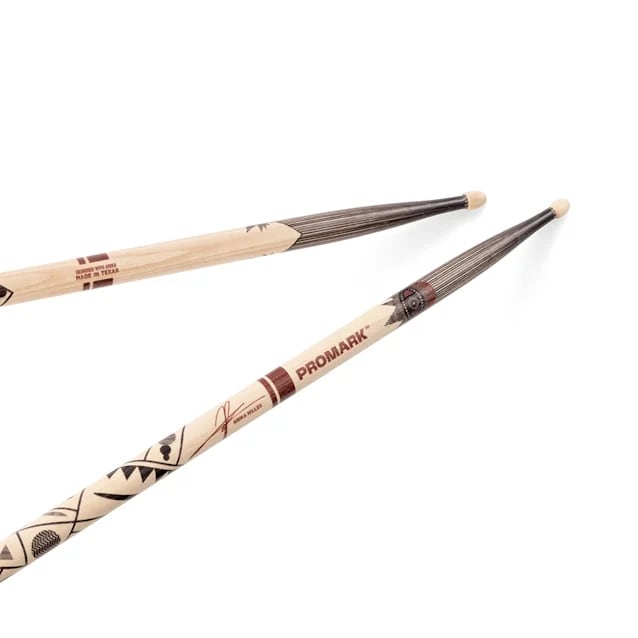
There are also limited runs. Our news story on the Anika Nilles Evans x ProMark collection covers a thicker version of her signature stick with her own artwork on it.
What else does Promark make?
Promark covers more than drum set sticks:
- Rods, including Hot Rods, which bundle thin birch dowels into a stick for quiet gigs, and the heavier Thunder Rods.
- Maple sticks, for a lighter feel.
- Marching and concert sticks and mallets.
Is Promark better than Vic Firth?
Neither is better. They are built to different shapes, and that is the point.
Promark is the brand for drummers who want choice in how a stick is weighted and finished. Forward or Rebound in the same size, hickory or oak, FireGrain for durability, ActiveGrip or Raw for grip. Vic Firth is the brand for drummers who want the default, available in every shop.
Our best 5A drumsticks comparison puts the two 5As side by side with Vater’s, our Vic Firth drumsticks guide covers the other big name, and our best drumstick brands guide ranks the whole field.
Are Promark sticks good for beginners?
Yes. A Classic Forward 5A is as sensible a first pair as any stick on the wall. It is a standard size, a standard wood and a standard finish, and you can buy the same pair again almost anywhere.
The one thing to be aware of is that Promark’s 5A is a touch slimmer than some rivals. Most beginners will never notice. If you have big hands, or a teacher who has asked you to bring a particular brand, try a 5B or the teacher’s choice instead.
Where Promark really helps a newer player is the Forward and Rebound choice. Once you have played for a few months, buying a Rebound pair in the same size is a cheap way to learn what balance does to your playing, without changing anything else.
How long do Promark sticks last?
That depends far more on you than on the stick. Hitting rimshots on every backbeat, playing into the edges of crash cymbals and using heavy hands will chew through any hickory stick.
If you are getting through a pair a week, there are two Promark answers. Classic Attack sticks are Shira Kashi oak, which is denser than hickory. FireGrain sticks are hickory that Promark says has been strengthened by heat. Both cost a little more per pair, and both are worth a try before you blame your technique.
Before you do either, though, check the angle you hit cymbals at. A stick that meets a crash edge-on breaks far sooner than one that glances across the bow.
Which Promark sticks should you buy?
- Not sure? Classic Forward 5A.
- Small hands or a light touch: Rebound 5A or 7A.
- You break sticks: FireGrain, or Classic Attack in oak.
- Sweaty hands: ActiveGrip.
- You want more reach: the 747.
- Quiet gigs: Hot Rods.
Then buy a pair of the opposite balance in the same size. It is the cheapest way to learn what you actually like, and our drumstick size guide will help you read the labels.
Where can I buy Promark sticks?
Almost everywhere sells Promark. Multi-pair packs usually work out cheaper per pair once you have found your model.
The right shop depends on where you are: Guitar Center in the Americas, Gear4music in the UK, or Thomann for Europe and the rest of the world.
Final thoughts
Promark is the stick brand for drummers who like to tinker. The Forward and Rebound split is genuinely useful, the oak sticks are a link back to where the company started, and FireGrain and ActiveGrip give you options few rivals match.
Our honest caveat is that the names have changed a few times, so older advice and used sticks can be confusing. Ignore the labels and go by size, wood and balance.
Find all our Promark coverage on the Promark drumsticks hub, and if you are stuck between two pairs, ask our Gear Guru.
Promark drumsticks FAQs
- What is the difference between Promark Forward and Rebound?
- Where the weight sits. Forward sticks have a short taper, so more wood sits towards the tip and the stick feels front-heavy and powerful. Rebound sticks have a longer taper, so the balance moves back towards your hand and the stick feels lighter and bouncier. Promark sells the popular sizes in both, so you can choose the size first and then the balance.
- What is Promark Classic Attack?
- The oak half of Promark's Classic range. Classic Forward sticks are hickory; Classic Attack sticks are Japanese Shira Kashi oak with the same front-weighted, short-taper design. The Classic Attack 5A, for example, is 0.551 inches across and 16 inches long. Oak is denser and heavier than hickory, so Attack sticks feel more solid.
- Who owns Promark?
- D'Addario, the American music accessories company that also owns Evans drumheads. D'Addario bought Promark in 2011 from the founder's son, Maury Brochstein. Promark was founded by Herb Brochstein in Houston, Texas, in 1957.
- Where are Promark drumsticks made?
- In Texas. Promark says its sticks are made at its Texas production facility, and the company has been based in Houston since it was founded. Some sticks, such as the Anika Nilles limited set, are printed with 'Made in Texas'.
- Are Promark sticks thinner than Vic Firth?
- In the 5A, yes, slightly. D'Addario lists the Promark Classic Forward 5A at 0.551 inches across, and Vic Firth lists its American Classic 5A at 0.565 inches. Our Vic Firth vs Promark vs Vater head-to-head compares the brands in detail.
Keep reading
All Our Buying Guides
Best drumstick brands (2026) | Nine compared
The best drumstick brands in 2026: Vic Firth, Promark and Vater, plus Zildjian, Meinl, Ahead, Los Cabos, Wincent and Innovative Percussion.

Promark Drumsticks
Promark FireGrain | Heat-tempered sticks
Promark FireGrain drumsticks are heat-tempered hickory built to last longer. How it works, which models exist, what they cost and who should buy them.
Vic Firth
Vic Firth drumsticks | Every range explained
Vic Firth drumsticks explained: American Classic, Extreme, American Custom, Heritage, the jazz lines and signature sticks, and what 7A, 5A, 5B and 2B mean.