Mike Portnoy | Dream Theater's returning monster
Mike Portnoy co-founded Dream Theater, left in 2010 and came back in 2023. His bands, his playing, the Monster kits, and his Tama and Sabian rig explained.
In September 2010, the drummer who had co-founded Dream Theater, produced most of their records and named most of their songs walked away from the band.
Thirteen years later, in October 2023, he walked back in.
Very few reunions in music are as satisfying as that one — and almost none of them involve a drummer whose absence was audible from the first bar. Here is who Mike Portnoy is, what he actually plays, and why the kit is the size of a small car.
Who is Mike Portnoy?
Mike Portnoy was born on 20 April 1967 in Long Beach, New York, the son of a rock radio DJ — which explains a record collection most drummers would take a decade to assemble.
He was largely self-taught, and good enough by the mid-eighties to win a scholarship to the Berklee College of Music in Boston.
That is where the story really starts. At Berklee he met bassist John Myung and guitarist John Petrucci, and in 1985 the three of them formed a band called Majesty. Within a couple of years it had a new name: Dream Theater.
The first run: 1985–2010
Portnoy was in the band for twenty-five years and nine studio albums, including the ones everybody cites — Images and Words (1992), Awake (1994), Metropolis Pt. 2: Scenes from a Memory (1999) and Six Degrees of Inner Turbulence (2002).
He was also, unusually, the band’s co-producer, de facto manager and archivist — the one running the fan club, curating the live releases and driving the concept records.
That workload is part of why he left in 2010. He asked for a hiatus, the band said no, and he went.
The years away
He did not sit still. Avenged Sevenfold (touring after the death of The Rev), Adrenaline Mob, The Winery Dogs, Flying Colors, Metal Allegiance, Sons of Apollo, the Neal Morse Band, and the long-running progressive supergroups Transatlantic and Liquid Tension Experiment.
Anyone else’s discography; his side hustle.
The return
In October 2023 Dream Theater announced he was back. Parasomnia, his first album with them in eighteen years, arrived in February 2025, and the 40th Anniversary tour has been running ever since.
What Mike Portnoy actually does
He is a song drummer disguised as a technical one. The kit is enormous and the chops are real, but listen to how he plays behind a Petrucci solo and it is all dynamics and section-marking. He tells you where you are in an eighteen-minute song.
He plays the odd time signatures as riffs. Portnoy’s approach to 7/8 or 13/8 is to lock the kick pattern to the guitar line rather than float above it. It is why Dream Theater’s most complex sections still headbang.
The double bass is fast but sparing. He is perfectly capable of a sustained gallop, and mostly chooses not to. Compare him with a modern extreme-metal player and he uses maybe a fifth as many kick notes for the same weight.
He is a stylistic chameleon. The Winery Dogs is bar-band hard rock. Transatlantic is 1970s prog. Neal Morse is gospel-inflected. Adrenaline Mob was straight groove metal. He sounds like the right drummer on all of them.
He sings while playing. Backing vocals through some genuinely inhospitable drum parts — a party trick that turns out to be a real skill.
The awards
He has more than thirty Modern Drummer readers’ poll wins, and in 2004, at 37, he became the youngest inductee into the magazine’s Hall of Fame. Drumeo’s voters gave him Progressive Drummer Of The Year in 2024 and again in 2025, for the return, the record and the tour.
The Monster kits
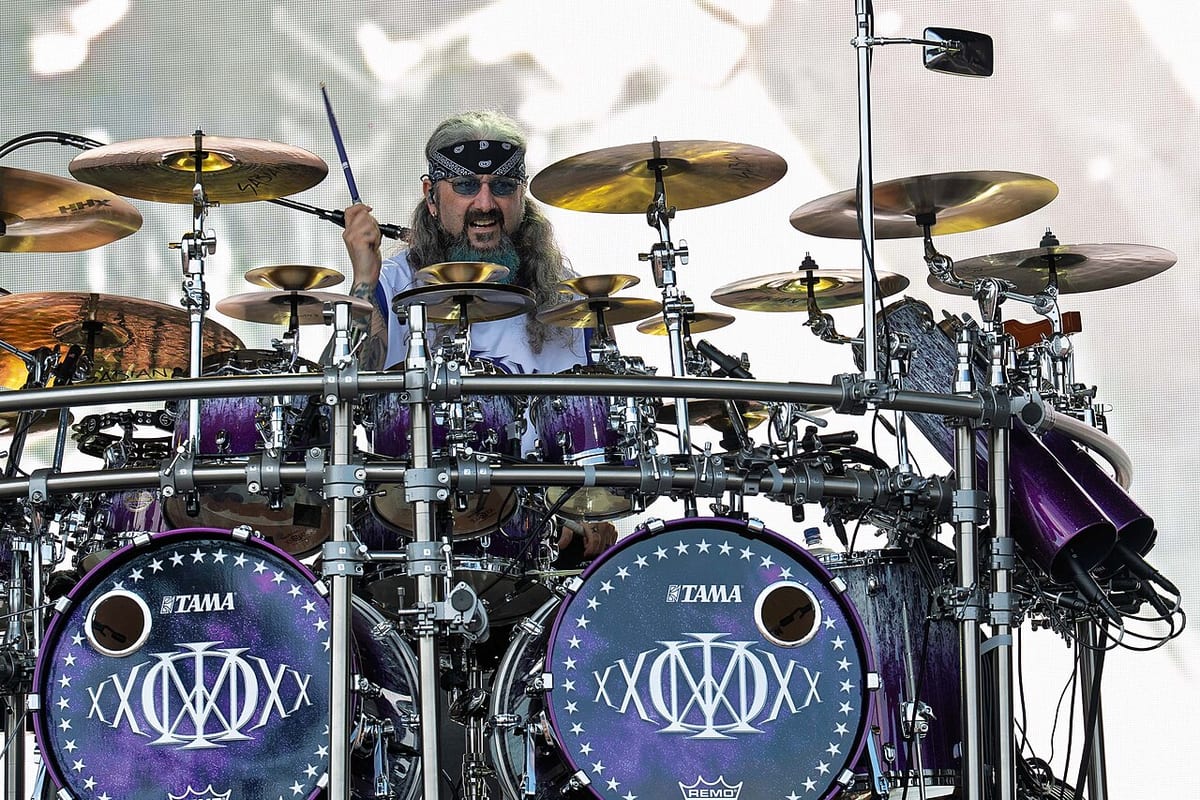
Portnoy’s setups have their own names and their own fan following. The lineage runs through the Siamese Monster, the Albino Monster, the Mirage Monster and the Purple Monster — and, since the reunion, the Dream Monster.
The Dream Monster is the most Portnoy object imaginable: two complete kits joined into one, in a purple-to-white fade. The left-hand side is a Tama Starclassic Maple double-bass setup much like his classic Dream Theater rig; the right-hand side is a Starclassic Bubinga kit with single-headed concert toms.
He does not sit in the middle for effect. Both halves get used, and the tonal difference between the maple and bubinga sides is the point.
Mike Portnoy’s drum kit
The endorsements have been remarkably stable for a man who changes bands so often.
- Drums — Tama. Starclassic Maple and Bubinga shells, in configurations that would embarrass a percussion department. Multiple signature snares too, including the MP125ST.
- Cymbals — Sabian. A vast setup: AAX hats and crashes, HHX Studio crashes, Max Splashes and his own Max Stax stacks, which are now a fixture on other people’s kits too.
- Pedals and hardware — Tama Iron Cobra.
- Sticks — ProMark. He has been a ProMark artist since the late nineties; the current model is the 420X ActiveGrip, which gets tackier as your hands sweat.
- Heads — Remo. Controlled Sound and Ambassador models.
Every era, with buy links, is on Mike Portnoy’s Rig Vault page.
Want the sound without the rig?
Nobody needs two kits. What is worth stealing is smaller.
Stacks. A cheap crash on top of a china is the single fastest way to add a Portnoy-shaped sound to a kit, and the Max Stax idea has trickled all the way down to budget cymbal packs. Our cymbal buying guide covers where stacks fit.
Marking sections. Learn to play a china on the downbeat of a new section instead of a crash. It is not a technique, it is a decision, and it is most of what makes long songs navigable.
The Gear Guru will spec you a prog-capable kit to a budget if you would rather not guess at the rest.
Where to start listening
- Dream Theater — “Pull Me Under” (1992). The one that got a prog band on MTV.
- Dream Theater — Scenes from a Memory (1999). His best whole-album performance, and the drums carry the narrative.
- Liquid Tension Experiment — “Paradigm Shift” (1998). Fusion Portnoy, entirely off the leash.
- The Winery Dogs — “Elevate” (2013). Proof he can just play rock drums.
- Dream Theater — Parasomnia (2025). The comeback, and he sounds like he never left.
Final thoughts
Portnoy’s reputation is for excess — the kit, the discography, the sheer number of bands — and that undersells him badly. The thing he is actually best at is arrangement: knowing what a song needs at bar 97 of a fourteen-minute piece and playing exactly that.
The reunion could have been nostalgia. Instead Parasomnia is a genuinely good record, and the tour is the best Dream Theater have sounded in years.
Some drummers are hard to replace. He turned out to be one of them.
See Mike Portnoy’s full rig in the Rig Vault, or read about Danny Carey — prog’s other great odd-time thinker.