Danny Carey | Tool's polyrhythm machine
Danny Carey has drummed for Tool since 1990. His jazz and tabla grounding, the odd-time playing, the sigils on the kit, and his Sonor and Paiste rig explained.
Ask a room full of drummers to name the best drummer alive and you will get an argument. Ask them to name the one they would most like to understand, and a surprising number say Danny Carey.
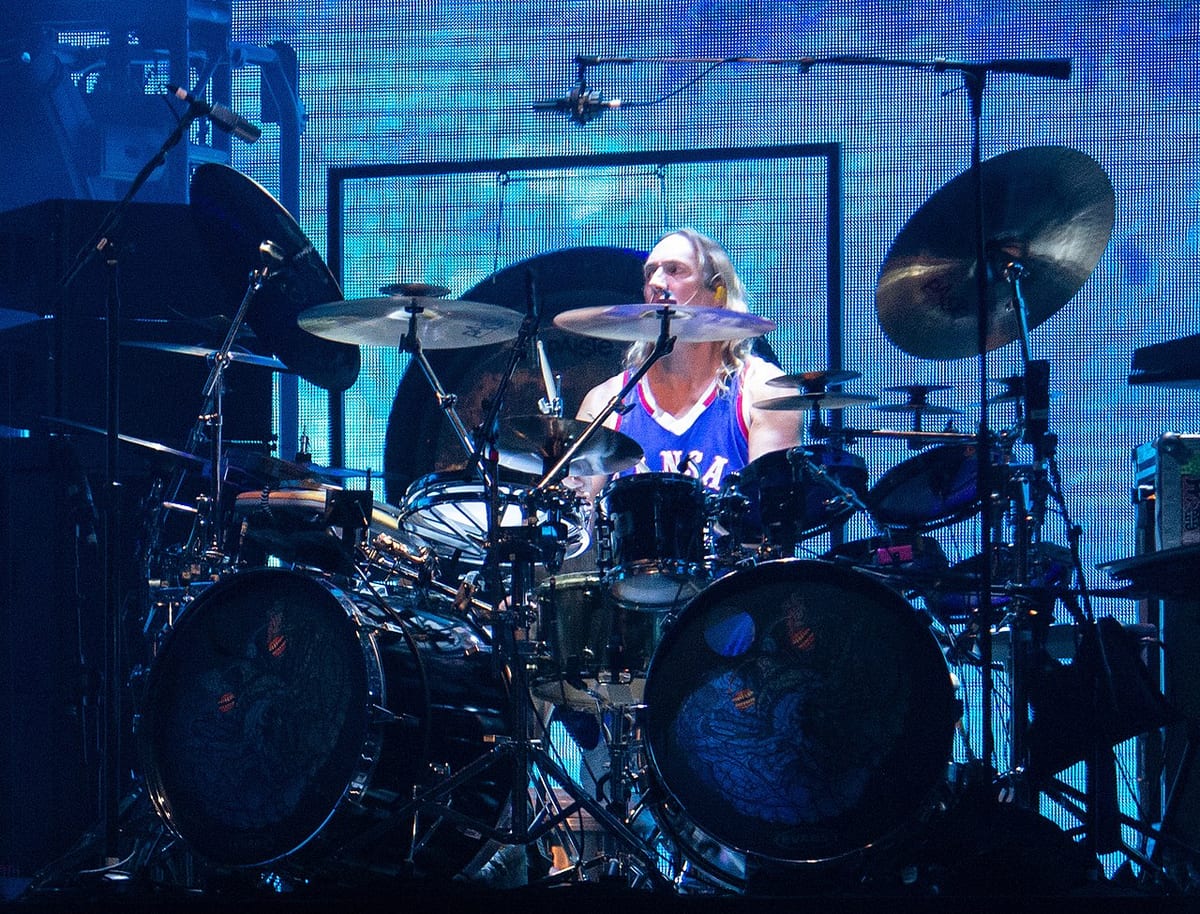
He is 6’5”, plays a kit covered in occult geometry, and treats a 5/4 bar as a resting state. He is also, underneath all of it, a jazz drummer who happens to have spent thirty-six years in a metal band.
Here is how a kid from Kansas ended up as progressive rock’s most-studied player — and what he is actually doing when it sounds impossible.
Who is Danny Carey?
Danny Carey was born on 10 May 1961 in Lawrence, Kansas, and grew up in Paola, a small town south of Kansas City.
He started on drums at around ten and went the full school-music route: marching band, concert band and — crucially — jazz band. He went on to study at the University of Missouri–Kansas City, playing jazz seriously enough that it, not rock, is the foundation of everything he does.
In the mid-eighties he moved to Los Angeles and did what jazz-trained drummers in LA do: whatever paid. Sessions, function work, and a run of odd bands including Green Jellÿ and Pigmy Love Circus.
Joining Tool
The Tool story is almost comically casual. Carey lived in the same building as Maynard James Keenan and knew Adam Jones. When the fledgling band needed a drummer, he sat in — by his own telling, partly out of politeness — and never left.
That was 1990. The catalogue since is short and enormous: Opiate (1992), Undertow (1993), Ænima (1996), Lateralus (2001), 10,000 Days (2006) and Fear Inoculum (2019).
Six records in thirty years. Tool are not a prolific band; they are a finished one.
The tabla, and why it matters
The single most important thing Carey did for his own playing was study tabla with Aloke Dutta in Los Angeles.
Indian classical rhythm is organised in cycles — long ones, subdivided in ways that Western pop simply does not use. Learning to feel a 16-beat cycle as a shape rather than as counting is exactly the skill that makes Tool’s odd time signatures sound like grooves instead of maths homework.
Listen to “Pneuma” or “Ticks & Leeches” and the pulse never disappears, however strange the bar length gets. That is tabla training doing the work.
What Danny Carey actually does
He grooves in odd time. This is the whole trick, and almost nobody else manages it. A 7/8 riff in most bands sounds like a 7/8 riff. In Tool it sounds like a groove that happens to be seven long. He lands the accent where your body expects weight, not where the count says beat one.
He plays polyrhythms as texture, not as a stunt. Three over four, five over four, the right hand in one cycle and the feet in another — but always underneath a riff, never instead of one.
He is a left-foot player. The hi-hat keeps working while the hands are elsewhere, which is why his fills never lose the pulse.
His hands are jazz hands. Ghost notes, buzz strokes, a light touch on the snare between the heavy accents. Strip the distortion off a Tool track and there is far more finesse in there than the volume suggests.
He can play a straight rock beat and make it enormous. “Sober” and “Stinkfist” have no arithmetic in them at all.
The bit everybody notices
Carey is deeply interested in sacred geometry, Enochian symbols and the occult, and it is all over the kit — sigils on the shells, a unicursal hexagram behind him, mystical script on the heads.
You can take that as seriously as you like. What is not in doubt is that it gives him the most visually recognisable drum setup in modern rock, and that “Chocolate Chip Trip” — his solo piece on Fear Inoculum, played against a modular synth — is one of the very few drum solos of the streaming era that people actually listen to twice.
The side projects
Volto! is the fusion trio that lets him play the jazz-rock he grew up on. Legend of the Seagullmen was the ludicrous, enjoyable nautical-metal side band with Mastodon’s Brent Hinds. He has also drummed on records by Zaum, Adrian Belew and others when the schedule allowed — which, given Tool’s release rate, it often does.
Danny Carey’s drum kit
Two brands have been constant for over three decades: Sonor shells and Paiste cymbals.
- The kit — Sonor throughout: Designer Series in the nineties, then the custom SQ2 kits that most people picture, with a 24” or 26” kick and a wall of toms.
- Cymbals — Paiste Signature in the earlier years, moving towards heavy 2002 models for the Fear Inoculum tour, plus Novo Chinas and a huge symphonic gong overhead.
- Pedals — Axis Longboards. Direct drive, no slack, which suits a player whose feet are doing counterpoint rather than blast beats.
- Electronics — the Mandala MIDI pads he helped develop, plus a synth rack. The pads are what trigger the tabla and orchestral sounds live.
- Sticks — his own Vic Firth signature model, long and heavy.
Every era, with buy links, is on Danny Carey’s Rig Vault page.
Want the sound without the rig?
You do not need an SQ2 and a 40” gong. You need three things.
Tune the toms low and open with almost no muffling — the Tool tom sound is length, not attack. Get a genuinely heavy ride so the bell cuts through two detuned guitars. And spend a month practising your left foot on the hi-hat while your hands play something else, which costs nothing and is the actual secret.
Our cymbal buying guide covers the heavy end of the range, and the Gear Guru will build you a spec to a number.
The awards
Drumeo’s voters gave him Progressive Drummer Of The Year in both 2022 and 2023, and a joint Drum Performance Of The Year in 2025 alongside Travis Barker and Chad Smith. He also played the Taylor Hawkins tribute concerts in 2022.
Where to start listening
- “Pneuma” (2019). The best single demonstration of everything he does.
- “Ticks & Leeches” (2001). Brutal, fast, and still grooving.
- “Lateralus” (2001). The Fibonacci one. Count it if you must, but feel it first.
- “Rosetta Stoned” (2006). Eleven minutes, and the drums never repeat themselves lazily.
- “Chocolate Chip Trip” (2019). The solo, and proof he can be funny.
Final thoughts
Carey is the rare technical drummer whose technique never gets in front of the song. Tool’s music is difficult by design, and he is the reason it still moves rather than merely impresses.
He is also a useful corrective to the idea that you need to play fast to be extraordinary. Most of what makes him remarkable happens at moderate tempo, in a bar length you would not have chosen, with the groove entirely intact.
See Danny Carey’s full rig in the Rig Vault, or read about Chad Smith and Travis Barker — the drummers he shared that 2025 award with.