Travis Barker | Pop-punk's most influential drummer
Travis Barker turned marching-band chops into pop-punk's defining drum sound. His story, his technique, his kits, and the latest Travis Barker news.
Ask a hundred drummers under forty who made them want to play, and a frightening number of them will say the same name. Travis Barker did not invent punk drumming, but he is the reason a generation of us bought a kit and cranked the snare until it hurt.
He is also more than the blink-182 drummer. He is a producer with a genuine hit rate, a survivor of a plane crash that killed four people, and the man who dragged hip-hop feel into a scene that had never asked for it.
Here you will find his full story, what actually makes his playing work, every kit he has played, and the latest Travis Barker news — we keep this page updated, so it is worth a bookmark.
Who is Travis Barker?
Travis Landon Barker was born on 14 November 1975 in Fontana, California.
His mum bought him his first drum kit when he was four. It was the only kit he owned until he was fifteen. Eleven years on one set of drums will teach you to get everything out of what you have.
He started formal lessons at five with a teacher called Michael Mai, who did the single most useful thing a drum teacher can do — he refused to let Travis specialise. Jazz, Latin, rock, rudiments. All of it, from the start.
That decision is the whole story, really. Everything that makes Travis sound like Travis comes from a punk drummer having a drum-corps education.
The Fontana High years
At Fontana High School he played kit in the jazz ensemble and snare in the marching band.
Marching snare is a brutal teacher. Every note is exposed, every stroke height is dictated, and you play the same four bars until your forearms give out. It builds a specific kind of hand — clean, loud, ruthlessly even.
Listen to any Travis fill and you can hear it. The notes are all the same size unless he decides otherwise.
Feeble, the Aquabats and a bin lorry
Before the fame, Travis played in a SoCal punk band called Feeble and collected rubbish in Laguna Beach to pay the bills. He has never been shy about that part.
In 1996 he joined ska-punk oddballs The Aquabats, taking the stage name “Baron von Tito” and playing on The Fury of The Aquabats!.
The horn section is why his early snare choice makes sense — he ran a Pearl Free Floating 14” x 3.5” brass piccolo, a whip-crack in the high register that was the only thing that would cut through a wall of brass.
Joining blink-182 in 45 minutes
The story sounds made up, and it isn’t. The Aquabats were opening for blink-182 in 1998 when blink’s drummer Scott Raynor left mid-tour.
Travis learned the entire set from a cassette in about 45 minutes and played the show that night.
He never left. The following year Enema of the State sold something like fifteen million copies and put his drumming in front of every teenager with MTV.
What actually makes Travis Barker’s drumming so good
This is the bit people get wrong. Travis is not “just” fast. Plenty of drummers are faster. What separates him is a very specific set of choices, and most of them are things you can steal.
He plays flat, and he plays low
Look at any Travis kit. The toms are almost horizontal, the cymbals are barely above the drums, and everything sits within a tight arc.
That is not a fashion choice. Flat toms mean less rebound loss and no rim-clipping on fast singles. Low cymbals mean shorter travel, which means the hand gets back to the snare quicker.
He also plays a small kit by rock standards — usually one rack tom and one or two floors. Fewer drums, less distance, faster fills.
There is a downside worth mentioning: a flat tom is harder to get a big open tone from, and playing that low is unkind to your wrists if your throne height is wrong. Copy the geometry by all means — just set your seat first.
The snare is the whole sound
His snare is cranked. Properly cranked — skin-tight, high-pitched, with a Remo Coated Emperor X on top and a black dot underneath.
Historically the drum itself was a 14” x 8” 20-ply vented maple OCDP with holes drilled in the shell. Very deep, very dry, very loud. These days it is more often a 14” x 6.5” black nickel over brass.
Either way, the tuning does the work. It gives him a backbeat that pops out of a dense mix without needing volume, and it makes his ghost notes and rimshot-to-ghost dynamics legible at 200bpm.
If you want to sound more like Travis, tune up before you buy anything. Our free drum tuner will get you there for nothing.
Hip-hop hands in a punk band
Here is the genuinely original bit.
Travis was listening to hip-hop and playing punk, and he started playing the pop-punk backbeat like a drum machine programmer would. Doubled snare hits, sixteenth-note hi-hat displacement, dropped kick patterns that sound like a chopped break.
Nobody in 1999 was playing “What’s My Age Again?” like that. Everyone after him was.
That crossover instinct is exactly what made him such a natural producer later on — he was already thinking in loops.
The one-handed sixteenths
Travis famously plays a lot of his hi-hat lines as one-handed sixteenths rather than alternating.
It keeps the left hand free for the snare and lets the groove stay locked while the backbeat moves around. It is also punishing on the right forearm, so build it up slowly.
Want to build the same engine? Start with our tempo trainer and a metronome you are honest with, and read how to drum faster before you hurt yourself.
The plane crash
On 19 September 2008 a Learjet 60 carrying Travis, his friend Adam “DJ AM” Goldstein and four others overran the runway at Columbia Metropolitan Airport in South Carolina.
Four people died. Travis and DJ AM survived with severe burns. The NTSB later put the crash down to under-inflated tyres, a rejected take-off that should not have been rejected, and a design issue with the aircraft.
Travis spent months in a burns unit, had multiple skin grafts, and did not fly again for over a decade.
DJ AM died of an overdose eleven months later.
You cannot understand the second half of Travis Barker’s career without this. The relentless output, the sobriety, the tattoos over the scars, the refusal to stop — it all traces back to that runway. It is also the spine of the Louder Than Fear documentary.
Travis Barker the producer
Somewhere along the way Travis became one of the most in-demand producers in American music, and he did it by being the guy who could put real drums on anything.
The obvious example is Machine Gun Kelly. Tickets to My Downfall (2020) and Mainstream Sellout (2022) were both Travis productions, and they more or less restarted pop-punk as a commercial force. A leftover from those sessions, “Times of My Life”, finally surfaced in January 2026.
Beyond that: Avril Lavigne, Lil Wayne, YUNGBLUD, Willow, Run the Jewels, iann dior, Trippie Redd, Jxdn. He runs DTA Records (“Don’t Trust Anyone”), founded with Elektra in 2019.
He also has a solo record — Give the Drummer Some (2011) — which is basically a drummer’s guest-list party and still holds up.
The other businesses
Outside music he founded the clothing brand Famous Stars and Straps in 1999, and later Barker Wellness Co, a vegan CBD line. Neither is a drumming story, but both explain why he is on this many magazine covers.
Travis Barker’s drum kit
Travis’s gear has changed badge several times and barely changed shape once.
The DNA is constant: a short stack, everything flat, cymbals low and fast, a cranked main snare, and something silly and personal bolted to the kick — a woodblock, a cowbell, or the vintage Cadillac emblem he has used as a bass drum badge for twenty years.
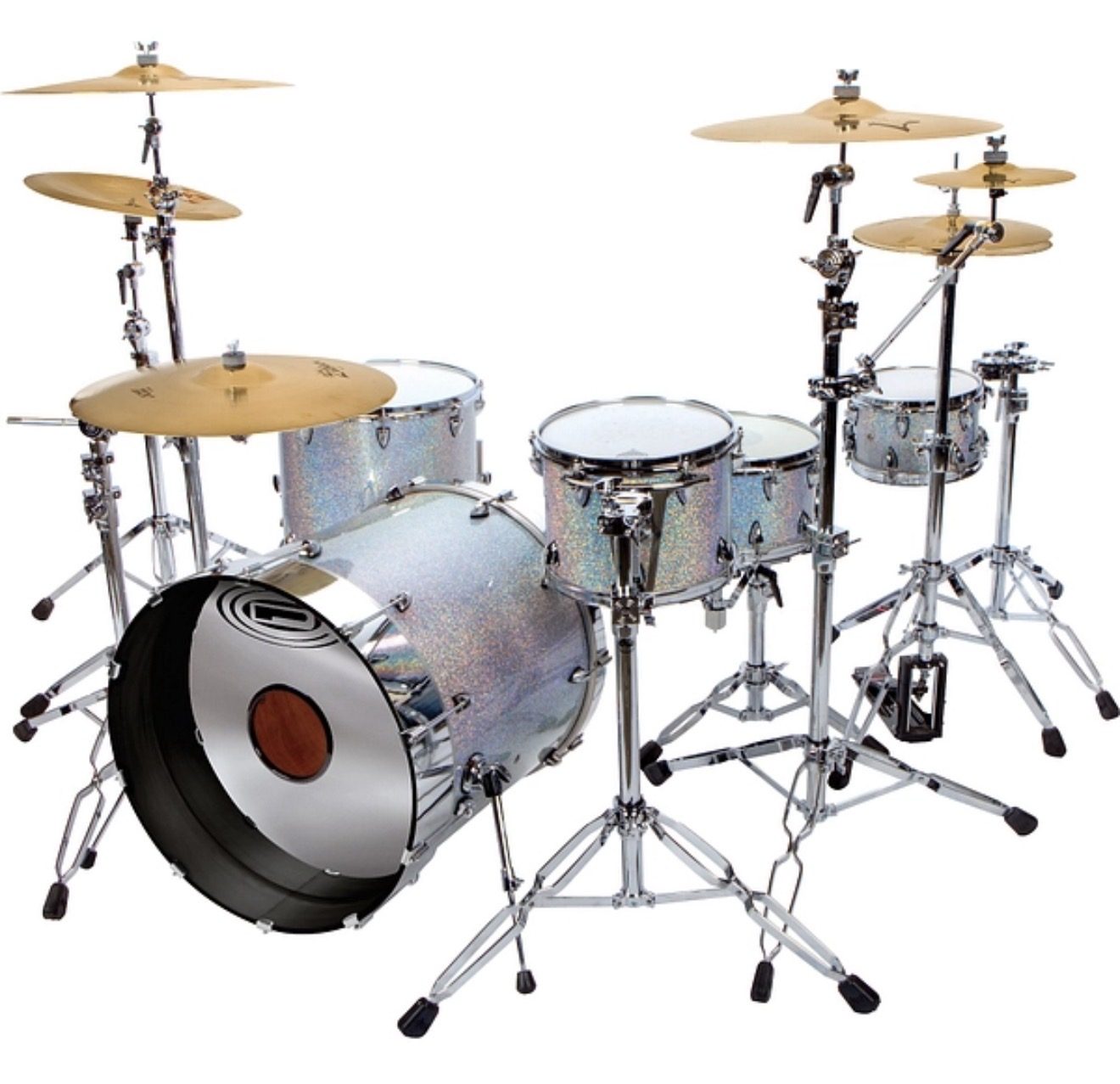
The eras, in short:
- Ludwig and Pearl (to 1998) — the hand-me-down kit and the brass piccolo snare.
- Orange County Drum & Percussion (1998–2016) — the big one. Travis was part-owner, and OCDP became his visual signature: orange glitter, the Jelly Bean kit with a different colour per drum, the Evel Knievel kit from the “Adam’s Song” video, tri-band glass glitter with a square 20” x 20” kick, plaid flannel, clear acrylic with the Famous Stars and Straps logo engraved into the shells.
- Q Drum Co (2016–2019) — a gap year or three. With OCDP gone as he knew it, his live acrylics were built by two of the original OCDP master builders, Daniel Jensen and Jeremy Berman, with LED strips inside the shells.
- DW (2019–present) — fully endorsed by Drum Workshop, after years of using their hardware anyway. The red-and-white striped candy-cane custom from the “EDGING” video is the most photographed kit he owns.
Cymbals have been Zildjian throughout — A Customs in the early years, and now brilliant-finish 15” A Custom Mastersound hats, 19” and 20” crashes, a 23” A Sweet ride he crashes as often as he rides, and an 18” Oriental China Trash off to the far right.
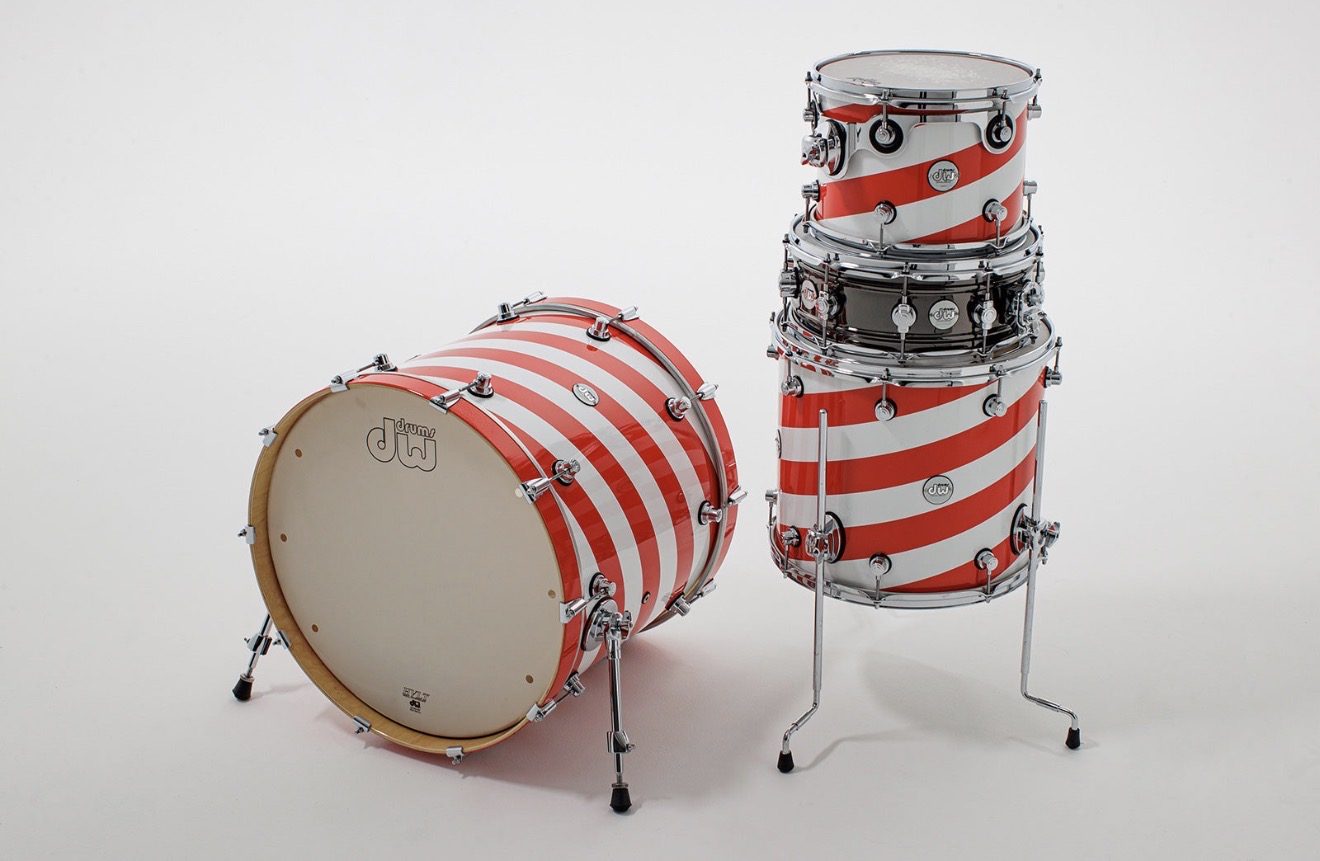
Here is the striped DW in its natural habitat:
Current gear, roughly:
- DW Collector’s Series shells
- DW 14” x 6.5” black nickel over brass snare, plus a 10” side snare
- Zildjian A Custom and A Sweet cymbals
- Remo Coated Emperor X (snare), Coated Emperor (toms), Powerstroke 3 (kick)
- DW 5000 Turbo single pedal, DW 9000 boom stands
- Roland SPD-SX Pro for samples and the hip-hop segues
- Zildjian Travis Barker Artist Series sticks, wrapped in grip tape
That is the summary. The full version — fourteen documented setups from 1996 to the ONE MORE TIME… stadium run, every drum, every cymbal, with buy links and what changed between eras — lives in the Rig Vault.
See Travis Barker’s full rig, era by era, in the Rig Vault →
Signature gear you can actually buy
- Zildjian Travis Barker Artist Series sticks — US select hickory, round wood tip, chunky neck. He tapes them anyway.
- Zildjian Travis Barker double stick mallets — the same stick with a felt mallet on the other end.
- LP Travis Barker Ridge Rider cowbell — for the bolted-to-the-kick department.
The OCDP signature kits and snares are long discontinued, so the used market is the only route. There are usually a few on Reverb if you are patient, and the Reverb price guide will tell you whether the asking price is fantasy.
If you want the sound rather than the badge, the honest answer is a cranked 14” x 6.5” metal snare, a small four-piece, and cymbals set low. That gets you 90% of the way for a fraction of the money — and our Gear Guru will happily spec it for your budget.
Where to start listening
If you are new to his playing, or you want to hear the range:
- “What’s My Age Again?” (blink-182, 1999) — the blueprint. Listen to the hi-hat, not the fills.
- “Feeling This” (blink-182, 2003) — the untitled album, and the moment he stopped being just a punk drummer.
- “I Feel So” (Box Car Racer, 2002) — looser, darker, more dynamic.
- “Can a Drummer Get Some” (Travis Barker feat. Swizz Beatz, Game, Lil Wayne and Rick Ross, 2011) — hip-hop played by hands, and the clearest statement of what he brought to the genre.
- “EDGING” (blink-182, 2022) — the reunion, and the candy-cane kit.
- “ONE MORE TIME” (blink-182, 2023) — restrained, and better for it.
Find more Travis Barker
Final thoughts
Travis Barker is the rare drummer who is both wildly popular and genuinely worth studying. The marching-band cleanliness, the drum-machine thinking, the discipline of a small kit set up properly — none of that is hype.
Is he the most technically advanced drummer alive? No, and he has never claimed to be. Put him next to Thomas Lang or Aquiles Priester and the vocabulary is narrower. But taste is a skill too, and almost nobody has been more influential on how modern drums are played and produced.
At fifty, with a tenth blink album in the works and a documentary in the charts, he shows no sign of slowing down. When he does something new, you will read about it in the news section at the top of this page.
And if you want to know exactly what he is hitting right now, Travis Barker’s full rig is in the Rig Vault — piece by piece, era by era.