Steve Gadd | The most copied drummer alive
Steve Gadd played 50 Ways, Aja and half the records in your parents' collection. His story, his rudimental technique, his Yamaha and Zildjian kit explained.
There is a good chance you have owned a record with Steve Gadd on it without knowing his name.
There is an even better chance that you, or your teacher, or your teacher’s teacher, has tried to play the groove from “50 Ways to Leave Your Lover” and got it wrong.
Gadd is the most influential session drummer of the last fifty years, and one of the very few whose parts — not just his playing — have entered the language. Here is how he did it.
Who is Steve Gadd?
Steve Gadd was born on 9 April 1945 in Irondequoit, just outside Rochester, New York.
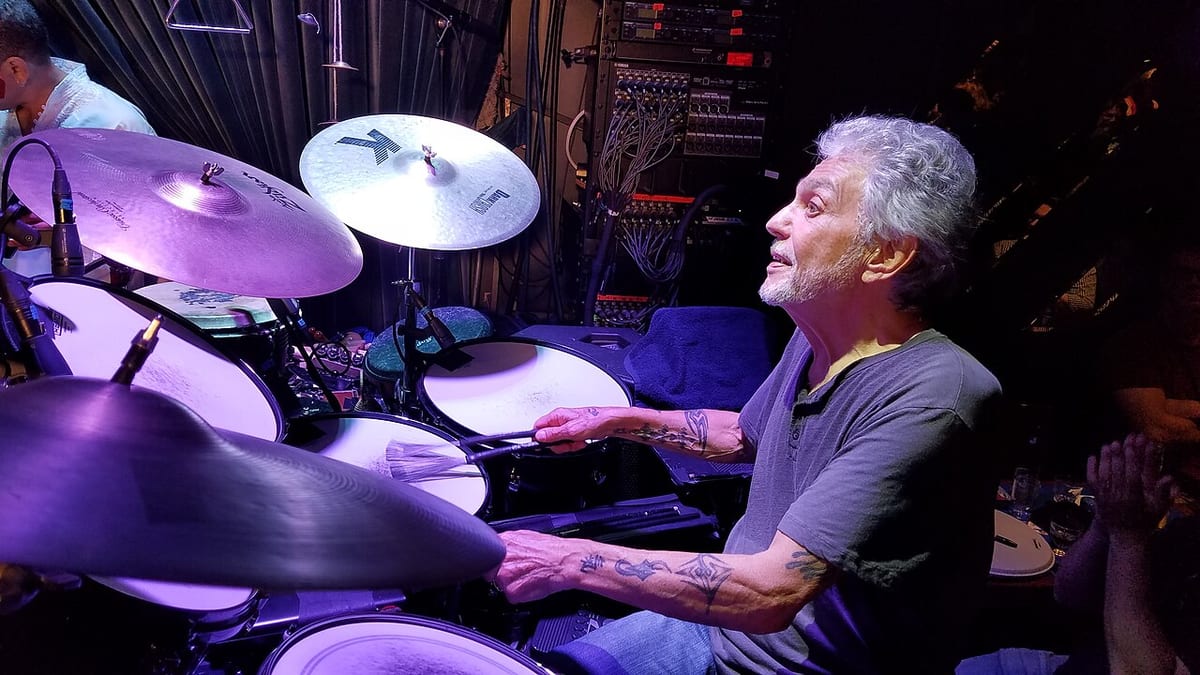
He was a genuine child prodigy. His uncle, a military drummer, started him on rudiments before he was old enough for school, and the story that follows is famous: at around eleven years old he sat in with Dizzy Gillespie.
He studied at the Manhattan School of Music and then the Eastman School of Music in Rochester, and spent three years in a US Army band — which is where the rudimental grounding got hammered into permanence.
Then, in the early seventies, he moved to New York and became busy in a way that is difficult to overstate.
The records
The list is silly. A very partial version:
- Paul Simon — “50 Ways to Leave Your Lover” (1975) and “Late in the Evening” (1980).
- Steely Dan — “Aja” (1977), including one of the most transcribed drum solos ever recorded.
- Chick Corea — The Leprechaun, Friends, Three Quartets.
- Stuff — the New York band with Richard Tee and Cornell Dupree that is basically a masterclass in groove.
- Eric Clapton, for years, on stage and on record.
- Al Jarreau, James Taylor, Joe Cocker, Rickie Lee Jones, Manhattan Transfer, Steps Ahead, and hundreds more.
He continues to lead the Steve Gadd Band, and he is in the Modern Drummer Hall of Fame and the Rock and Roll Hall of Fame’s ranks of session players.
Drumeo gave him the Buddy Rich Award for Career Achievement in 2021 — the Legacy Award for exactly this kind of body of work.
The two parts everybody steals
“50 Ways to Leave Your Lover”
The most recognisable drum part in popular music that is not a fill.
It is a linear, marching-derived pattern: no two limbs strike at the same time, the snare is played with the snares off and a soft, muffled tone, and the whole thing is built out of rudimental sticking rather than rock-kit vocabulary.
It sounds simple. It is not, and the reason most attempts fail is that people play it as a groove with fills instead of as one continuous rudiment.
“Aja”
Two minutes of the most musical drum soloing on a pop record, played in and around a saxophone solo rather than instead of one.
It also demonstrates the thing that makes Gadd Gadd: everything he plays resolves. However far out he goes, he lands.
What Steve Gadd actually does
He is a rudimental player on a drum kit. Paradiddles, flams, ratamacues and rolls, moved around the drums. That is the whole vocabulary, and it is why his fills sound like sentences rather than noise.
He tunes low and plays quietly. Gadd’s studio sound is famously fat, dead and thumping — muffled heads, moderate stroke, no ring. Half of “his sound” is tuning.
His time is the point. Producers hired him because the first take was usable. Ask any engineer who worked in seventies New York.
He plays the song. There is almost no ego in his recorded work. When a track needs him to play a whole note for four minutes, he does, and it sounds enormous.
He grooves. For a man with a marching background, the amount of swing in his straight-eighth playing is the real trick.
The part of the story that gets skipped
Gadd has spoken openly about the cocaine addiction that ran through the peak of his session career in the late seventies and early eighties, and about getting clean.
It is worth knowing, not for the drama, but because he is a rare example of a musician whose best work is spread across the decades after that period as well as before it. He has been playing at the top level for over fifty years, most of them sober.
Steve Gadd’s drum kit
He has been a Yamaha artist since 1976 — one of the longest endorsement relationships in the business, and the reason Yamaha’s Recording Custom sounds like it does.
- The kit — Yamaha throughout, in modest sizes. A 22”x14” bass drum, 10” and 12” rack toms and 14”/16” floor toms is a typical Gadd setup. No 26” kicks, no towers of toms.
- The snare — usually a 14”x5.5”, and he has long had a soft spot for a chrome-over-brass Ludwig Supraphonic alongside his Yamaha models.
- Cymbals — Zildjian. He has his own K Custom Session line, and his live setup mixes old and new: a top hi-hat he bought used in the sixties, riveted crashes, a thin dark crash and a dry ride.
- Rivets. More than most drummers use. The sizzle is a big part of the Gadd wash.
- Sticks — Vic Firth. His signature model is short, light and barrel-tipped, built for recording rather than volume — which tells you everything about his priorities. Our drumstick size guide explains what a change like that actually does.
Every era, with buy links, is on Steve Gadd’s Rig Vault page.
Want the sound without the rig?
The Gadd sound is a tuning exercise, not a shopping trip.
Tune the batter heads low with a controlled ring — a single-ply head with a built-in dampening ring gets you most of the way. Detune the snare’s bottom head slightly and play with less force than feels natural. Then add rivets or a sizzle chain to a crash and use it as a ride. Our drum head buying guide covers the muffled-head options.
The rest is rudiments. Genuinely — our drum rudiments guide is where that road starts.
Where to start listening
- Paul Simon — “50 Ways to Leave Your Lover” (1975). Learn it properly. It will take longer than you think.
- Steely Dan — “Aja” (1977). The solo, obviously, but listen to the verses first.
- Stuff — “Foots” (1976). Gadd playing pure groove with nothing to prove.
- Chick Corea — “Nite Sprite” (1976). The fusion side, wide open.
- Paul Simon — “Late in the Evening” (1980). Two sticks in each hand and a mozambique-derived groove that nobody else would have thought of.
Final thoughts
Gadd’s influence is unusual because it is specific. Most great drummers influence how people feel. Gadd influenced what people play — actual parts, actual stickings, reproduced note for note on thousands of records since.
He also settled an argument that drummers keep restarting. You do not need a big kit, you do not need speed, and you do not need to be heard soloing to be the most important musician in the room.
Fifty years of first takes says so.
See Steve Gadd’s full rig in the Rig Vault, or read about Questlove — another drummer whose entire reputation rests on feel rather than fireworks.