Drummer's wrist | Tendonitis, RSI and how to avoid it
Why drummers' wrists hurt: tendonitis, De Quervain's and carpal tunnel explained, the grip and gear changes that prevent them, and when to see a doctor.
Drummers hurt their wrists the way runners hurt their knees: not from one bad stroke, but from a hundred thousand slightly wrong ones. The pain arrives slowly, gets blamed on age, and usually comes from something you can fix in a week once you know what it is.
So here is what goes wrong, why, what to change, and the signs that mean it is time to stop reading and see someone.
Nothing here is medical advice. It is what drummers and the physios who treat them have learned, and it is a starting point rather than a diagnosis.
What actually hurts
Three things, mostly, and they feel different.
Tendonitis. An ache along a tendon that gets worse during a session and better with rest. On the thumb side of the wrist, where the tendons that move the thumb run through a tight tunnel, it is called De Quervain’s, and it is the drummer’s classic. On the outside of the elbow, where the forearm muscles that lift the wrist attach, it is the same thing by another name. Both are overload injuries: the tendon was asked to do more than it had been trained for.
Carpal tunnel. Pressure on the median nerve where it passes through the wrist. The signs are not pain but numbness and tingling in the thumb, index and middle fingers, often at night, sometimes with weakness in the grip. This is a nerve, not a tendon, and it needs a doctor.
Plain overuse. The dull, everything-aches tiredness of a long session, which is normal and goes by the next morning. If it does not go by the next morning, it has stopped being normal.
Why it happens
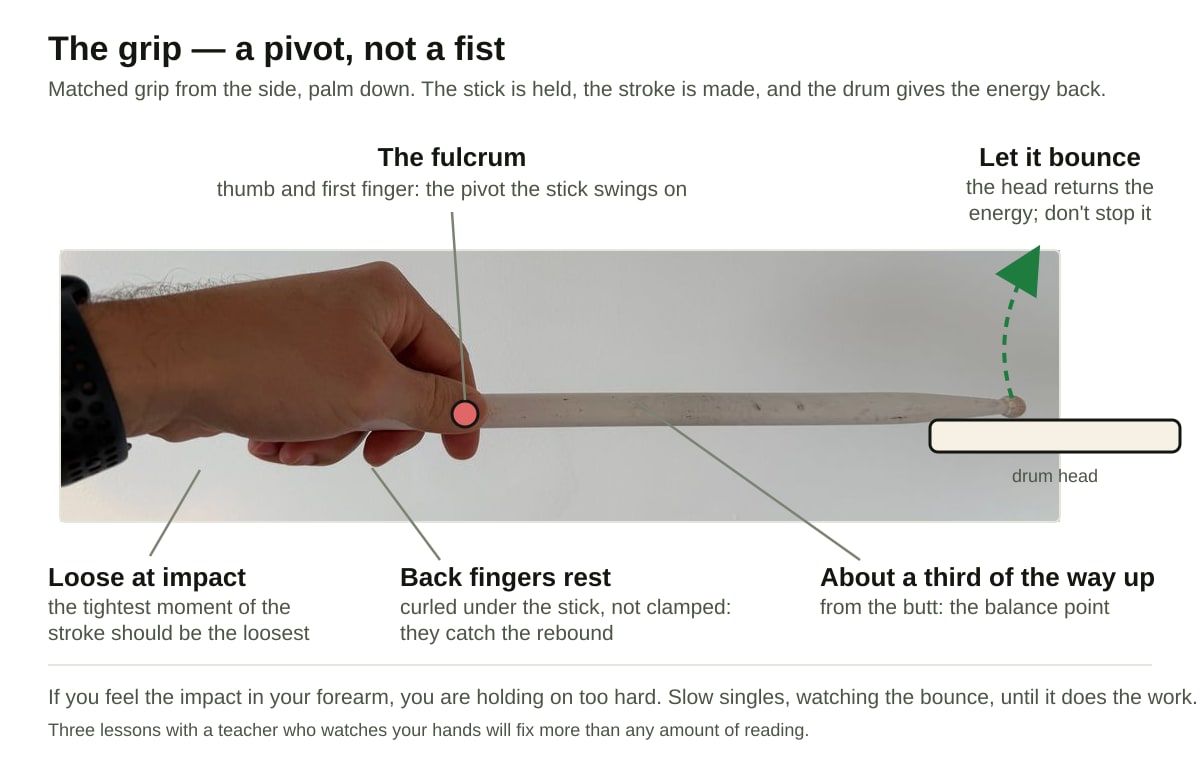
The death grip. The number one cause. A stick held in a fist, with the fingers clamped, transmits every impact up the forearm and makes the tendons work against each other on every stroke. The stick should pivot between thumb and first finger with the other fingers resting on it, and the moment of impact should be the loosest moment of the stroke, not the tightest.
Fighting the rebound. Stopping the stick dead on the head, rather than letting it bounce back, means the muscles absorb the energy the drum would have returned. Multiply by the number of strokes in a gig.
Too much, too soon. The first rehearsal after a month off. The week before a gig when practice goes from twenty minutes to two hours. A new rudiment at a tempo the hands have not earned. Tendons strengthen slowly and are asked to keep up fast.
Hard surfaces. A practice pad on a kitchen worktop with nothing giving under it. Rubber pads on an older electronic kit, which are harder than any drum head. Rimshots all night. Each one puts the impact into the arm rather than the stick.
Heavy sticks and a cold start. A 2B at full tilt with no warm-up is a load the wrist was not ready for. Our drumstick size guide covers weight; the warm-up is below.
What to change
Loosen the grip, and let the stick work. The whole fix, most of the time. Hold the stick at the balance point, pivot it between thumb and first finger, keep the back fingers in contact but not gripping, and let it rebound. If you feel the impact in your forearm, you are holding on too hard. The rudiment trainer at a slow tempo is the place to retrain this: the single stroke roll at 60, watching the stick bounce, until the bounce is doing the work.
Warm up. Five minutes of singles and doubles at half speed before anything hard. Tendons are like cold toffee: brittle until they are warm, then fine. Every drummer who has ever been injured will tell you they skipped this.
Build up slowly. Twenty per cent more a week, not a hundred. The practice log shows the jumps, and the practice home charts the tempo climbing, so you can see when you are pushing faster than the hands are keeping up.
Soften the surfaces. A pad with some give, a rubber mat under a pad on a table, mesh heads over rubber pads on an e-kit, and fewer rimshots in practice than in the song. The practice pad guide covers which pads are kind to hands.
Stretch and rest. Gentle forearm stretches after playing, wrist both ways, fingers back, for thirty seconds each. And a day off a week, which is not laziness; it is when the tendons do the rebuilding.
Learn the stroke properly
Most wrist problems are technique problems in disguise, and the technique that fixes them is the one every good teacher starts with: the stroke comes from the wrist and the fingers, with the arm as a support rather than a hammer. The Moeller stroke, rebound control, the fulcrum. Three lessons with a teacher who watches your hands will do more than any amount of reading. Our free lessons guide weighs the options.
When to see someone
- Numbness or tingling in the fingers, especially at night. Doctor.
- Pain at rest, or at the start of a session rather than the end. Physio.
- Swelling or heat over a tendon. Doctor.
- Any pain that has not improved after two weeks of rest and a lighter grip. Physio, ideally one who treats musicians; the music colleges and the musicians’ unions can usually point you at one.
Playing through an injury does not make you tougher. It makes the injury take three months instead of three weeks. Larry Mullen Jr. rebuilt his technique from scratch after surgery; most of us can avoid the surgery.
Final thoughts
Loosen the grip, let the stick bounce, warm up, build up slowly and play on surfaces with some give. That prevents most drummers’ wrist pain, and it fixes a good deal of it.
And when the fingers go numb or the ache is still there on Monday, stop being a drummer about it and go and see someone. The drummer health section has the ears and the back too, and the same rule applies to all three.
Drummer wrist pain FAQs
- Why do my wrists hurt after drumming?
- Usually one of three things: gripping the sticks too hard, playing too much too soon after a break, or practising on a surface that sends the impact straight back up your arm. Each one overloads the tendons that run through the wrist, and tendons complain slowly. Loosen the grip and let the stick rebound before you change anything else.
- What is drummer's tendonitis?
- Inflammation of a tendon or its sheath from repeated strain, and for drummers it is usually on the thumb side of the wrist (De Quervain's), the back of the wrist, or the outside of the elbow where the forearm muscles attach. It comes on as an ache that gets worse through a session and settles with rest, and it is almost always a technique or workload problem first.
- Can drumming cause carpal tunnel syndrome?
- It can contribute. Carpal tunnel is pressure on the nerve that runs through the wrist, and the signs are different from tendonitis: numbness or tingling in the thumb, index and middle fingers, often worse at night. That pattern needs a doctor rather than a technique fix, because it is a nerve rather than a tendon.
- Should I play through wrist pain?
- No. An ache that goes away by the next day is a signal to look at technique; pain that is there at the start of the next session, or that persists at rest, is an injury and playing on it makes it slower to heal. Rest it, fix the cause, and if it has not improved in two weeks see a physiotherapist who treats musicians.
Keep reading

All Our Buying Guides
Audio interfaces for drums | How many inputs?
Which audio interface to buy for recording drums: how many mic inputs you need, the two- and eight-input standards, ADAT expansion and the e-kit case.

All Our Buying Guides
Drum VSTs | The best sounds for your e-kit
The best drum VSTs for an electronic kit: Superior Drummer 3, EZdrummer 3, Addictive Drums 2, GetGood Drums and Steven Slate Drums compared, plus the free ones.

How to
Connect an e-kit to a computer | USB, MIDI, latency
How to connect an electronic drum kit to a computer: the USB cable, MIDI versus audio, the buffer and driver settings that kill latency, and mapping the pads.