Remo Powerstroke P3 | The kick drum default
The Remo Powerstroke P3 explained: how the inlay ring works, the kick versions from Clear to Felt Tone, how it sounds on snare and toms, and who it suits.
Look inside almost any kick drum and there is a good chance the batter head is a Remo Powerstroke P3. It came out in 1993 and has been the default kick drum head ever since.
It does one simple thing very well. It takes the boom out of a bass drum without killing it. You get punch, a clear low note and a short, controlled decay, often without stuffing a duvet inside the shell.
So how does it work, which version should you buy, and is it any good on snares and toms? Let’s find out.
What is the Powerstroke P3?
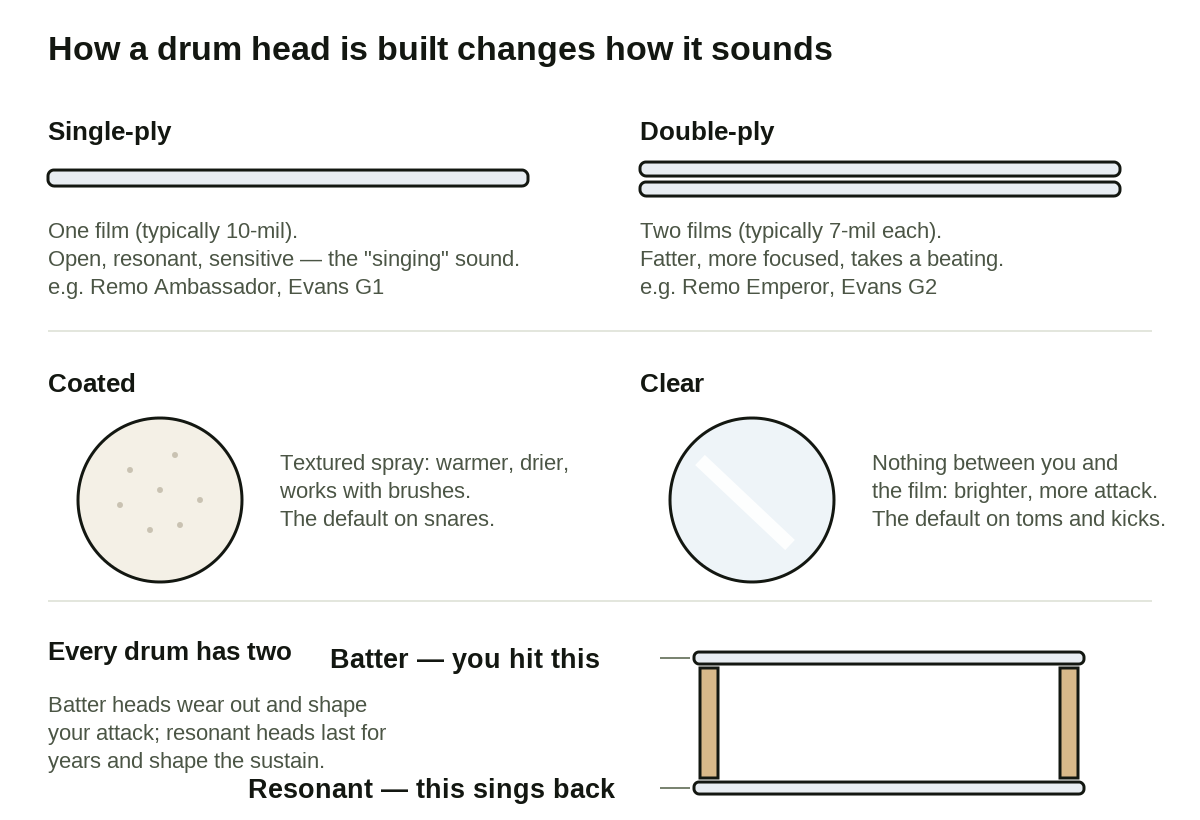
The Powerstroke P3 is a single ply of 10-mil film, the same weight as a Remo Ambassador, with one addition: a thin ring of film laid around the inside edge of the head.
Remo calls this an inlay ring. On bass drum sizes the ring is 10-mil thick. On tom and snare sizes it is a lighter 3-mil ring.
That ring is the whole trick. The edge of a drum head is where a lot of the high, ringing overtones live. Damp the edge and those overtones die away quickly, while the centre of the head still moves freely and gives you the fundamental note and the attack.
Remo describes the result as focused mid and low tones with well-defined attack, and the perfect balance of response and tone control. That is about right.
Where did the Powerstroke come from?
Remo’s first Powerstrokes, the P1 and P2 in 1984, were marching heads. They put an underlay ring of film into the hoop to cut high frequencies and reduce ring.
The Powerstroke 3 followed in 1993, made with Remo’s standard aluminium channel so it would fit drum kits. It caught on fast, especially on snares and bass drums. More than thirty years later it is still the head most kick drums wear.
There is more history in our Remo drum heads guide.
How does the Powerstroke P3 sound on a bass drum?
Punchy, focused and low. Compared with an open single-ply head, a P3 kick has:
- Less boom and ring. The long, rumbly sustain dies away quicker.
- A clearer note. The low end is still there, but tighter.
- More attack from the beater. You hear the click, especially on the clear version.
Most drummers find a P3 kick needs only a small pillow or a folded towel touching the head, and some use nothing at all. That is the appeal. It is the sound of a modern record kick drum with almost no work.
The honest caveat: a P3 is still a single ply. If you want a really dead, metal-style kick, or a very short thud, a Powerstroke P4 or an externally damped head will get you there quicker.
Which Powerstroke P3 bass drum head should you buy?
There are a lot of versions. Here are the ones that matter, from Remo’s own specs.
| Head | What it is | Best for |
|---|---|---|
| P3 Clear | 10-mil clear ply, 10-mil inlay ring | Punch and beater click: rock, pop, metal |
| P3 Coated | 10-mil coated ply, 10-mil inlay ring | Warmer, softer attack: all-rounder |
| P3 Clear Black Dot | Clear ply with inlay ring and a black dot | More attack and durability; Remo says it was inspired by Steve Smith |
| P3 Coated Black Dot | Coated ply with inlay ring and an underside dot | Durability with a warmer tone |
| P3 Felt Tone | Coated, Fiberskyn or Hazy with a free-floating felt strip | The old-school felt-strip sound, built in |
| P3 Fiberskyn | 7.5 or 10-mil film laminated to fibre, 2-mil ring | Warm, vintage, jazz-friendly kick |
| P3 Ebony / Smooth White | 10-mil ply with 10-mil ring; Smooth White includes an impact patch | Resonant (front) heads, or a batter with a look |
If you are not sure, buy the Coated or Clear P3 as the batter. Clear for more click, coated for a warmer thud.
The Felt Tone deserves a mention. Old bass drums were damped with a strip of felt stretched across the head under the hoop. The P3 Felt Tone builds that strip into the head, so you get the vintage sound without the faff of fitting one yourself.
Is the Powerstroke P3 good on snares and toms?
Yes, and it is underrated there. The tom and snare versions use a 3-mil inlay ring, so the control is gentle.
On toms, a clear P3 gives a focused, punchy note that dies away a bit quicker than an Ambassador but stays more open than a Pinstripe. Our Rig Vault lists Powerstroke clear tom batters on Josh Dun’s kit.
On snares, a coated P3 gives a controlled, slightly dry crack with fewer high overtones than an Ambassador. If your snare rings and you want to stop reaching for the gel pads, it is a good next step.
For an even drier snare, Remo makes the Powerstroke 77: two 7-mil plies with a 7-mil inlay ring and a top clear dot. And the Powerstroke P3 X is a thick 14-mil single ply with an inlay ring and a top dot, which Remo pitches between a coated Powerstroke and an Emperor X.
Powerstroke P3 vs P4
The Powerstroke P4 uses two plies of 7-mil film with a 3-mil inlay ring. That makes it fatter, darker and more durable, with even less sustain. Remo lists it for hard-hitting applications or wherever minimal sustain is wanted.
Our Rig Vault lists P4 kick batters for Meshuggah’s Tomas Haake, which tells you the kind of player it suits. On toms, the P4 gives a deep, short, punchy note.
Rule of thumb: P3 for most players and most styles, P4 if you hit hard, play fast double bass or want the deadest kick in the room.
Powerstroke P3 vs Evans EQ4 and EMAD
The closest Evans equivalent to a P3 kick head is the EQ4, also a single 10-mil ply with an internal damping ring. The two are very similar in concept.
The Evans EMAD takes a different approach: a single ply with foam rings mounted on the outside of the head, which you can swap to change the amount of damping. If you like to tweak, it is worth a look. Our Evans EMAD guide explains it.
Remo’s own answer to external damping is the newer SMT range. Our best drum head brands guide compares the three big makers more widely.
Who plays Powerstroke P3 heads?
Plenty of people. Our Rig Vault lists the Coated Powerstroke 3 as the kick batter on Travis Barker’s kit, with a Smooth White Powerstroke 3 on the front, and Powerstroke P3 kick heads for Tommy Lee, Josh Dun and Zak Starkey. John Otto’s rig lists the P3 Clear.
That is punk, metal, pop and classic rock. It is a versatile head.
How do you set up a Powerstroke P3 kick?
A few tips:
- Start with no damping. Tune the batter just past wrinkle-free, then bring it up until the beater bounces back the way you like.
- Add a little damping if needed. A small pillow just touching the batter is plenty. A P3 rarely needs the full duvet.
- Port the front head for mics. A ported resonant head lets you mic inside the drum and lets some air out for more punch.
- Protect the beater spot. Remo’s Falam Slam patch, or a P3 Smooth White with its impact patch, stops a hard beater wearing through.
Our drum tuner can help you find a pitch that works, and the drum head buying guide covers the wider kit.
How much is a Powerstroke P3?
At the time of writing, a 22” Powerstroke P3 bass drum batter costs around £30–£40 in the UK and around $30–$45 in the US. Smaller tom and snare sizes are cheaper; speciality versions like Felt Tone and Fiberskyn cost a little more.
Where can I buy one?
The right shop depends on where you are: Guitar Center in the Americas, Gear4music in the UK, or Thomann for Europe and the rest of the world.
Final thoughts
The Remo Powerstroke P3 is not glamorous. It is a 10-mil head with a ring of film round the edge. But it has been the default kick drum head for more than thirty years because it gets a great modern bass drum sound with almost no effort.
If you only change one head on a tired kit, make it the kick batter, and make it this. Then read our Remo drum heads guide for the rest of the kit, or see who plays what on the Remo heads hub.
Remo Powerstroke P3 FAQs
- What is a Remo Powerstroke P3?
- A single ply of 10-mil film with a thin inlay ring of film around the inside edge. The ring cuts the high edge overtones, so the drum sounds focused without being choked. Bass drum sizes use a 10-mil ring; tom and snare sizes use a 3-mil ring.
- Is the Powerstroke P3 good for bass drums?
- It is the most common kick batter there is. It gives a punchy, focused kick with a clear low end and much less boom than an open single ply, so most players need only a small pillow or none at all.
- What is the difference between Powerstroke P3 and P4?
- The P3 is one 10-mil ply with an inlay ring. The P4 is two 7-mil plies with a 3-mil inlay ring, so it is fatter, darker and tougher, with even less sustain. Hard hitters and metal players often prefer the P4.
- What is the Evans equivalent of the Powerstroke P3?
- The Evans EQ4 is the closest: a 10-mil single ply with an internal damping ring. The Evans EMAD takes a different route, with foam rings mounted on the outside. See our Evans EMAD guide.
- Should I use a Powerstroke P3 as a resonant head?
- Yes, it is common. The Ebony and Smooth White P3s are popular front heads, and Remo calls the P3 Ebony its most popular resonant bass drum head. You can get them ported or cut your own hole for a mic.
Keep reading
All Our Buying Guides
Best drum head brands (2026) | Remo vs Evans
Remo, Evans or Aquarian? The best drum head brands in 2026 compared, with the heads to buy for your snare, toms and bass drum, plus Code and Attack.
Evans Heads
Evans drum heads | Every series (2026)
Evans drum heads explained: G1, G2, EC2, UV1, Genera, Hydraulic, Onyx, Calftone and the EMAD and EQ kick heads, and which to buy for each drum.
Evans Heads
Evans EMAD | Bass drum control, your way
The Evans EMAD bass drum head explained: how the swappable foam rings work, EMAD vs EMAD2 vs Heavyweight, the Powerstroke P3 rival, and who it suits.