Remo Ambassador Coated | The reference head
The Remo Ambassador Coated is the world's best-selling drum head. What it is, how it sounds on snare and toms, who it suits, and the alternatives.
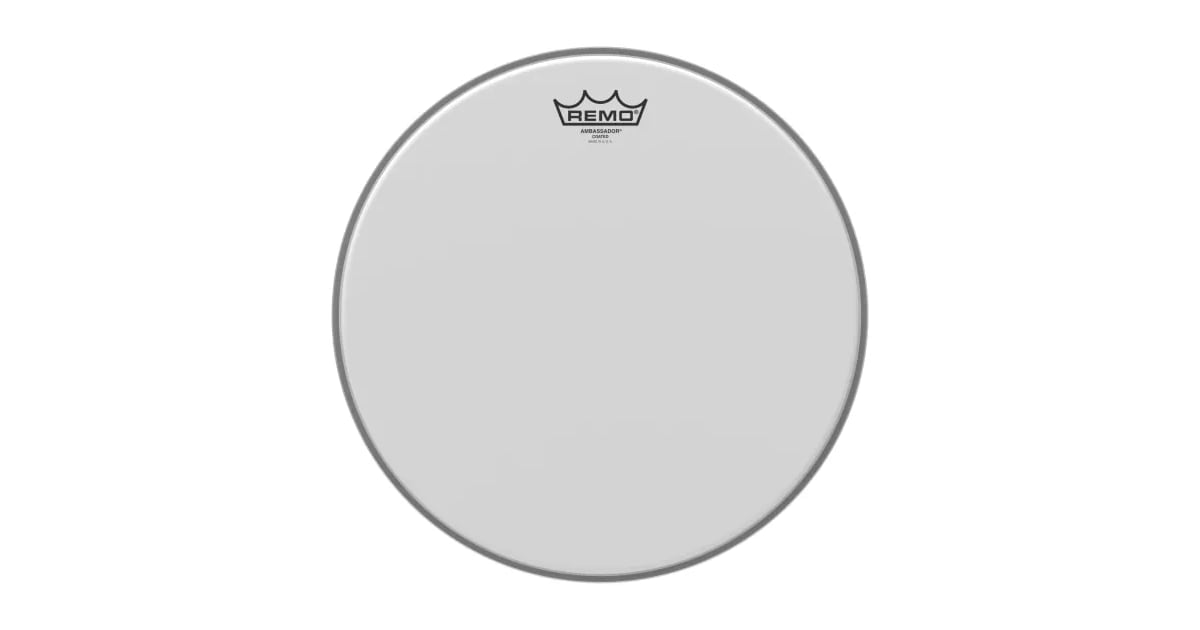
If there is one drum head every drummer should know, it is this one. The Remo Ambassador Coated has been on snare drums since before most of us were born, and Remo calls it the most popular drumhead in the world.
Our Rig Vault has it on Ringo’s kit and Chad Smith’s. It is what most shops reach for when you ask for “a normal snare head”. It is, in a very real sense, what a snare drum is supposed to sound like.
So what actually is it, why has it lasted, and is it the right head for you? Let’s find out.
What is the Remo Ambassador Coated?
The Ambassador Coated is a single ply of 10-mil polyester film with Remo’s white sprayed coating on top. A mil is a thousandth of an inch, so the film is about a quarter of a millimetre thick.
That is the whole recipe. No rings, no dots, no second ply. Remo describes it as a combination of warm, open tones with bright attack and controlled sustain, and lists it for snare, tom and bass drum batters.
The part number is BA-0114-00, and it comes in every size you could want, from tiny auxiliary snares up to bass drums.
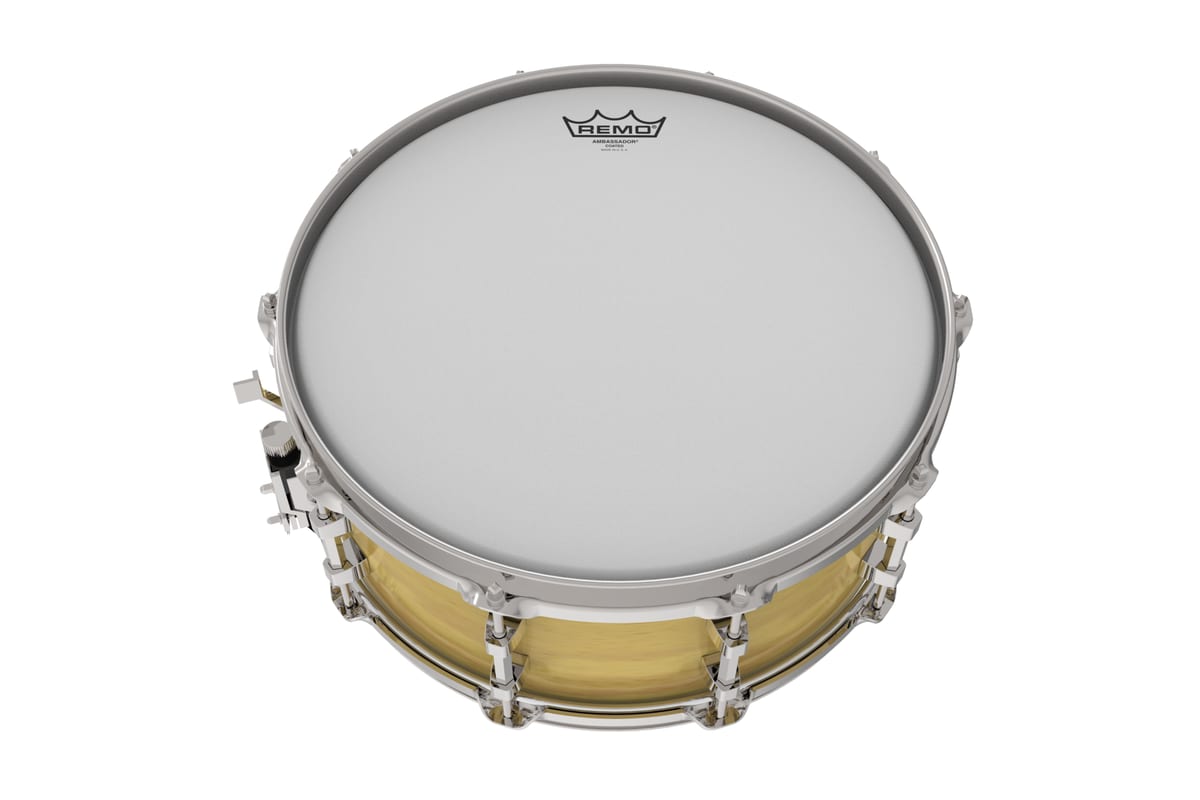
Where did the Ambassador come from?
Remo started in 1957 with the WeatherKing, the first commercially successful plastic drum head. The first Ambassador, in 1958, was actually a two-ply head: a 7.5-mil and a 3-mil film together.
In 1959 Remo replaced it with the 10-mil single ply we know today. The weight has not changed since. Think about that for a second: a drum product that has stayed the same for more than sixty-five years because nobody has found a better default.
There is more on the company in our Remo drum heads guide.
How does it sound?
So how does it sound? In a word: open.
A single ply lets the drum vibrate freely, so you hear the shell, the bearing edges and the snare wires. Ghost notes are clear. Rolls are smooth. Rimshots ring out with plenty of overtone.
The coating takes a little edge off the top end compared with a clear head and adds a bit of warmth. It also gives brushes something to grip. Without a coating, brushes barely make a sound.
On a snare, the Ambassador is the sound of the sixties and seventies records you know, and plenty of modern ones too. Tuned high, it cracks. Tuned low, it fattens up, though it can get a bit floppy if you go too slack.
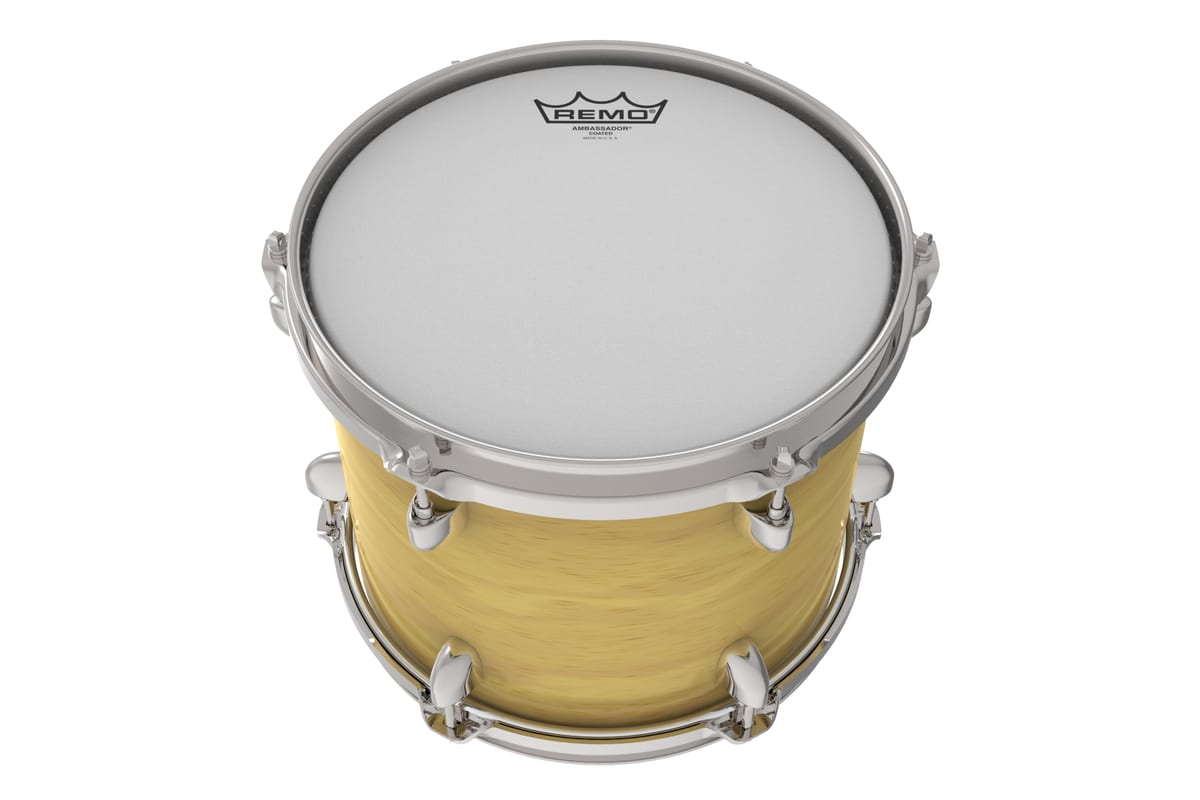
On toms, coated Ambassadors are warm, round and long. They sing. If you play jazz, or anything where the toms are meant to have a note, they are lovely. If you want short, punchy rock toms, they will probably ring more than you want.
Who is the Ambassador Coated for?
Most drummers, honestly. It is a safe first choice on a snare for:
- Beginners re-heading a first kit. It sounds right, it is cheap, and it teaches you what a snare is meant to do.
- Jazz, funk, soul and pop players who need dynamics and ghost notes.
- Brush players. The coating matters.
- Anyone who likes an open, lively drum and does not mind a bit of ring, or controls it with a little gel.
Our Rig Vault lists the Coated Ambassador on rigs from Ringo Starr and Chad Smith to Neil Peart, Phil Collins and Zak Starkey. That is a fair spread of styles.
Who should buy something else?
There is one big thing to mention. The Ambassador is a 10-mil single ply, and it is not the toughest head in the world.
If you hit hard, play rimshots on every backbeat or use heavy sticks, you will dent the centre and wear through the coating. Some players get months out of one; others get weeks.
If that is you, the alternatives are:
- Ambassador X (12-mil) or X14 (14-mil). The same film, 20% and 40% thicker, for more durability with a similar character.
- Controlled Sound Coated Black Dot. A 10-mil ply with a 5-mil dot underneath. Sensitive edges, tougher and more focused centre.
- Coated Emperor. Two 7-mil plies. Fatter, softer, longer-lasting.
- Emperor X. Two 10-mil plies and a black dot. Remo calls it the world’s most durable snare head.
And if your snare rings too much and it annoys you, a Powerstroke P3 or Powerstroke 77 builds the control in.
Ambassador Coated vs Ambassador Vintage
The Ambassador Vintage is worth a look if you love the Ambassador but want something a bit warmer. It combines a 7.5-mil and a 3-mil film into a two-ply head, a nod back to the original 1958 Ambassador.
Remo sums it up as Diplomat feel, Emperor tone and Ambassador durability. In practice that means a softer, more focused midrange with good sensitivity. It is lovely on vintage drums and on toms.
What about vintage drums?
There is one more variant to know about. Drums made before the mid-1960s were often a little oversized and not perfectly round, especially with thick wraps.
The Ambassador Classic Fit has a slightly narrower flesh hoop and a step design to fit them. If a modern head will not sit on your old Ludwig or Slingerland, this is why, and this is the fix.
Ambassador Coated vs Evans G1 and UV1
The closest Evans equivalent is the G1 Coated, which is also a single ply of 10-mil coated film. The two are near-twins. Evans fits its heads with a steeper Level 360 collar, which is designed to seat the head flatter on the drum and make tuning a little easier.
Evans also makes the UV1, another 10-mil single ply with a UV-cured coating that is designed to last longer than a sprayed one. If coating wear is your main complaint with Ambassadors, it is worth a try. See our Evans UV1 guide.
Honestly, all three sound more like each other than unlike. Our best drum head brands guide goes through the wider Remo vs Evans vs Aquarian question.
How do you tune an Ambassador Coated?
A few tips to get the best from it:
- Seat it first. Tune it up a bit higher than you want, press firmly in the middle with your palm, then back off.
- Tune evenly. Small turns, lug by lug, across the drum. Even tension is what makes a single ply sound clean.
- Match the resonant head. On a snare, an Ambassador Hazy Snare Side underneath is the standard pairing.
- Use a tuner if you like. Our free drum tuner helps, and the best drum tuners guide covers the gadgets.
A little gel or a Muff’l ring is fine if it rings too long. Taping a towel to it is a sixties trick. It works, but it is a bit Ringo.
How much is a Remo Ambassador Coated?
It is one of the cheapest upgrades in drumming. At the time of writing a 14” Ambassador Coated costs around £15–£20 in the UK and around $15–$22 in the US. Smaller sizes cost less; bass drum sizes cost more.
Where can I buy one?
The right shop depends on where you are: Guitar Center in the Americas, Gear4music in the UK, or Thomann for Europe and the rest of the world.
Final thoughts
The Remo Ambassador Coated is not exciting. It does not have a dot, a ring or a clever name. It is just the head that makes a snare drum sound like a snare drum, and has done for more than six decades.
The only real downside is durability if you hit hard. If that is you, there is an Ambassador X, a Black Dot or an Emperor waiting. Everyone else: buy one, tune it, and enjoy your snare again.
For the rest of the range, read our Remo drum heads guide, or head to the Remo heads hub to see who plays what.
Remo Ambassador Coated FAQs
- How thick is a Remo Ambassador Coated?
- It is a single ply of 10-mil film, which is a quarter of a millimetre. The Ambassador X is 12-mil and the Ambassador X14 is 14-mil, for players who want the same sound with more durability.
- Is the Ambassador Coated good for snare drums?
- It is the reference snare head. It is open and sensitive, ghost notes speak clearly, and brushes work well on the coating. If you hit very hard and dent it quickly, step up to a Controlled Sound Black Dot or an Emperor.
- Should I use Ambassador or Emperor on toms?
- Ambassadors give a more open, resonant, singing tom. Emperors give a fatter, shorter, punchier tom and last longer. Jazz and lighter players tend to prefer Ambassadors; rock players tend to prefer Emperors.
- What is the Evans equivalent of a Remo Ambassador Coated?
- The Evans G1 Coated is the closest match: also a single 10-mil ply with a coating. The Evans UV1 is the same weight with a tougher UV-cured coating. See our Evans UV1 guide.
- How often should I change my Ambassador snare head?
- When the coating has worn through where you hit, the head has dents, or the drum will not hold its tuning. Gigging drummers often change a snare batter every couple of months; home players might go a year.
Keep reading
All Our Buying Guides
Best drum head brands (2026) | Remo vs Evans
Remo, Evans or Aquarian? The best drum head brands in 2026 compared, with the heads to buy for your snare, toms and bass drum, plus Code and Attack.
Evans Heads
Evans drum heads | Every series (2026)
Evans drum heads explained: G1, G2, EC2, UV1, Genera, Hydraulic, Onyx, Calftone and the EMAD and EQ kick heads, and which to buy for each drum.
Evans Heads
Evans EMAD | Bass drum control, your way
The Evans EMAD bass drum head explained: how the swappable foam rings work, EMAD vs EMAD2 vs Heavyweight, the Powerstroke P3 rival, and who it suits.