Tama Speed Cobra 910 | Pedal guide (2026)
The Tama Speed Cobra 910 explained: the long footboard, LiteSprocket and Recessed Setting, how it differs from the Iron Cobra, and the cheaper 310.
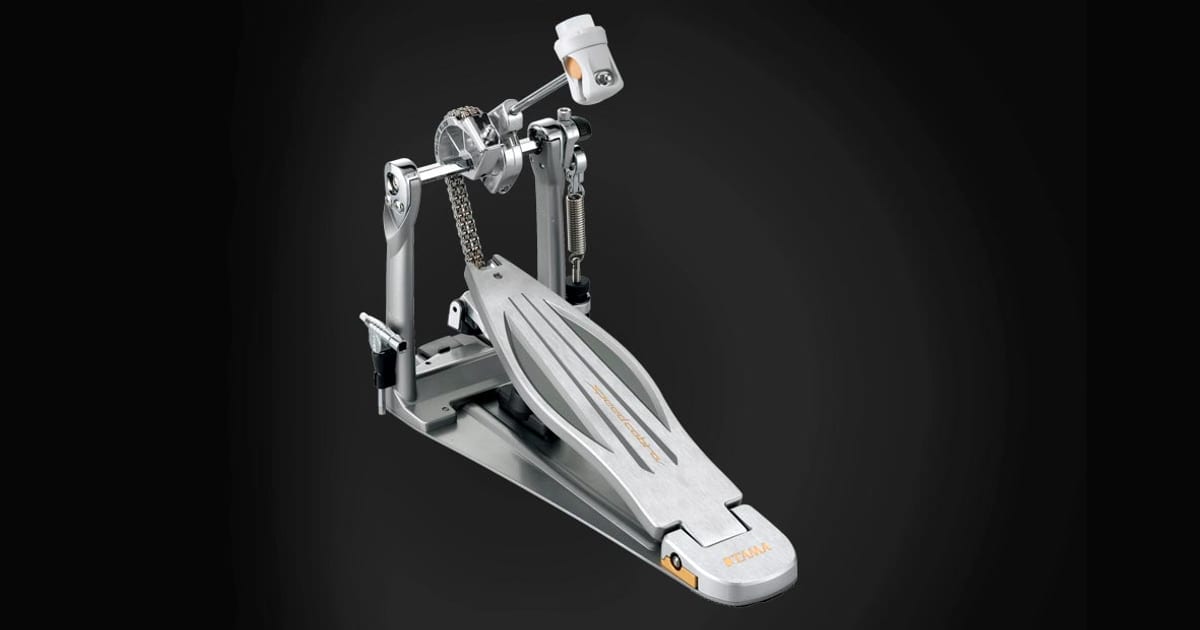
Some pedals are built to do everything. The Tama Speed Cobra is built to do one thing very well: go fast.
It is the Iron Cobra’s quicker sibling, with a longer footboard, a lighter round cam and a clever bit of geometry under the heel. You will find it under a huge number of metal drummers’ feet, but plenty of rock and gospel players swear by it too.
So what exactly makes the Speed Cobra 910 tick, how does it differ from the Iron Cobra, and is the cheaper 310 worth a look? Let’s find out.
What is the Tama Speed Cobra?
The Speed Cobra is a double-chain bass drum pedal from Tama. The first-generation Speed Cobra appeared around 2010, by most accounts, and Tama revamped it as the Speed Cobra 910 at Winter NAMM 2016. That is the version you buy today.
Tama’s own tagline for it is “Unprecedented Velocity. Serious Power. Minimum Work.” Marketing, sure, but it tells you what the pedal is for.
There are three versions of the 910:
- HP910LN, the single pedal
- HP910LWN, the twin (double) pedal
- HP910LWLN, the left-footed twin
All of them come with a hard carrying case.
What makes the Speed Cobra fast?
Three things do most of the work.
The long footboard
The Speed Cobra’s footboard is longer than the Iron Cobra’s. A longer board gives you more leverage, so the beater moves faster for the same effort. It also gives you more room to move your foot up and down the board, which is why it suits heel-toe and slide techniques so well.
Tama also smoothed the playing surface to reduce friction between your shoe and the board.
The Rolling Glide LiteSprocket
The sprocket (the cam the chain wraps around) is perfectly round and, according to Tama, 40% lighter than the old Iron Cobra cam. A round cam gives you an even, linear feel through the whole stroke, with no sudden acceleration at the end. Less weight means it gets moving quicker.
The Recessed Setting
This is the clever bit. Tama moved the footboard’s position relative to the sprocket so the angle between your foot’s push and the chain’s pull is wider.
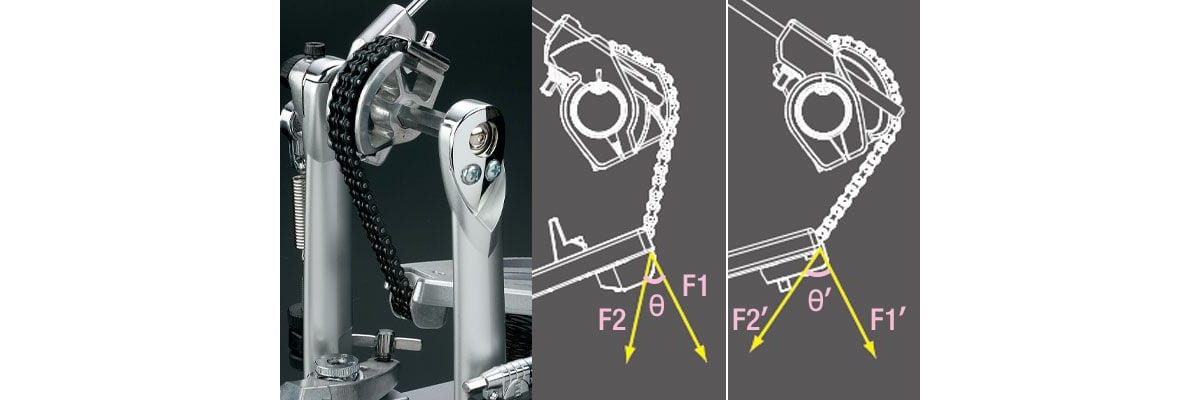
The physics is simple enough. The wider the angle, the less force you need on the footboard to get the same pull on the chain. Tama says the result is about 20% less effort for the same power and feel. We have not measured it, but the light action is the first thing everyone mentions when they try one.
What else do you get on the Speed Cobra 910?
The 910 is loaded with Tama’s best pedal features. The main ones are:
- Super Stabilizer Design. The frame is wider than the old Cobra: the shaft supports are 15mm wider and the under-plate about 12mm wider. That cuts side-to-side sway when you are digging in.
- Swivel Spring Tight. The base of the spring swivels so it always pulls in a straight line, which Tama says makes the action smoother.
- Speedo-Ring. A rocker cam with a built-in ball bearing, in place of a nylon one.
- Oiles bearing hinge. A low-friction hinge bearing that also stops the footboard wobbling side to side.
- Hinge Guard Block. A two-piece hinge construction that holds the bearing more evenly.
- Vari-Pitch beater holder. Lets you set the beater angle independently of the footboard angle.
- Cobra Coil. A steel spring under the footboard that helps push it back up, and can be moved forwards or backwards to change the feel.
- Super Spring. A main spring that needs less effort at the start of the stroke.
- Para-Clamp II Pro. A hoop clamp with a three-dimensional rubber grip that holds onto almost any bass drum hoop.
- Accu-Strike Cobra beater. A butadiene rubber beater for a strong, articulate attack.
In short, it is a lot of pedal. The upside is that you can tune the feel almost any way you like. The downside is that there is a lot to fiddle with, and some drummers spend more time adjusting than playing.
How does the Speed Cobra compare with the Iron Cobra?
This is the question everyone asks, and the honest answer is that it comes down to feel.
| Speed Cobra 910 | Iron Cobra 900 | |
|---|---|---|
| Footboard | Long | Standard length |
| Cam | Round Rolling Glide LiteSprocket | Power Glide (offset) or Rolling Glide (round) |
| Geometry | Recessed Setting | Standard |
| Feel | Light, quick, even | More planted and punchy (Power Glide) |
| Best for | Speed, double bass, heel-toe | All-rounder |
The Iron Cobra Power Glide has an offset cam that speeds the beater up towards the end of the stroke. It feels powerful and a bit “heavier” under the foot. The Speed Cobra feels lighter and more even, and the long board makes it easier to play fast for long stretches.
If you play a lot of fast double bass, go Speed Cobra. If you want one pedal for everything, or you like to feel the pedal pushing back, try an Iron Cobra first. Mike Portnoy’s rig is a good example of a career spent on Iron Cobras.
What about the Speed Cobra 310?
The Speed Cobra 310 takes the same design principles and builds them to a lower price.
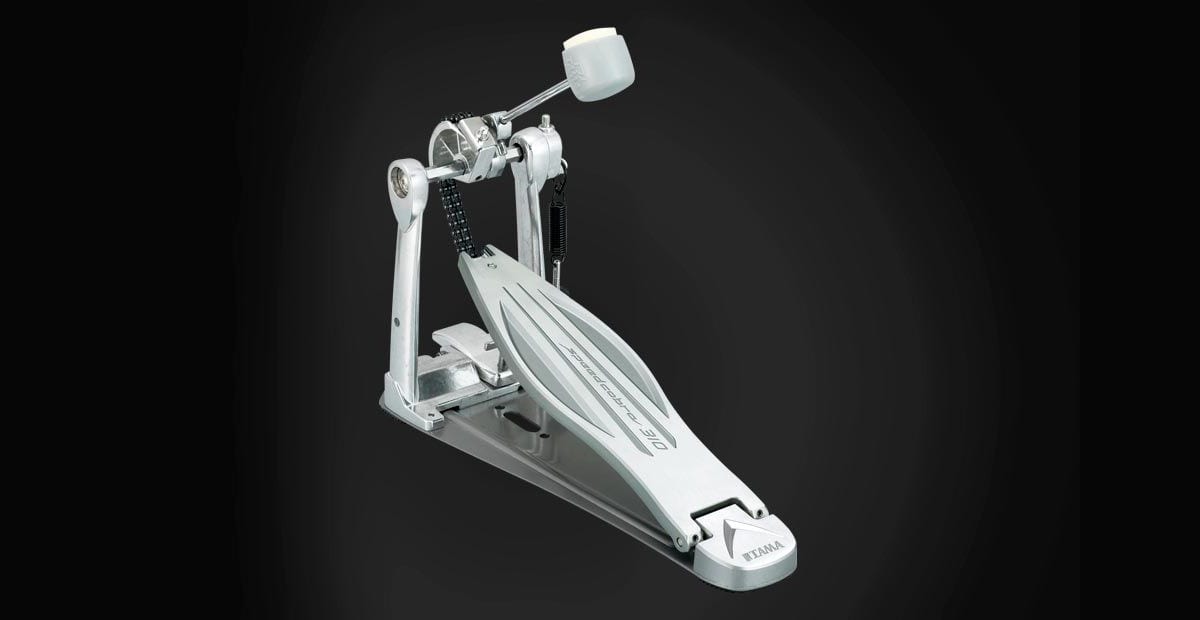
You keep:
- The long footboard
- The Recessed Setting
- A round LiteSprocket, again 40% lighter than the Iron Cobra’s
- A double chain drive
- A new hinge with a brass sleeve protecting the hinge pin
- Beater angle adjustment, although on the 310 it is linked to the footboard angle
What Tama does not list on the 310 is the 910’s premium kit: the Oiles bearing hinge, Speedo-Ring, Cobra Coil, Swivel Spring Tight, Para-Clamp II Pro and the hard case.
It comes as the HP310L single and HP310LW twin. For a beginner or a drummer on a budget who wants the Speed Cobra feel, it is a great buy. Lars Ulrich’s M72 setup in the Rig Vault lists a Speed Cobra 310 double, which tells you the cheaper one is no toy.
Should I buy a chain drive or a direct drive pedal?
If you are shopping for speed, it is worth knowing about the alternative. Direct-drive pedals replace the chain with a solid link, which gives a very immediate, one-to-one feel. Tama makes one, the Dyna-Sync, and Axis is the brand most associated with the idea.
Our guide to direct-drive bass drum pedals covers the pros and cons. For most drummers, a good chain pedal like the Speed Cobra is the safer bet. It feels familiar, it is easier to set up, and it is easier to find spares for.
If you are weighing it up against DW, read our guides to the DW 5000 and the DW 9000.
How much does a Tama Speed Cobra cost?
At the time of writing, the Speed Cobra 910 single pedal is around £215 in the UK and roughly $270 to $290 in the US, with the hard case included. The twin costs considerably more, as twins always do. The Speed Cobra 310 is the cheaper option at both sizes.
Prices move around, so check before you buy.
Where can I buy one?
The Speed Cobra is one of the most popular pedals on the market, so almost every drum shop stocks it.
The right shop depends on where you are: Guitar Center in the Americas, Gear4music in the UK, or Thomann for Europe and the rest of the world.
Pedals are built to last, so a used one is a great way to save money. Check used Speed Cobras on Reverb and make sure the bearings feel smooth before you hand over the cash.
Final thoughts
The Tama Speed Cobra 910 is one of the best pedals you can buy if speed and endurance matter to you. The long board, the light round cam and the Recessed Setting add up to a pedal that feels effortless.
Our honest caveat is that “effortless” is not for everyone. Some drummers find it too light and prefer the punch of an Iron Cobra Power Glide. If you can, try both in a shop before you buy.
For the rest of the range, read our Tama drums guide, and see how Tama stacks up against the rest in our best drum brands guide.
Tama Speed Cobra FAQs
- What is the difference between the Tama Speed Cobra and Iron Cobra?
- The Speed Cobra has a longer footboard, a round Rolling Glide LiteSprocket and a Recessed Setting that changes the angle between the footboard and the chain. Tama says that makes it feel about 20% lighter for the same power. The Iron Cobra has a shorter board and comes with either the offset Power Glide cam or a round Rolling Glide cam, and feels more planted. The Speed Cobra is built for speed; the Iron Cobra is the all-rounder.
- Is the Tama Speed Cobra good for metal?
- Yes, it is one of the most popular pedals in metal. The long board suits heel-toe and slide techniques, and the light action makes fast double bass less tiring. Lars Ulrich's M72 rig in the Rig Vault uses Speed Cobra pedals.
- What is the difference between the Speed Cobra 910 and 310?
- The 310 keeps the Speed Cobra's long footboard, Recessed Setting, round LiteSprocket and double chain, but Tama does not list the 910's Oiles bearing hinge, Speedo-Ring, Cobra Coil, Para-Clamp II Pro or hard case on it. Its beater angle is linked to the footboard angle rather than adjusting independently. It is the cheaper way into the Speed Cobra feel.
- How much does a Tama Speed Cobra cost?
- At the time of writing, a Speed Cobra 910 single pedal is around £215 in the UK and roughly $270 to $290 in the US, with a hard case included. The twin pedal costs considerably more, and the Speed Cobra 310 is the cheaper option.
Keep reading
DW 5000 Series
DW 5000 pedal | The industry standard (2026)
The DW 5000 pedal explained: Accelerator vs Turbo vs single chain, XF and double versions, prices, and how it compares with the 3000, 9000 and MDD.
Head to Head
Axis A21 vs DW 9000 | Direct drive or chain?
The direct-drive benchmark against the chain-drive default: footboard, cam, feel at speed, servicing, availability and price, with a verdict on every row.

Hardware
Pearl Curved Boom Arm Stand | Worth it in 2026?
Pearl's curved Boomerang boom stand launched in 2021. Here is what it does, what it costs in 2026 and whether a curved arm belongs on your kit.