Tama drums | Every series explained (2026)
Tama drums explained: every kit from Club-JAM and Imperialstar to Starclassic and STAR, plus S.L.P. snares and Cobra pedals, and who each one suits.
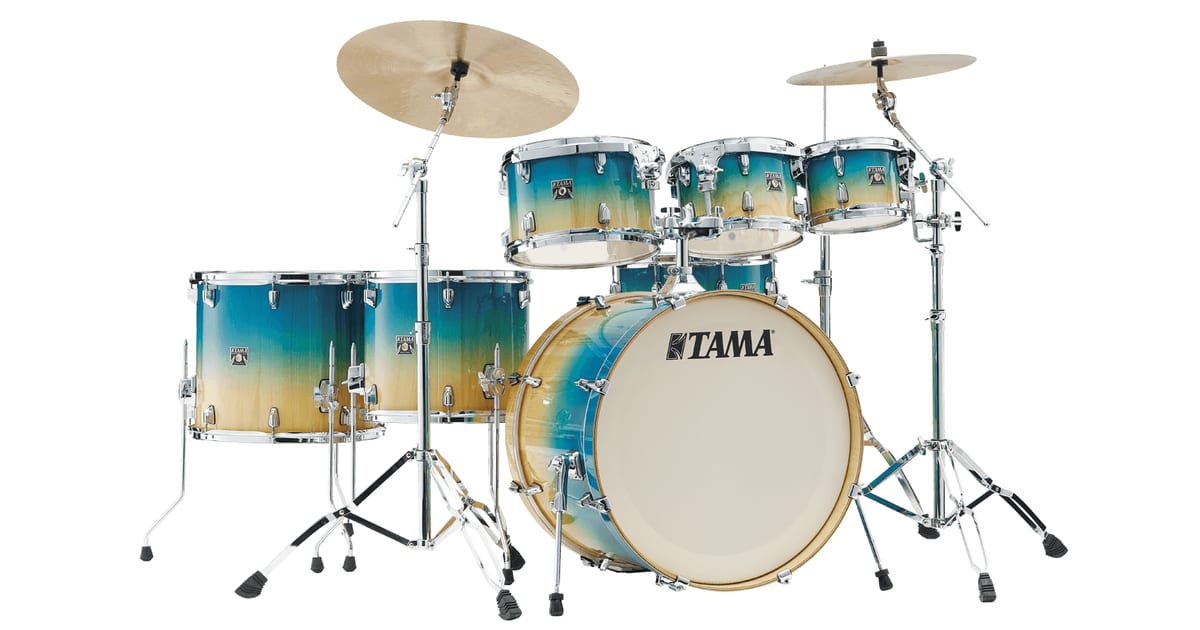
Some drum brands are known for one thing. Tama is known for about four.
There is the Imperialstar, the kit half the world’s drum teachers seem to own. There is the Starclassic, which helped kick off the thin-shell craze in the nineties. There are the Iron Cobra and Speed Cobra pedals, which are under the feet of more metal drummers than we could count. And there is the S.L.P. snare range, which is quietly one of the best-value lines of snares going.
So what does Tama make in 2026, what does each series cost, and which one is right for you? Let’s find out.
Who are Tama?
Tama is the drum brand of Hoshino Gakki, the Japanese company that also owns Ibanez guitars.
Hoshino started making drums in the 1960s under the name Star Drums. The Tama name arrived in 1974, and it comes from Tama Hoshino, the founder’s wife. “Star” never really went away, though. Look down the current line-up and you will find Imperialstar, Stagestar, Superstar Classic, Starclassic and STAR.
Today Tama’s professional drums are developed and built at its factory in Seto, Japan. The more affordable kits and most of the hardware are made in China, which is how Tama keeps an Imperialstar at a beginner’s price.
Tama made its name in the late seventies and eighties with big, powerful kits and heavy-duty hardware, and that reputation has stuck. It is still a go-to brand for rock and metal players. Lars Ulrich’s M72 rig is a Tama Starclassic Maple kit on Speed Cobra pedals, and Mike Portnoy played Iron Cobras for years.
What is the full Tama drum kit line-up?
Here is the current range from the bottom up, as listed on Tama’s US site at the time of writing. Prices are rough and move around, so treat them as a guide.
| Series | Shells | Who it is for | Rough price |
|---|---|---|---|
| Stagestar | Poplar | First kit, tight budget | Around $600 to $750 complete |
| Club-JAM | Poplar | Small gigs, compact setups | Around $600 to $700 shell kit |
| Imperialstar | 6-ply poplar | Beginners who will stick with it | £750 to £1,000 / $900 to $1,000 complete |
| Superstar Classic | 100% maple | First “proper” maple kit | Around $1,050 five-piece shell kit |
| Starclassic Performer | Maple/birch hybrid | Entry pro | Around £1,550 / $1,900 five-piece |
| Starclassic Walnut/Birch | Walnut/birch hybrid | Pro | Between the Performer and the Maple |
| Starclassic Maple | Thin maple | Pro | Around $3,000 and up |
| STAR | Maple, walnut or bubinga | Flagship, made in Japan | More again, often built to order |
Those are US street prices at the time of writing. UK prices are in a similar ballpark, so shop around.
Stagestar
Tama’s cheapest complete kit. You get poplar shells, a double tom holder, a pedal, stands, a throne and a set of 14” hi-hats and a 16” crash/ride in the box.
It is a first kit, plain and simple. It will get you playing, but you will outgrow it faster than an Imperialstar.
Club-JAM
The Club-JAM is the odd one out, and we love it. It is a compact, vintage-flavoured kit with a cymbal holder mounted straight onto the bass drum shell, curved spurs and a wooden bass drum hoop.
The shells are poplar: 9-ply on the wrapped versions, and 7-ply poplar with a decorative outer ply on the lacquered ones. There are Mini and Pancake versions too, plus the even smaller Cocktail-JAM. If you play coffee shops, jazz brunches or anywhere with a small stage, have a look.
Imperialstar
The Imperialstar is Tama’s big beginner seller and the kit it pits against the Pearl Export. It is a 100% poplar, 8mm, 6-ply shell with Tama’s Accu-Tune hoops and a full hardware pack.
The headline for beginners is the cymbals. Every complete Imperialstar ships with a Meinl HCS set, which are better than most cymbals bundled at this price. We have a full Tama Imperialstar guide, and if you are cross-shopping, read Pearl Export vs Tama Imperialstar.
Superstar Classic
This is where the shells turn to maple. The Superstar name goes back to the seventies, and the Superstar Classic leans into that with Tama’s old T-shaped badge and small, low-mass single lugs.
The toms and snare are 5mm, 6-ply maple, and the bass drums are 7mm, 8-ply. The exotic versions swap the outer two plies for lacebark pine, which has a lovely busy grain. Tama mounts the toms on its Star-Mount system rather than drilling a bracket through the shell.
For a first all-maple kit, it is excellent value. It is also the kit most people compare with the Yamaha Stage Custom, so we put the two head to head.
Starclassic Performer
The Performer is Tama’s entry point to the Starclassic family. It has a 6mm hybrid shell of four birch plies and two inner maple plies on the toms (7mm on the bass drum), die-cast hoops and Tama’s Star-Cast mounting system.
In plain English, it has the attack of birch with a bit of maple warmth underneath. We have a full Starclassic Performer guide.
Starclassic Walnut/Birch
The step up. Tama swaps the maple inner plies for American black walnut: 6mm toms with four birch plies and two walnut, and an 8mm bass drum. Walnut adds low-mid warmth, so it sounds punchy but a little sweeter than the Performer.
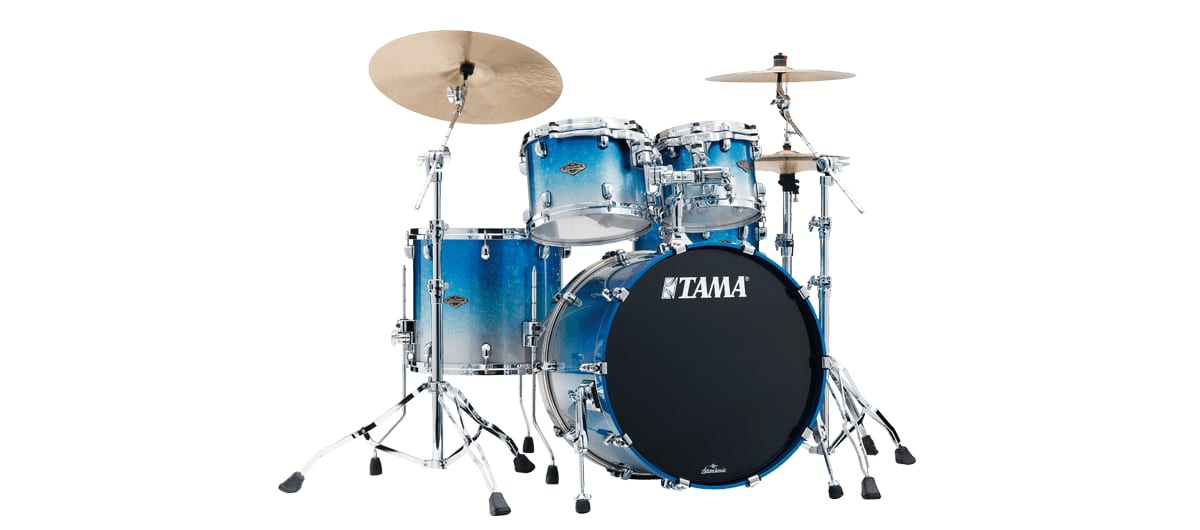
Starclassic Maple
The kit that, in Tama’s own words, “ignited the thin-shell revolution”. Starclassic has been around since 1994, and the Maple version is still the classic big-rock Tama sound.
The trick is thin plies. Rather than using fewer plies, Tama slims each one down and cross-laminates them into a 6-ply, 5mm tom shell and an 8-ply, 7mm bass drum. The result is thin enough to resonate freely but still strong. There are more than 30 shell sizes, three hardware finishes (chrome, black nickel and smoked black nickel) and a range of exotic outer plies.
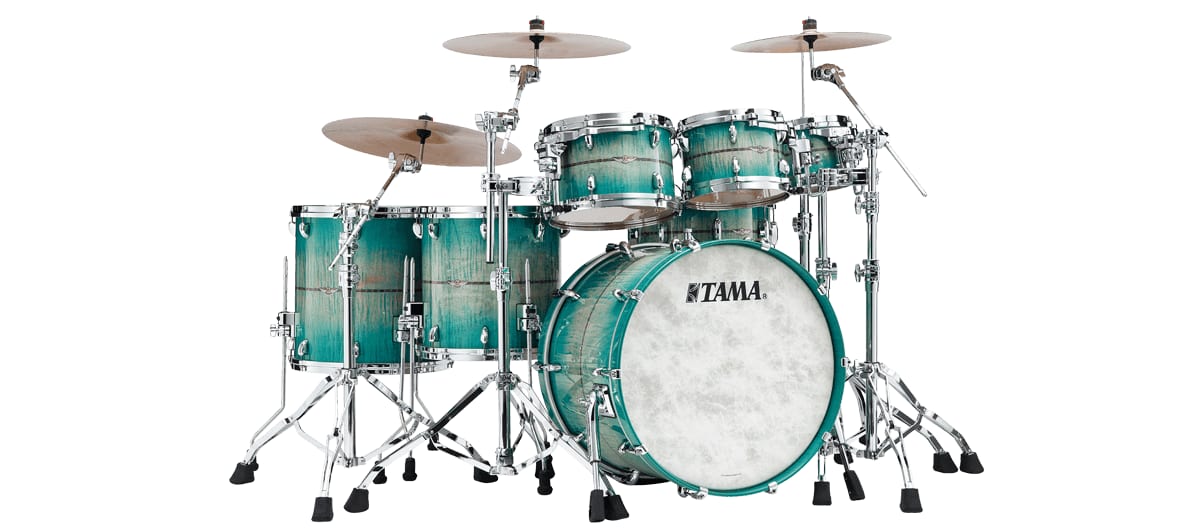
STAR
STAR is the flagship. It comes in three woods:
- STAR Maple, with a 2mm solid core ply sandwiched between two 1.5mm plies. The idea is the open sound of maple with some of the body of a solid shell.
- STAR Walnut, which Tama describes as “naturally EQ’d”: booming low mids and crisp highs.
- STAR Bubinga, a much thinner shell than the old Starclassic Bubinga, with 9mm Sound Focus Rings for support.
The bearing edges and shell interiors are hand finished with oil, the bass drums get wooden hoops, and every shell has a centre wood inlay unless you ask for it without. These are serious, expensive drums. Nice.
Which Tama snare drum should I buy?
Tama’s snare range is bigger than most brands’ entire catalogues. The main families are:
- S.L.P. (Sound Lab Project). The best-value line, with a different wood or metal for every flavour. Our Tama S.L.P. guide covers the full range.
- Woodworks and Metalworks. Affordable wood and steel snares, ideal as a first upgrade.
- Starphonic. Tama’s pro-level snare line, a step up from the S.L.P.
- Starclassic, STAR and STAR Reserve snares. The top-end wood drums, made to match the kits.
- Signature snares. Artist models, including the Peter Erskine and Anika Nilles snares.
If you are on a budget, start with an S.L.P. It is where Tama hides some of its best ideas.
What about Tama pedals and hardware?
For a lot of drummers, Tama means pedals.
Iron Cobra
The Iron Cobra is the pedal Tama built its hardware reputation on. The current 900 Series comes in Power Glide (an offset cam that speeds up the beater towards the end of the stroke) and Rolling Glide (a round cam with a more even feel). The 600 and 200 Series bring the design down to more affordable prices.
Speed Cobra
The Speed Cobra is the Iron Cobra’s quicker sibling, with a longer footboard and a round LiteSprocket. It is the metal and fast double-bass favourite, and it gets its own guide: Tama Speed Cobra. There is a cheaper Speed Cobra 310 too.
Dyna-Sync
Dyna-Sync is Tama’s direct-drive pedal. Instead of a chain or strap it uses a solid double linkage, with a cam you can slide to change the feel. If you are curious about direct drive, our direct-drive pedal guide explains the pros and cons, and Axis is the other big name to try.
Stands and racks
Tama’s stands come in several tiers, from lightweight and affordable up to the heavy-duty stands touring drummers bolt together night after night. Then there is the Power Tower rack system, and the newer Spartan hardware for players who want something lighter.
How do I choose the right Tama kit?
Here is the short version.
- First kit, small budget: Stagestar.
- First kit, and you know you will keep going: Imperialstar.
- Small venues and tiny rooms: Club-JAM.
- Your first maple kit: Superstar Classic.
- Pro features for a sensible price: Starclassic Performer.
- The classic big Tama sound: Starclassic Maple.
- Money no object: STAR.
If you are torn between Tama and another brand at the same price, our best drum brands guide lines them all up. And our Gear Guru will happily argue it through with you.
Is Tama a good brand?
Yes, and its reputation is earned. Tama’s strengths are build quality, tough hardware and kits that feel well thought out at every price.
There is one thing to mention. Tama’s catalogue changes by region, so a kit or finish on the Japanese or US site might not be sold in the UK, and vice versa. Always check with a local dealer before you set your heart on a particular finish.
Tama also has a habit of limited editions. Our round-up of Tama’s 2026 new finishes and limited editions is worth a look before you buy.
Where can I buy Tama drums?
Most big music shops stock Tama, from the Imperialstar up to the Starclassic range. STAR kits are usually ordered through a specialist drum shop.
The right shop depends on where you are: Guitar Center in the Americas, Gear4music in the UK, or Thomann for Europe and the rest of the world.
Tama kits also hold their value well, so the used market is worth a look. Check used Tama drums on Reverb and the Reverb price guide before you buy new.
Final thoughts
Tama is one of the few brands that is genuinely good at every price. The Imperialstar is a brilliant first kit, the Superstar Classic is a bargain maple kit, and the Starclassic and STAR ranges sit with the best drums in the world.
Our honest caveat is that the sheer number of series, snares and pedals can be overwhelming. Start with your budget, pick the series from the list above, and go and hear one in a shop if you can.
For everything Tama in one place, visit our Tama drums hub.
Tama drums FAQs
- Are Tama drums good?
- Yes. Tama is one of the big Japanese drum makers alongside Yamaha and Pearl, and its kits run from affordable complete packages like the Imperialstar to the hand-finished STAR flagship. Its Iron Cobra and Speed Cobra pedals are among the most played in the world. See our best drum brands guide for how Tama compares.
- Where are Tama drums made?
- Tama is the drum brand of Hoshino Gakki, based in Nagoya, Japan. Its professional drums are developed and built at the company's factory in Seto, Japan, while the more affordable kits and most of the hardware are made in China. Check the individual series if it matters to you.
- What is the difference between Tama Starclassic and STAR?
- STAR is the flagship above Starclassic. Starclassic covers Maple, Walnut/Birch and the Maple/Birch Performer, with thin shells and die-cast or Mighty hoops. STAR goes further, with thinner shells built around Sound Focus Rings, a solid core ply on the Maple version, oil-finished interiors and wooden bass drum hoops. It costs a good deal more.
- Which Tama drum kit is best for beginners?
- The Stagestar is Tama's cheapest complete kit, and the Imperialstar is the one we recommend if you know you will stick with drumming. It comes with Meinl HCS cymbals, a throne and a full set of stands, so you can play the day it arrives.
- What does Tama mean?
- The brand is named after Tama Hoshino, the wife of the company's founder. Hoshino Gakki originally sold its drums as Star Drums, which is why so many Tama series still carry the word Star: Imperialstar, Superstar, Starclassic and STAR.
Keep reading
All Our Buying Guides
Best drum brands (2026) | Every budget ranked
The best drum kit brands in 2026, from Yamaha, Pearl and Tama to Ludwig, DW, Gretsch, Sonor, Mapex and PDP, with the right pick for every budget.
DW Collector's Series
DW Collector's Series | Guide (2026)
DW's Collector's Series explained: the pure woods, SSC shell options, curated Jazz and Santa Monica shells, finishes, prices, and who it is really for.
DW Drums
DW drums | Every series explained (2026)
DW drums explained: Design, Performance, Collector's and DWe kits, the 5000 and 9000 pedals, where they are made, and what Roland owning DW means for you.