Axis A21 vs DW 9000 | Direct drive or chain?
The direct-drive benchmark against the chain-drive default: footboard, cam, feel at speed, servicing, availability and price, with a verdict on every row.
Hear it
Chain against direct drive on the same pedal, back to back — one Yamaha FP9 body, both drives fitted in turn — the only fair way to hear what the linkage does on its own, before you add two different footboards and two different cams on top
These are the two pedals every argument about bass drum pedals ends up being about. The Axis A21 is the machined, aluminium, no-slack pedal that metal drummers made famous. The DW 9000 is the chain pedal that has been the professional default for twenty years.
They cost roughly the same. They are both excellent. And the question people actually ask — is direct drive faster than chain? — turns out to be the least useful question you can ask about them.
So what should you buy? Let’s go row by row.
The short answer
Buy the DW 9000 if you play anything other than fast double kick, if you want a pedal that is right within five minutes of unboxing, and if you would like to be able to buy one this afternoon from any shop in the country. It is the safer purchase by a distance and the reason it is everywhere.
Buy the Axis A21 if you spend your playing life at speed, if you use heel-toe or swivel technique, or if you are the kind of player who enjoys dialling a pedal in over a month rather than an evening.
If you are reading this because you want to play faster, buy neither yet. A pedal will not do that. The tempo trainer is free and it is the thing that actually moves the number.
| Spec | Axis A21 Longboardsingle pedal | DW 9000single pedal | Our take |
|---|---|---|---|
| Price band | UK: £380–£460 US: $375–$430 EU: €430–€520 | UK: £330–£400 US: $400–$450 EU: €380–€450 | Street prices, new, at the time of writing. They move; the links below are live. |
| Drive | Direct: a machined aluminium linkage from board to beater shaft | Chain, with a nylon strap in the box as an alternative | The headline difference, and the smallest one on this table. Direct drive has no slack; the chain takes up its tension through the stroke. |
| Footboard | ✓Full-length longboard, flat, no heel wedge | Standard board with a heel plate; the XF model is the longboard version | A flat longboard is what heel-toe and swivel technique want. On the DW you pay extra to get one. |
| Cam and ratio | A21 cam: adjustable ratio, beater set at 21 degrees for a shorter throw | Infinitely adjustable cam, anywhere between accelerator and turbo | Both let you change the geometry rather than just the spring. Different routes, same freedom. |
| Spring | Microtune tensioner, adjusted with a key in small increments | Floating swivel spring mounted inside the frame, linked straight to the cam | The Axis is the finer adjustment; the DW is the smoother return. Neither is a reason to choose. |
| Feel at speed | ✓Instant, light, unforgiving — the beater goes where your foot goes | Fast, but the power arrives at the end of the stroke | The one row the Axis wins outright. Doubles and triples at high tempo are simply easier on it. |
| Feel at low volume | Takes practice; quiet strokes need deliberate control | ✓Forgiving, with a natural rebound that flatters soft playing | The DW is the better pedal for ghosted kick notes and anything with dynamics in it. |
| Hoop clamp | Standard clamp, effective | ✓Tri-Pivot toe clamp, three padded contact points | DW’s clamp is the kindest thing on the market to a bass drum hoop. It matters more than it sounds. |
| Out of the box | Needs setting up before it feels right | ✓Playable and sensible at the factory settings | Switch from a chain pedal to an Axis and your first hour will be strange. That is normal, not a fault. |
| Build and servicing | ✓Machined aluminium, ball bearings throughout, fully rebuildable from parts | Very well made, but not a pedal you take apart | An Axis is a machine you can keep alive indefinitely. That is a real argument for the money. |
| Buying one | Direct from the maker in the US; patchy stock in the UK and Europe | ✓In stock in essentially every drum shop on earth | Availability is the quiet reason most people end up on a DW. |
| Resale | Holds value well, but sells to a narrower crowd | ✓Sells in a weekend, anywhere | Both keep their money. Only one of them keeps it quickly. |
| Where to buy | Guitar Center 🇺🇸Gear4music 🇬🇧Thomann 🇪🇺Reverb · used | Guitar Center 🇺🇸Gear4music 🇬🇧Thomann 🇪🇺Reverb · used | Affiliate links to the shop for your region; buying through them costs you nothing extra. |
| Rows won | 3 of 11 | 5 of 11 | A count, not a verdict: the rows that matter to you are the ones to weigh. |
✓ marks the row's winner. Prices are bands, not quotes: 🇬🇧 UK · 🇺🇸 US · 🇪🇺 EU. Full review: Axis A21 Full review: DW 9000.
What direct drive actually changes
Not speed. Speed is your foot.
What direct drive changes is when the power arrives. On a chain pedal, the chain takes up its tension as the board goes down, so the stroke builds and the power lands at the end of it. On a direct drive pedal there is no take-up at all, so the power has to go in at the beginning. That is why players switching to an Axis spend a fortnight feeling like they have lost their kick foot: the technique that works on a chain pedal is back to front on this one.
Once you have adjusted, the payoff is control at the top end. Nothing lags, nothing catches up, and doubles that were mushy on a chain are separate. If you never play there, you have bought a strange-feeling pedal for no gain.
The demo at the top of this page is the fairest test of that we have found — the same pedal body with both drives fitted in turn, so the only thing changing is the linkage. Listen to it before you read anyone’s opinion, including ours.
And then the argument
Here is the other side of it, at 2026 prices and with the numbers in front of him:
The footboard is the bigger difference
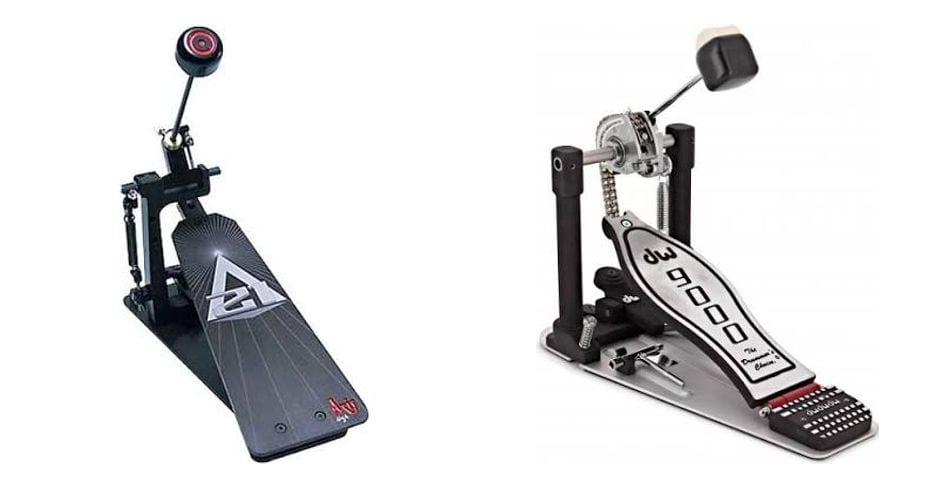
This is the part that gets lost. An Axis A21 is not just a direct drive pedal — it is a flat, full-length longboard with no heel wedge, and that changes where your foot can sit far more than the linkage does. Slide your foot up the board and you get leverage and speed; drop it back and you get power. There is nowhere on a standard DW board to do that, which is exactly why heel-toe players end up on longboards regardless of brand.
DW does make one: the 9000 XF has the extended footboard. If longboard is the thing you want, that is the cheaper way to find out whether you like it, and you keep the chain.
Buying one in the UK and Europe
Worth saying plainly, because the price band above does not tell the whole story. The DW 9000 is stocked everywhere and you can have one tomorrow. Axis sells direct from the US and through a thin scattering of European dealers, so the sticker price is only part of what you pay and a warranty claim is a shipping exercise. Our full Axis guide goes through the cams, boards, springs and beaters, because the pedal is configured rather than simply bought.
If the idea of direct drive appeals but the import does not, the direct drive buying guide covers the ones you can buy locally — Tama’s Dyna-Sync, Pearl’s Demon Drive, Yamaha’s FP9D and DW’s own MDD.
Who should buy which
- Metal, fast double kick, heel-toe or swivel. Axis A21. This is the pedal it was built for.
- Rock, pop, funk, jazz, worship, function bands. DW 9000. Better at everything you actually do.
- Your first serious pedal. DW 9000, without hesitation. Learn on something forgiving.
- You already own a longboard and like it. Axis, or the DW 9000 XF if you want to keep the chain.
- You want one pedal for the next twenty years. Either — but only the Axis can be rebuilt back to new.
- You are buying from outside the US. DW 9000, unless you have a specific reason to import.
Still deciding between drive types rather than brands? Start with the direct drive pedal guide. And whichever you buy, it will not make you faster on its own — how to drum faster is the honest version of that story.
Keep reading

Head to Head
Electronic cymbal pads | Is Roland worth it?
Three ways to add a ride or crash pad to your e-kit, side by side: zones, choke, feel, module compatibility and price — and whether Roland is worth it.

Head to Head
Zildjian L80 vs Sabian Quiet Tone | How quiet?
The three low volume cymbal sets worth buying, side by side: how quiet each one really is, what survives the drop in volume, and which one suits you.

Head to Head
Best 5A drumsticks | Vic Firth vs Promark vs Vater
The three 5As most drummers actually buy, side by side: dimensions, tip, balance, durability, consistency and price per pair — and which one to put in your bag first.