Tomas Haake | Meshuggah's polyrhythm engine
Tomas Haake made djent possible. How Meshuggah's polymetric riffs actually work, what Bleed costs to play, and his Sonor, Sabian and Vic Firth rig.
There is a whole subgenre of metal that exists because somebody sampled Tomas Haake’s drum kit.
There is also a generation of drummers who learned what polymetre means by trying, and failing, to count along to Meshuggah.
He is the most quietly influential metal drummer of the last thirty years, and almost none of it is about speed. Here is what he is actually doing.
Who is Tomas Haake?
Tomas Haake was born on 13 July 1971 in Umeå, Sweden — a northern university town that has produced a startling amount of extreme music.
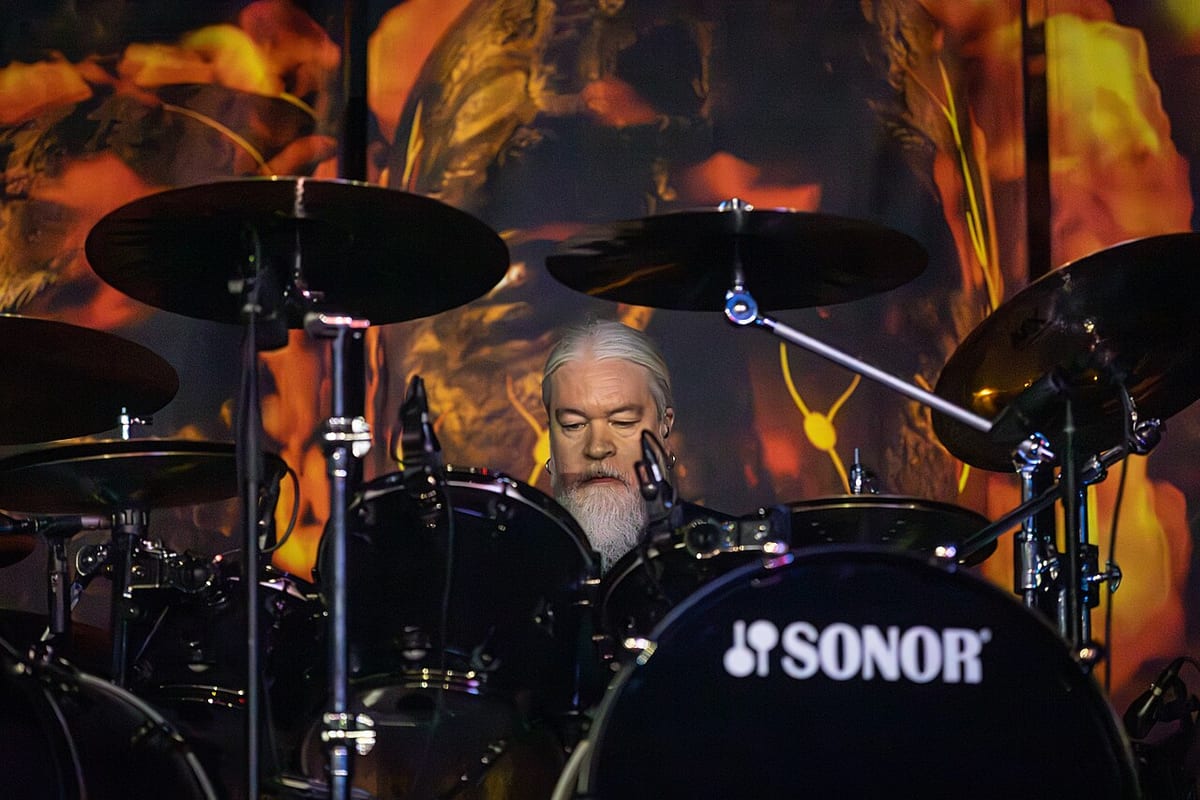
He joined Meshuggah in 1990, and has been there ever since. The catalogue is unusually consistent for a band that has been going that long:
Contradictions Collapse (1991), Destroy Erase Improve (1995), Chaosphere (1998), Nothing (2002), Catch Thirtythree (2005), obZen (2008), Koloss (2012), The Violent Sleep of Reason (2016) and Immutable (2022).
He also does the spoken-word passages on several records, which is an unusual line on a drummer’s CV.
The thing everybody gets wrong
Meshuggah are not “in weird time signatures”. This is the single most common misunderstanding about the band, and Haake is the reason it matters.
Here is what actually happens. The guitars play a riff of some awkward length — 17 beats, say, or 23. Haake plays a steady 4/4 on the hi-hat or ride, with the snare on 2 and 4, while his feet double the guitar riff.
So the riff cycles against the pulse and slowly drifts out of phase, until — after some number of bars — the two line up again and the whole thing resolves with a bang.
That is polymetre, not odd time. And it means that however chaotic the music sounds, there is always a straight backbeat sitting inside it. If you can find the snare, you can headbang to Meshuggah. Millions of people do.
“Bleed”
The other thing Haake is famous for is the drum part on “Bleed”, from obZen.
It is a sustained double-kick figure — sixteenth-note bursts in a repeating pattern, held for the length of the song at a tempo that is merciless. Haake has been open about how physically punishing it is, and about the cramping that came with recording it.
Drummers use it as a benchmark the way runners use a marathon time. Most of them are not close.
Drumkit From Hell
In the early 2000s, Haake’s kit was sampled in full for Toontrack’s Drumkit From Hell, with Haake performing all the material himself.
That library — and its successor, Superior Drummer — became the sound of a whole era of home-recorded metal. If you have heard a self-produced djent record from the last twenty years, you have probably heard Tomas Haake’s actual drums.
It is an odd sort of influence: the man’s tone, not just his playing, is in thousands of records he never touched.
What Tomas Haake actually does
He keeps the pulse while his feet do something else entirely. This is the whole skill, and it is much harder than playing fast.
He plays cleanly at brutal tempos. Every kick note is articulated. Nothing is smeared or buried.
He is a groove drummer. Slow the band down and what is left is a heavy, mid-tempo shuffle feel. He has said as much himself.
He does not solo. In thirty-five years, essentially no drum solos. The parts are the performance.
He uses cymbals sparingly. Chinas and stacks mark structure. Crashes are rationed. In a band this dense, a cymbal wash would ruin everything.
Tomas Haake’s drum kit
A stable rig, endorsed by Sonor, Sabian and Remo.
- The kit — a Sonor SQ2 in Macassar ebony, with twin 22”x18” bass drums, a 12”x11” and 14”x14” rack tom, and 15”x15” and 18”x18” floor toms. All Sonor hardware.
- The snare — a Sonor 14”x6” Artist bronze, with a Remo aramid-fibre custom batter head. That head is a big part of the record sound: it is essentially bulletproof and almost completely dead.
- Cymbals — a wide HHX and AAXtreme setup: 15” HHX Stage hats, 14” HH Rock hats, 19”/20”/21” HHX Stage crashes, 19” and 21” AAXtreme Chinese, a 15” HH crash stacked over a 19” Paragon Chinese, and a 22” Legacy Ride used as a crash.
- Heads — Remo. Clear Emperor tom batters over clear Ambassadors, Powerstroke 4 kick batters and Ebony Powerstroke 3 resonants.
- Sticks — Vic Firth Tomas Haake signature (SHAA).
Every era, with buy links, is on Tomas Haake’s Rig Vault page.
Want the sound without the rig?
Three things get you most of the way, and only one costs money.
Kill the resonance. The Meshuggah drum sound is dry, dead and articulate. A thick two-ply batter and a heavily muffled kick will do more than a new kit will. Our drum head buying guide covers the two-ply options.
Stack a cymbal. A crash sitting on a china gives you the short, ugly, structural accent that his music runs on.
Practise the pulse, not the riff. Put on a metronome at 100bpm, keep straight quarters on the hi-hat and the snare on 2 and 4, and play a 7-note kick pattern underneath it. That is Meshuggah in one exercise, and it will take longer than you expect. The Gear Guru can handle the shopping while you do it.
Where to start listening
- “Bleed” (2008). The benchmark. Watch the feet.
- “Rational Gaze” (2002). The clearest demonstration of polymetre against a straight pulse.
- “Future Breed Machine” (1995). Where it all started to click.
- “Do Not Look Down” (2012). Groove Haake, and proof this is dance music if you squint.
- “The Abysmal Eye” (2022). Thirty-two years in and still nobody else sounds like this.
Final thoughts
Haake’s award — Drumeo’s Louie Bellson Award for Double Bass, in 2024 — is well earned, but it slightly undersells him. The double bass is the tool, not the point.
The point is that he found a way to make music that is genuinely rhythmically complex feel physical. Meshuggah are difficult on paper and obvious in a room, and that translation is entirely his doing.
Thirty-five years in one band, no solos, no showboating, and half of modern metal built on top of his drum sound.
See Tomas Haake’s full rig in the Rig Vault, or read about Danny Carey — the other great polyrhythmic thinker in heavy music.