Tré Cool | Green Day's chaos merchant
Tré Cool has drummed for Green Day since 1990. The punk simplicity, the surf and swing underneath it, Saviors, and his SJC, Ludwig and Zildjian rig.
Ask most people what Tré Cool does and they will say “hits things fast”. Ask a drummer and you get a different answer.
Underneath the pogo-stick tempos and the falling-off-the-riser routine, Green Day’s drummer is a genuinely sophisticated player with a surf-rock right hand and a taste for swing that has no business being in a punk band.
Thirty-six years in, he is still the loudest and most entertaining thing on that stage. Here is what is actually going on.
Who is Tré Cool?
Frank Edwin Wright III was born on 9 December 1972 in Frankfurt, Germany, where his father was stationed, and grew up in Willits, California — a small town in Mendocino County.
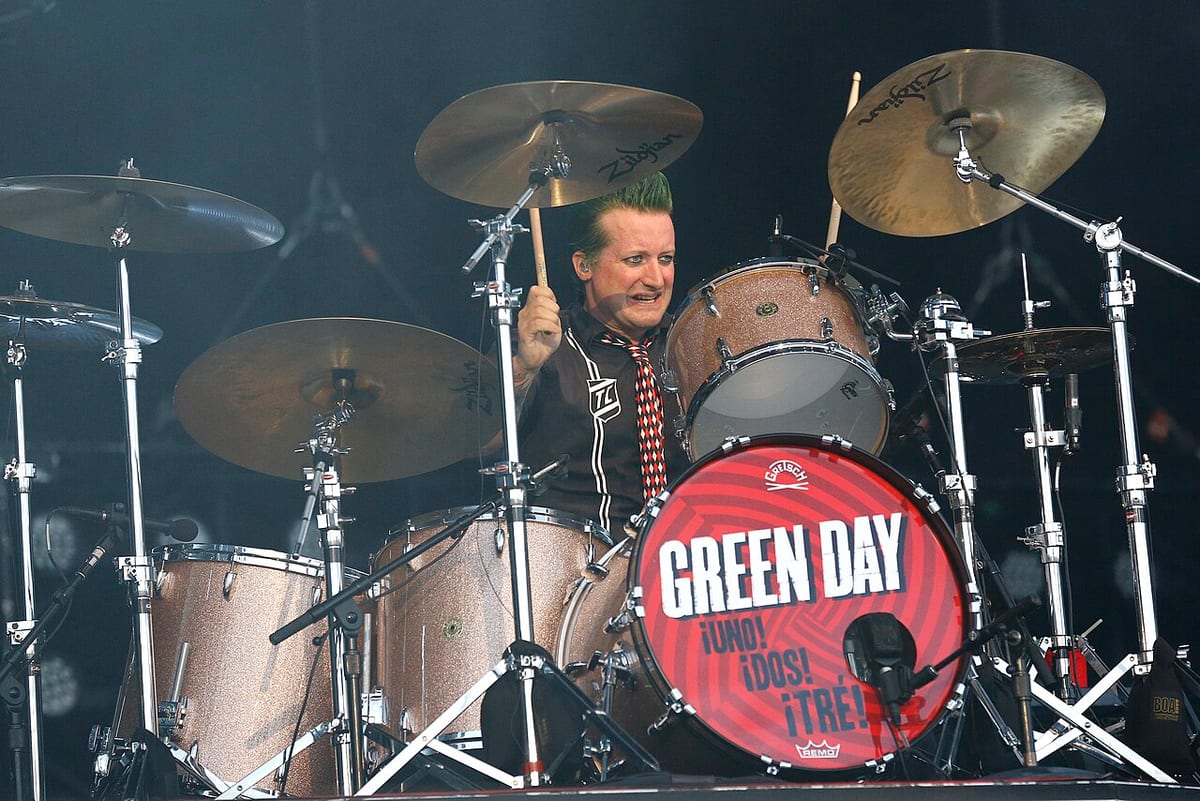
He started drumming as a child and got his first real gig at around twelve with a local punk band, The Lookouts, run by Larry Livermore — who also ran Lookout! Records, and who gave him the stage name.
In 1990, Green Day’s original drummer John Kiffmeyer left for college. Tré Cool got the job, and everything changed almost immediately: Dookie arrived in 1994 and sold in the tens of millions.
The albums
Kerplunk! (1991), Dookie (1994), Insomniac, Nimrod, Warning, American Idiot (2004), 21st Century Breakdown, the ¡Uno! ¡Dos! ¡Tré! trilogy, Revolution Radio, Father of All… and Saviors (2024).
Green Day went into the Rock and Roll Hall of Fame in 2015.
What Tré Cool actually does
He is a surf drummer in disguise. The tom fills, the ride-bell work, the driving eighths on a crash — that is Dick Dale and the Ventures, not the Ramones. It is why Green Day never sounded quite like the rest of the Lookout! scene.
He swings when nobody is looking. “Longview” is a shuffle. “Basket Case” has jazz phrasing in the fills. He hides a lot of feel inside two-minute songs.
He plays for the vocal. The parts get out of the way of Billie Joe’s lyrics, then fill the gaps between lines. Simple, and much rarer than it should be.
He can play a whole rock opera. American Idiot runs through half a dozen styles, including two nine-minute suites, and he changes character across every section without losing the band’s identity.
He is a showman. The stick tricks, the falls, the standing on the kit — it is an act, and it is a good one. It also means he is playing correct, tight parts while doing something physically ridiculous, which is harder than it looks.
Saviors
Drumeo’s voters gave him Drum Recording Of The Year in 2024 for Saviors — a record made with Rob Cavallo, the producer behind Dookie and American Idiot, and one that leans hard into the big, dry, close-miked drum sound of those albums.
It is the best-recorded drum kit on a Green Day album in twenty years, and the award recognised the sound as much as the playing.
Tré Cool’s drum kit
His gear story has an unusual shape: he left a big brand, spent years with a boutique builder, and then came back.
- SJC Custom Drums. For a long stretch his live kits were SJC — including a maple kit in a custom leopard-print finish, and a signature line. He also plays an SJC 14”x6.5” aluminium snare.
- Back to Ludwig. He has since returned to the Ludwig family, complete with a social-media unboxing video, which is a very 2020s way to announce an endorsement.
- The 1970s Supraphonic. A vintage Ludwig Supraphonic has stayed in the rig throughout, whatever the shells are.
- Two floor toms. A signature of his setup, and it is built around the cymbal placement as much as the drum sound.
- Cymbals — Zildjian. A deliberately contrasting setup: a 19” K Dark Thin Crash sitting low against a higher A Medium Thin Crash, and a 22” A Ping Ride.
Every era, with buy links, is on Tré Cool’s Rig Vault page.
Want the sound without the rig?
The Green Day drum sound is one of the easiest big sounds to get, because it is deliberately plain.
One-ply coated heads, tuned medium, barely muffled. No gels, no rings. Then hit the drums properly — most of the Dookie sound is stroke weight, not equipment.
Add a second floor tom. A 16” alongside a 14” gives you the tom fills without needing a rack tom you will not use. Cheaper than you would think secondhand — our used gear guide covers doing that safely.
Then buy one dark crash. The contrast between a thin dark crash and a bright one is his whole cymbal idea, and it costs one cymbal. Our cymbal buying guide explains the difference; the Gear Guru will do the rest.
Where to start listening
- “Longview” (1994). The shuffle. Play it slowly first.
- “Basket Case” (1994). Two minutes, and every fill is different.
- “Jesus of Suburbia” (2004). Nine minutes, five sections, no cheating.
- “St. Jimmy” (2004). Pure speed and attitude.
- “The American Dream Is Killing Me” (2024). Fifty-one years old and the snare still cracks.
Final thoughts
Punk is supposed to be simple, and Tré Cool has spent thirty-six years quietly proving it does not have to be. The parts are direct because the songs need them to be, not because that is all he has.
He is also, still, enormous fun to watch — which is not a small thing in a genre that mostly stopped smiling in about 1996.
See Tré Cool’s full rig in the Rig Vault, or read about Travis Barker — the other side of the same coin.