Roy Haynes | Snap Crackle, and eight decades of it
Roy Haynes played with Charlie Parker, Coltrane and Chick Corea across an eighty-year career. His style, his small bebop kit, and what made him different.
Roy Haynes played with Lester Young, Charlie Parker, Thelonious Monk, Sarah Vaughan, John Coltrane, Miles Davis, Chick Corea and Pat Metheny.
That is not a list of influences. That is a list of employers, and it spans from the 1940s to the 2010s.
He is one of the most recorded drummers in the history of jazz, he was still leading a band in his late eighties, and he did all of it while sounding like nobody else. Here is why.
Who was Roy Haynes?
Roy Owen Haynes was born on 13 March 1925 in Roxbury, Boston, to Barbadian parents.
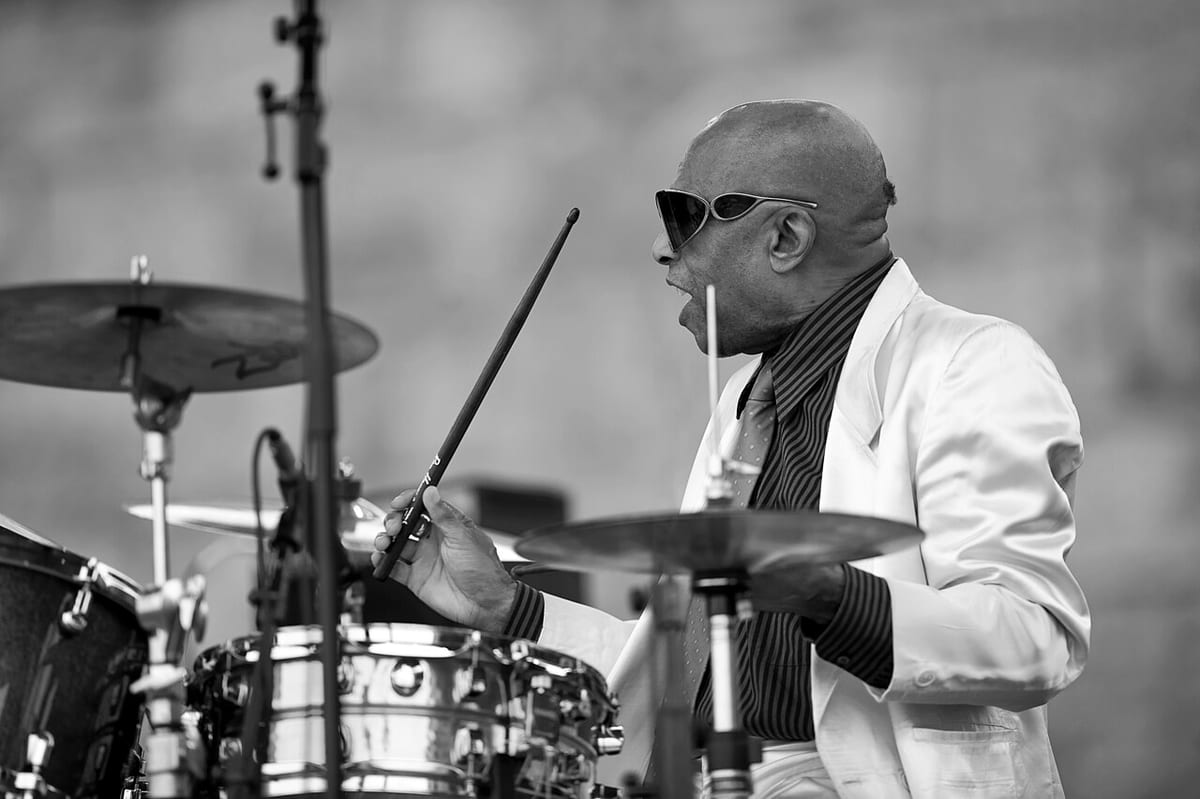
He turned professional in the mid-1940s, at exactly the moment bebop was being invented, and immediately found himself in the middle of it — with Lester Young from 1947, and then with Charlie Parker from 1949 to 1952.
Consider what that means. He was the drummer in Charlie Parker’s band, in his mid-twenties, while the music was still being figured out.
The rest of the century
- Sarah Vaughan, 1953–58 — five years as a singer’s drummer, which is its own discipline.
- Thelonious Monk, on and off.
- John Coltrane — famously deputising for Elvin Jones, including at Newport in 1963.
- Chick Corea — Now He Sings, Now He Sobs (1968), one of the great piano trio records, and a landmark for what a drummer could do in that format.
- Pat Metheny — Question and Answer (1990), with Dave Holland.
- His own bands: the Hip Ensemble in the seventies, and later the Fountain of Youth Band, which he led into his eighties with musicians sixty years his junior.
He was named an NEA Jazz Master in 1995 and received a Grammy Lifetime Achievement Award in 2011. Drumeo’s panel gave him the Buddy Rich Award for Career Achievement in 2023.
Roy Haynes died on 12 November 2024, at 99.
“Snap Crackle”
The nickname arrived in the 1950s and it is the best short description of his playing anyone has managed.
Where most bebop drummers laid down a continuous ride pattern and commented on it with the left hand, Haynes broke the pattern up. His ride cymbal stutters. His snare interjects in unexpected places. The whole thing crackles rather than flows.
That sounds like it should be disruptive. It is not, because his time is immovable underneath — which is precisely the trick, and precisely why so many drummers have tried and failed to copy it.
He was also, by common consent, the most modern-sounding of the bebop generation. Put a Haynes record from 1958 next to one from 1968 and he sounds like he arrived from the later one.
What Roy Haynes actually does
He plays around the beat rather than on it. Nothing is where you expect. The pulse is never in doubt.
He is a small-kit player. Tight sizes, high tuning, everything close. That is where the crackle comes from — small drums speak fast.
He accompanies actively. Haynes does not comp politely behind a soloist; he argues with them. Listen to the Corea trio record and the drums are a third voice, not a rhythm section.
He is loud for a jazz drummer. More attack, more edge, more presence than the era’s convention.
He never stopped modernising. He hired young musicians into the Fountain of Youth Band for decades and played their music, rather than a museum version of his own.
The other thing
He was also, famously, one of the sharpest dressers in jazz — named to Esquire’s best-dressed list in 1960, which for a working drummer is a genuinely unusual line on a CV.
Roy Haynes’s drum kit
A classic bebop setup, and small.
- The kit — a WFL (the Ludwig predecessor) set with a 20”x14” bass drum, a 16”x16” floor tom and a 12” or 13” rack tom, depending on the photograph.
- Snares — a WFL 14”x5.5”, and a bebop piccolo among others.
- Yamaha, later. He became a Yamaha artist, and Yamaha built him a Roy Haynes signature 14”x5.5” hand-hammered copper snare.
- Cymbals — Zildjian, throughout.
- Sticks — Zildjian Roy Haynes Artist Series. A super-long taper and an oversized elongated bead: a light, fast stick that pulls a broad sound out of a cymbal. It tells you everything about how he played.
Every era, with buy links, is on Roy Haynes’s Rig Vault page.
Want the sound without the rig?
The Haynes sound is a size decision, and it is the cheapest upgrade in drumming.
Go smaller and tune higher. A 20” or 18” bass drum, a 12” rack tom and a 14” floor tom, all tuned up rather than down. Small drums respond faster, which is what lets a player articulate at speed. Our beginner drum kit guide covers what shell sizes actually change.
Then buy a thin, dark, dry ride — a cymbal with enough stick definition that a broken pattern still reads. Our cymbal buying guide is the place to start; the Gear Guru will spec a jazz kit to a number.
And break your ride pattern. Play the standard jazz ride for eight bars, then start leaving beats out. That is the whole idea.
Where to start listening
- Chick Corea — Now He Sings, Now He Sobs (1968). Start here. The drumming is astonishing.
- Charlie Parker — the early-fifties sides. Him inventing the job.
- John Coltrane — Newport ‘63. Deputising for Elvin Jones and sounding nothing like him.
- Roy Haynes — Out of the Afternoon (1962). His own record, with Roland Kirk.
- Fountain of Youth Band, live, in his eighties. Still faster than you.
Final thoughts
Eighty years is not a career, it is a geological period. Haynes played on records that defined bebop, hard bop, modal jazz, the piano trio and fusion, and he did not sound out of place on any of them.
The extraordinary thing is not the longevity, though. It is that a drummer working in 1949 had already found a personal voice so distinct that you can identify him from four bars — and that the voice never went out of date.
Snap Crackle, for eight decades.
See Roy Haynes’s full rig in the Rig Vault, or read about Steve Gadd and Terri Lyne Carrington — two more careers measured in decades rather than records.