Electronic cymbal pads | Is Roland worth it?
Three ways to add a ride or crash pad to your e-kit, side by side: zones, choke, feel, module compatibility and price — and whether Roland is worth it.
Hear it
A Lemon three-zone ride against the Roland pads it is copying — the budget pad played next to Roland’s CY-15R and CY-18DR and an ATV — the triggering, the choke and the acoustic noise, side by side
Almost every electronic kit is sold one cymbal short. You get hats, a crash and a ride, you play it for six months, and then you want a second crash, or a bigger ride, or something you can actually choke.
At that point you discover the spread: Roland will sell you a pad for the price of a small acoustic kit, and a handful of direct-from-China brands will sell you something that looks identical for a fifth of it. Between them sits Thomann’s house brand, doing what house brands do.
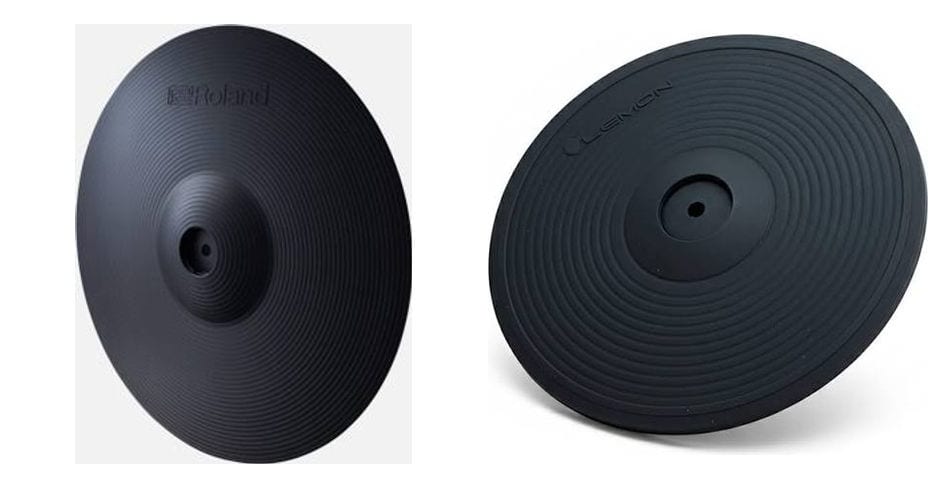
Is the Roland worth four times the Lemon? Sometimes. Let’s work out when.
The short answer
Buy the Roland if you own a mid or high-end Roland module, if you want the pad to work the moment it is plugged in, and if the acoustic noise of your kit matters — this is the quietest pad here by a distance, and in a flat that is not a small thing.
Buy the Lemon if you want size for your money. A three-zone 15 or 18-inch ride for around a hundred pounds is a thing Roland simply does not sell, and the triggering is far closer to the real thing than the price suggests.
Buy the Millenium if you are in Europe, you want it this week, and you want the cheapest pad that still chokes.
If you are on an Alesis Nitro Max or anything at that end of the market, do not buy the Roland. The module is the limit, not the pad.
| Spec | Roland CY-14R-T14", three zones | Lemon LE-13C313", three zones | Millenium MPS-750 14"14", three zones | Our take |
|---|---|---|---|---|
| Price band | UK: £300–£370 US: $390–$430 EU: €350–€420 | UK: £90–£110 US: $110–$150 EU: €105–€135 | UK: £60–£90 US: $75–$110 EU: €70–€100 | Street prices, new, at the time of writing. They move; the links below are live. |
| Size | 14 inch | ✓13 inch, with 15 and 18-inch models in the same range | 14 inch | Lemon is the only one of the three that will sell you a big ride without a big bill. |
| Zones | Three: edge, bow, bell | Three: edge, bow, bell, switchable to two | Three, with choke | On paper, identical. Everything below is about how well they work. |
| Choke | ✓Grab the edge anywhere; behaves like a cymbal | Works, but the usable strip is narrow — an inner lip gets in the way | Works; less consistent than the Roland | The row where the money shows. If you choke a lot, you will feel this every night. |
| Triggering | Excellent, even across the bow, no hotspots | Genuinely close; reviewers struggle to separate it from a CY-15R | Good, with a little more variation across the pad | Close enough to call a draw between the top two, and that is the whole story of this page: the gap is nothing like the price gap. |
| Swing and feel | ✓Thin profile, swings on the stand like a cymbal | Heavier and stiffer; swings less | Stiffer again | Roland’s thin pads move under the stick, and it is the thing you notice first. |
| Acoustic noise | ✓Soft rubber, the quietest of the three | Louder — a definite slap | Louder | Worth real money if you are playing at night in a flat with neighbours. |
| Module compatibility | ✓Plug in and play on any Roland module | Works on most Roland and Alesis modules; some need rewiring for three zones | Best on Millenium and Alesis modules | Nobody advertises the afternoon with a soldering iron. Budget for it as a possibility. |
| Cabling | Two cables for full three-way on the advanced modules | One or two depending on how you wire it | One or two | Check your module’s spare inputs before you buy anything three-zone. This catches people out. |
| Build | ✓Roland build quality, spares available for years | Solid, but a consumable — buy it expecting five years not fifteen | Fine; Thomann honour the warranty | The Roland is the one you will still be using on your next kit. |
| Buying one | ✓Every shop, everywhere | ✓Direct, Amazon and specialists; stock varies | Thomann, and that is it | The Millenium is Europe-only in practice, which decides it for a lot of readers. |
| Price | Four times the Lemon | The value pick | ✓The cheapest here | And at this end of the market, price is most of the decision. |
| Where to buy | Guitar Center 🇺🇸Gear4music 🇬🇧Thomann 🇪🇺Reverb · used | Guitar Center 🇺🇸Gear4music 🇬🇧Thomann 🇪🇺Reverb · used | Guitar Center 🇺🇸Gear4music 🇬🇧Thomann 🇪🇺Reverb · used | Affiliate links to the shop for your region; buying through them costs you nothing extra. |
| Rows won | 5 of 11 | 1 of 11 | 1 of 11 | A count, not a verdict: the rows that matter to you are the ones to weigh. |
✓ marks the row's winner. Prices are bands, not quotes: 🇬🇧 UK · 🇺🇸 US · 🇪🇺 EU.
What you are actually paying for
Not triggering. That is the surprise, and it is worth saying plainly: people who own both report that a Lemon ride reads a stick about as well as the Roland it is copying, and the reviews back them up. If your only question is “will it play”, the cheap pad plays.
What the Roland money buys is the three things nobody puts on a spec sheet. It is quieter, because the rubber is softer and thinner. It swings, because the pad is thin enough to move on the felt. And it chokes properly, anywhere round the edge, without you having to learn where the sweet spot is.
Whether those are worth three hundred pounds depends entirely on where you play and what you play. In a flat at midnight, the noise alone might settle it. In a garage, it will not.
Which is why the scoreboard under that table lies a little. Roland wins most of the rows — of course it does, it is four times the money — and we would still send more readers to the Lemon than to the Roland. Count the rows that describe your room, not all of them.
The compatibility trap
This is the part that turns a cheap pad into an expensive afternoon.
Three-zone pads are only three-zone if the module supports it, and modules differ on how they expect the bell and edge signals to arrive. Lemon pads are sold as compatible with Roland and Alesis kits, and mostly they are — but there is a well-documented tail of owners who had to open the pad and move a wire to get the bell and the choke working on their particular module. Millenium pads are happiest on Millenium and Alesis modules.
Two things to check before you spend anything:
- Spare inputs. A three-zone pad may need two jacks. Count what your module actually has free.
- What your module supports. Entry-level modules often only read two zones no matter what you plug in, which makes a three-zone pad a waste of money. Our electronic drum kit buying guide covers which tier does what.
Where Lemon actually wins
Size, and it is not close. Roland’s big pads — a 16 or 18-inch ride — cost more than most people’s entire kit. Lemon will sell you an 18-inch three-zone ride for roughly what a Roland 12-inch crash costs, and an 18-inch pad under the stick feels like a ride in a way a 13-inch pad never does.
If you have one spare input and one decision to make, a big cheap ride will change how your kit feels more than a small expensive one.
And the effects cymbals
None of the three makes a proper china or splash, which is the other half of this problem. We have separate guides to electronic china cymbal pads and electronic splash pads — different brands, same rules about zones and inputs.
The other way to solve it, of course, is not to use pads at all: low volume cymbals on a stand next to an e-kit give you real cymbal feel with no module input needed, at the cost of not being in your headphones.
Who should buy which
- A Roland TD-17, TD-27 or VAD kit. Roland. The module deserves it and everything just works.
- An Alesis Nitro, Nitro Max or Surge. Lemon or Millenium. Spending Roland money here fixes nothing.
- You want a big ride more than a good one. Lemon 18-inch. Easily the best value on this page.
- Playing at night in a flat. Roland, for the noise alone.
- In Europe, want it Thursday, on a budget. Millenium.
- You choke cymbals constantly. Roland. The others will annoy you.
Still choosing the kit itself rather than a pad for it? Our Roland TD-07KV vs Alesis Nitro Max head-to-head covers the rung below, and the electronic drum kit buying guide covers the whole ladder.
Keep reading
Head to Head
Axis A21 vs DW 9000 | Direct drive or chain?
The direct-drive benchmark against the chain-drive default: footboard, cam, feel at speed, servicing, availability and price, with a verdict on every row.
Head to Head
Zildjian L80 vs Sabian Quiet Tone | How quiet?
The three low volume cymbal sets worth buying, side by side: how quiet each one really is, what survives the drop in volume, and which one suits you.
Alesis
Alesis Nitro Max review | The best first electronic kit?
The cheapest all-mesh electronic kit worth owning: what is in the box, what the module can do, how the pads feel, where it falls short, and who should buy it instead of spending twice as much on a Roland.