Zildjian L80 vs Sabian Quiet Tone | How quiet?
The three low volume cymbal sets worth buying, side by side: how quiet each one really is, what survives the drop in volume, and which one suits you.
Hear it
Zildjian L80 against Sabian Quiet Tone, same room, same player — the two sets everyone cross-shops, played back to back in a shop — listen past the volume and to what is left of the tone
If you have decided you want low volume cymbals — and if you have not, that guide is the one to read first — the choice has narrowed to three. Zildjian’s L80 is the one everybody has heard of. Sabian’s Quiet Tone is the one that keeps more of the cymbal in it. Agean’s R Series is real B20 bronze with the holes drilled through it.
They are not trying to do the same thing. One is chasing silence, one is chasing tone, and one is somewhere in the middle. Which means the right answer depends entirely on who is on the other side of your wall.
Let’s take them apart.
The short answer
Buy the Zildjian L80 if the point is the neighbours. It is the quietest of the three by a clear margin, it is everywhere, and at the price it is the default for a reason.
Buy the Sabian Quiet Tone if you want to practise on something that still sounds a bit like a cymbal. It gives up some of the silence to keep a real bell and a bit more body, and the four-piece set is a genuinely complete setup.
Buy the Agean R Series if this is not really a practice set at all — if you want something you can take to a quiet gig, a restaurant, a church hall or a session where a full cymbal would be too much. It is bronze, it sounds like bronze, and it is the loudest thing here.
If you are buying blind and you just want it to work: L80.
| Spec | Zildjian L8014" hats, 16" crash, 18" crash-ride | Sabian Quiet Tone14" hats, 16" and 18" crashes, 20" ride | Agean R Series14" hats, 16" crash, 20" ride | Our take |
|---|---|---|---|---|
| Price band | UK: £250–£300 US: $370–$420 EU: €290–€350 | UK: £300–£360 US: $385–$500 EU: €350–€420 | UK: £350–£450 US: $400–$550 EU: €400–€500 | Street prices, new, at the time of writing. They move; the links below are live. |
| Material | A proprietary alloy with a matte finish | A proprietary alloy Sabian rates as dent-proof | B20 bronze, hand-made in Istanbul | Only the Agean is a real cymbal alloy, and you can hear it the moment it is hit. Everything below follows from this row. |
| How quiet | ✓Up to 80 per cent quieter; the stick is louder than the cymbal | Quiet, with a little more left in the room | Quietest-in-name-only; think a soft acoustic cymbal | If somebody is asleep on the other side of the wall, this is the only row that matters. |
| Tone that survives | Very little; a dry tick with a hint of pitch | Noticeably more body and a proper bell note | ✓Rich, clear and recognisably a cymbal | The straight inverse of the row above, which is the whole trade in this category. |
| Bell | Present, but thin | Defined and musical — Sabian made a point of it | ✓A real bell, because it is a real cymbal | The L80 bell is the weakest part of the set. If you ride on the bell, notice that now. |
| Feel and rebound | Natural stick response, light under the stick | Very close to a normal Sabian; the most cymbal-like of the two practice sets | Identical to a normal cymbal, because it is one | A draw, and the reason this category exists: all three are miles better under the stick than a rubber pad. |
| Hi-hats | Clean chick, very quiet, a little clacky | ✓Fuller chick with more tone in the open sound | Proper hi-hats at a lower volume | The Quiet Tone hats are the pick if your practice is mostly groove work. |
| Range beyond the box | ✓Widest by far: splashes, chinas, extra crashes, multiple sizes | Good: extra crashes, rides and a china | Good, but you are ordering from a smaller maker | Zildjian treats L80 as a real line. Expanding later is easiest here. |
| What the set gives you | Hats, crash, crash-ride — three pieces | ✓Hats, two crashes and a ride — four pieces | Hats, crash, ride — three pieces plus a bag | The Quiet Tone box is the most complete kit of cymbals for the money. |
| Buying one | ✓Every shop, everywhere | ✓Every shop, everywhere | Specialists and direct; stock can be thin | The Agean is worth hunting for. It is still a hunt. |
| Gigging with them | No | Only somewhere very quiet | ✓Yes — this is what it is for | An R Series set earns its money at low-volume gigs, which no practice cymbal can do. |
| Price | ✓The cheapest of the three | Mid, and the most cymbals per pound | Full cymbal money, because they are full cymbals | The L80 is the cheapest way into the category and always has been. |
| Where to buy | Guitar Center 🇺🇸Gear4music 🇬🇧Thomann 🇪🇺Reverb · used | Guitar Center 🇺🇸Gear4music 🇬🇧Thomann 🇪🇺Reverb · used | Guitar Center 🇺🇸Gear4music 🇬🇧Thomann 🇪🇺Reverb · used | Affiliate links to the shop for your region; buying through them costs you nothing extra. |
| Rows won | 3 of 11 | 2 of 11 | 3 of 11 | A count, not a verdict: the rows that matter to you are the ones to weigh. |
✓ marks the row's winner. Prices are bands, not quotes: 🇬🇧 UK · 🇺🇸 US · 🇪🇺 EU.
How quiet is quiet?
Quiet enough to matter, not quiet enough to be silent. Every set here still makes a noise when you hit it, and downstairs will still know you are playing. What changes is whether it is a noise anybody minds.
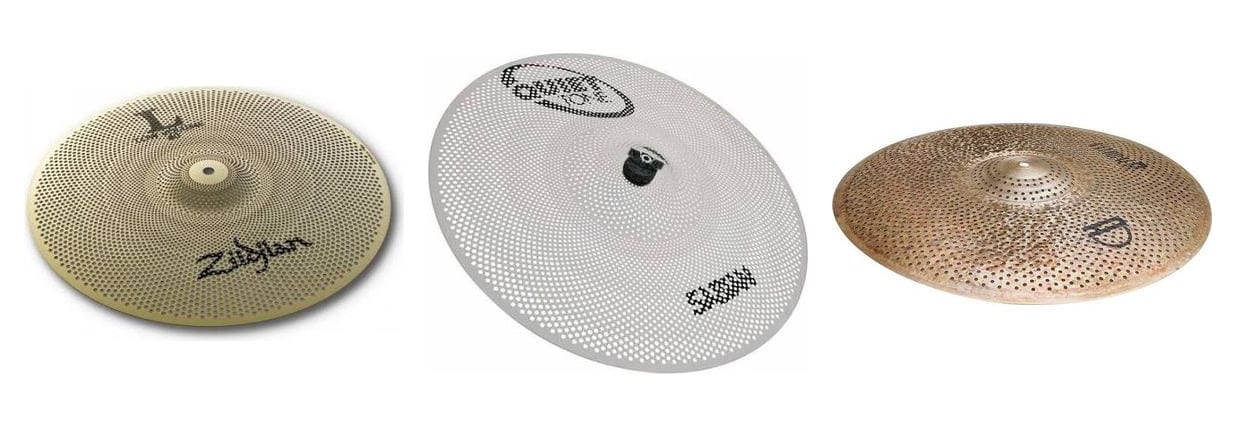
The L80 is the extreme end. Zildjian drill hundreds of holes through a soft alloy and the result is a cymbal where the sound of the stick landing is genuinely louder than the cymbal itself. It is astonishing the first time and slightly depressing the tenth, because there is almost nothing musical left. For a flat at eleven at night, that is exactly right.
Here are two of them against a normal cymbal set, so you have a reference for exactly what has been taken away:
What the holes cost you
Two things, and it is worth knowing both before you spend.
The first is dynamics. A quiet cymbal has a narrow range between a tap and a smash, so you can practise for six months on L80s and lose the habit of playing into a crash. Fix it by going back to your real cymbals now and then, and by doing your dynamics work — our accents and dynamics lesson — on the loud kit when you get the chance.
The second is the bell and the ride. Ride patterns need definition to be any use, and on the quietest sets the ping goes first. If most of your practice is jazz or anything ride-led, that pushes you up the table towards the Quiet Tone or the Agean.
The cheaper way in
None of the above is cheap, and you do not have to start there. Thomann’s Millenium Still series and Gear4music’s WHD sets both claim the same 80 per cent reduction for a fraction of the money, and for a first practice set they are perfectly good — a little less consistent, a little less refined, and nobody will ever know. Our main low volume cymbals guide covers both, along with how the category works and why the holes are there.
The other half of a quiet setup is the drums themselves, which is what mesh heads are for. Low volume cymbals on a kit with normal heads solves half a problem.
Who should buy which
- A flat, a shared house, a sleeping baby. Zildjian L80. Quietest wins.
- A garage or a spare room where some noise is fine. Sabian Quiet Tone. You get to enjoy practising.
- Quiet gigs, dep work, acoustic sets, church. Agean R Series. The only one that can do a job.
- Practising mostly ride patterns and jazz. Quiet Tone at least, Agean if you can.
- Buying online without hearing them. L80. They are the known quantity.
- Building a quiet kit from nothing, tight budget. Millenium or WHD now, and put the difference into mesh heads.
Whichever you land on, the quiet kit is only worth having if you actually use it — pair it with the tempo trainer and those late sessions will move your playing on properly. And when it is time to choose the loud cymbals, the cymbal buying guide is the next one to read.
Keep reading
Head to Head
Axis A21 vs DW 9000 | Direct drive or chain?
The direct-drive benchmark against the chain-drive default: footboard, cam, feel at speed, servicing, availability and price, with a verdict on every row.

Head to Head
Electronic cymbal pads | Is Roland worth it?
Three ways to add a ride or crash pad to your e-kit, side by side: zones, choke, feel, module compatibility and price — and whether Roland is worth it.

Head to Head
Best 5A drumsticks | Vic Firth vs Promark vs Vater
The three 5As most drummers actually buy, side by side: dimensions, tip, balance, durability, consistency and price per pair — and which one to put in your bag first.