Drum thrones | The seat matters more than the snare
How to choose a drum throne: the height rule that fixes back pain, round versus saddle seats, the thrones worth buying at every budget, and when to replace one.
The throne is the cheapest part of a drum kit and the only part you are in contact with for the whole gig. It decides where your hips are, which decides where your spine is, which decides whether you can still play in your sixties.
And it is the part most drummers buy last, cheapest, and set up wrong.
So let’s fix that. The height rule, the seat shapes, the thrones worth your money, and the signs that the one you have is done.
Why it matters more than the snare
A snare drum affects how you sound. A throne affects how you play, how long you can play, and how your back feels the morning after. A seat that is too low closes the hip angle, rounds the lower back and makes every stroke come from the shoulders. A seat that wobbles makes you brace your core for two hours without knowing it.
Our posture guide goes through the whole setup. The throne is the first thing it tells you to fix, because everything else is measured from it.
The height rule
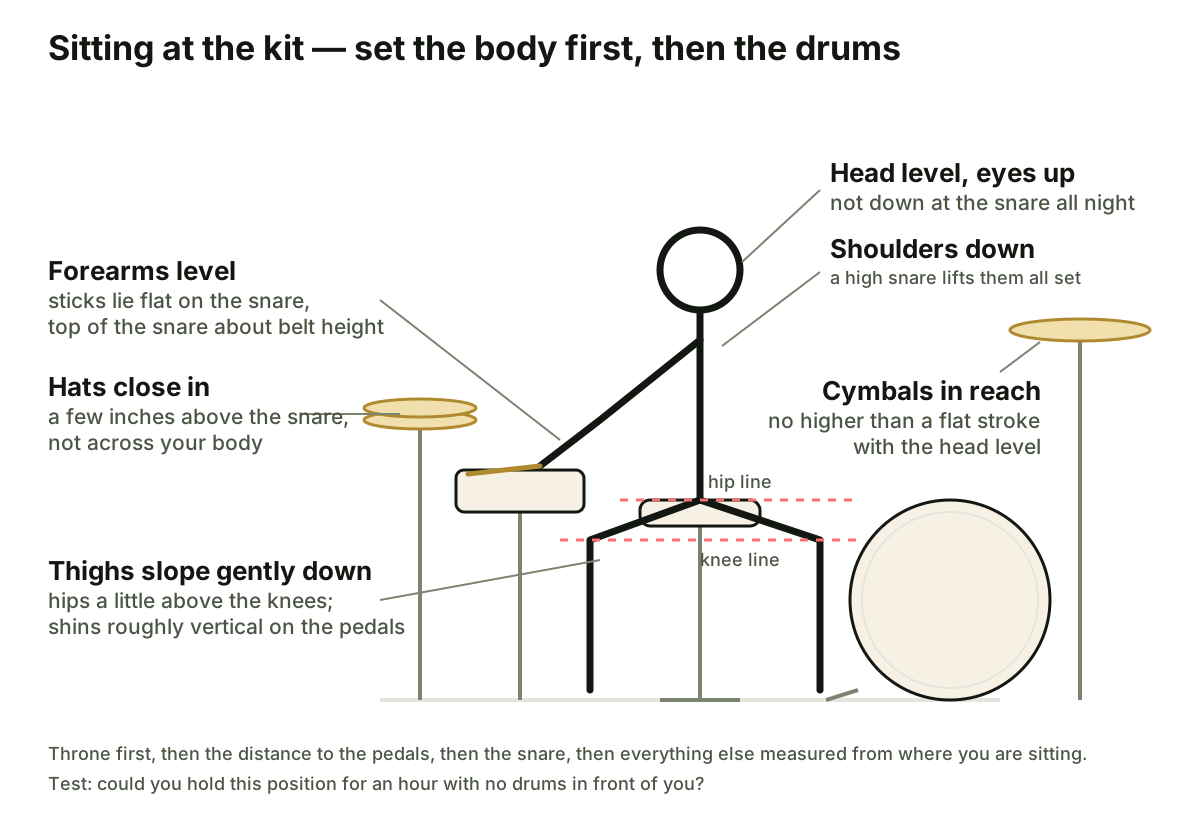
Sit on the throne with your feet on the pedals. Your hips should sit slightly above your knees, so your thighs slope gently down towards the pedals. Not level, not steeply down: gently.
That height varies with your leg length, so the number is yours to find. For a lot of drummers it is around the top of the kneecap when standing next to the seat, and it is almost always higher than the throne came out of the box.
Two checks. Your heel should rest on the pedal without lifting. And when you reach for the floor tom, you should not have to lean, because the throne height sets the tom height.
Once you find it, mark the post with tape. Every drum shop throne you sit on will be wrong, and a taped post lets you set yours back in ten seconds.
Round or saddle?
Round seats are the classic: a padded disc, usually 13 or 14 inches across. Cheap, simple, and the right shape for drummers who move around the seat a lot or sit very upright.
Saddle seats have a cutaway at the front, like a motorbike saddle. Your thighs drop into the gaps, which takes pressure off the back of your legs and lets the hips open. Most drummers who try a saddle for a week do not return to a round seat.
Bicycle seats, the narrow ones, suit a few players who like to perch. They are a taste you will know you have.
The padding matters as much as the shape. Soft and thick feels great in the shop and collapses in a year. Firm and dense feels hard for a day and lasts a decade.
The thrones worth buying
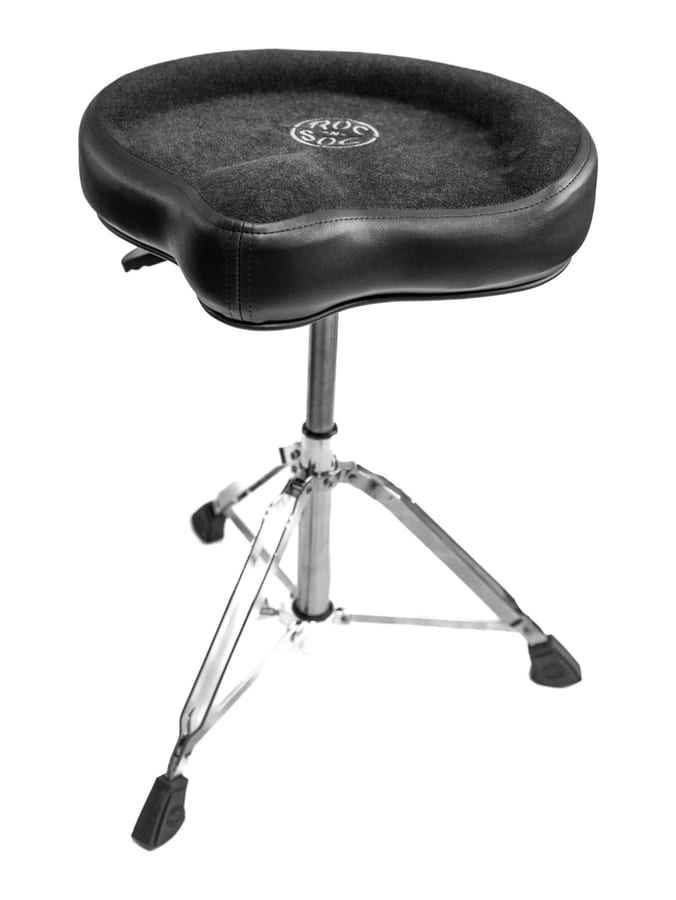
Roc-N-Soc Nitro. The one. A gas-lift post you adjust while sitting on it, a thick firm seat in round or saddle shapes, and a reputation for lasting twenty years of touring. It costs what a cheap cymbal costs and it is the best money you will spend on your kit.
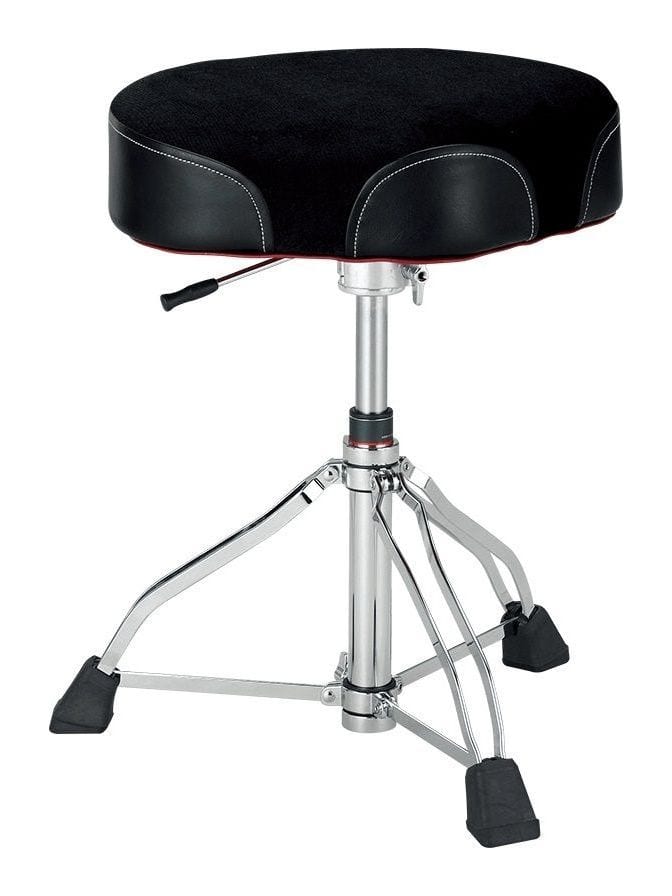
Tama 1st Chair Ergo-Rider. The best saddle seat on a threaded post, with a backrest option for drummers who want one. Heavy, stable, beautifully made.
Gibraltar 9608. The sensible choice. A big round seat, a threaded post, a double-braced base, and a price that makes it the default upgrade from the throne that came with the kit.
DW 9100M. Built like the rest of DW’s 9000 hardware, which is to say it will outlive you. The heaviest and most stable base here. Overkill for a bedroom and exactly right for a gigging drummer.
Pearl Roadster. Pearl’s gas-lift answer to the Roc-N-Soc, with a comfortable saddle and a slightly lower price.
Budget: Mapex T770 and Tama HT430B. Both have a double-braced base, a threaded post and a seat that will do a beginner for years. The first throne worth buying, as opposed to the one that came free.
When to replace the one you have
The seat has a dent in it that does not come back. The post slips during a set. The base rocks on a flat floor. Any of those is a throne that is making your back do its job.
A good throne is a ten-year purchase. A bad one is a problem you sit on every day.
Gas lift or threaded post?
Threaded posts are the standard: spin the seat to set the height, lock it off. Cheap, reliable, slow to adjust.
Gas-lift posts, on the Roc-N-Soc and the Pearl Roadster, adjust with a lever while you sit. Quicker, a little bouncy, which some drummers love and some find odd. The bounce is not a fault; the Roc-N-Soc has felt like that for decades.
Where can I buy one?
The right shop depends on where you are: Guitar Center in the Americas, Gear4music in the UK, or Thomann for Europe and the rest of the world.
A used Roc-N-Soc is a safe buy because they wear so slowly — check Reverb before paying full price.
Final thoughts
Set the height right, which is probably higher than it is now. Try a saddle. Buy a Gibraltar if money is tight and a Roc-N-Soc if it is not, and either way buy a throne before your next cymbal.
Then read the posture guide, because the throne is step one and there are four more.
Drum throne FAQs
- How high should a drum throne be?
- High enough that your hips sit slightly above your knees, so your thighs slope gently downwards towards the pedals. For most people that puts the seat somewhere around the top of the kneecap when standing beside it. Too low and your hips close up and your back rounds; too high and your heels lift off the pedals.
- What is the best drum throne?
- The Roc-N-Soc Nitro is the one touring drummers buy with their own money: a gas-lift height adjust and a thick, firm seat that lasts. The Tama 1st Chair Ergo-Rider is the best saddle seat, the Gibraltar 9608 is the best value round seat, and the DW 9100M is the heaviest-built. Below those, a Mapex T770 or a Tama HT430B will do a beginner for years.
- Round or saddle seat on a drum throne?
- Saddle seats, the ones with a cutaway at the front like a motorbike seat, let your thighs drop and reduce pressure on the back of your legs. Most drummers who try one do not go back. Round seats are simpler, cheaper and suit drummers who sit very upright or move around the seat a lot. Try both if you can; it is as personal as a stick choice.
- Can a bad drum throne cause back pain?
- Yes, and it is one of the most common causes. A throne that is too low, too soft or wobbles makes you compensate with your back for an hour at a time. Fix the height first, then the seat. If pain persists after that, see a physio — the posture guide covers the rest of the setup.
Keep reading

All Our Buying Guides
Audio interfaces for drums | How many inputs?
Which audio interface to buy for recording drums: how many mic inputs you need, the two- and eight-input standards, ADAT expansion and the e-kit case.

All Our Buying Guides
Drum VSTs | The best sounds for your e-kit
The best drum VSTs for an electronic kit: Superior Drummer 3, EZdrummer 3, Addictive Drums 2, GetGood Drums and Steven Slate Drums compared, plus the free ones.

How to
Connect an e-kit to a computer | USB, MIDI, latency
How to connect an electronic drum kit to a computer: the USB cable, MIDI versus audio, the buffer and driver settings that kill latency, and mapping the pads.