Yamaha's 2026 drum hardware | SS9WR Flip Grip
Yamaha has refreshed nearly its whole hardware range — a new SS9WR snare stand with a Flip Grip basket, plus 14 updated stands and three new parts.
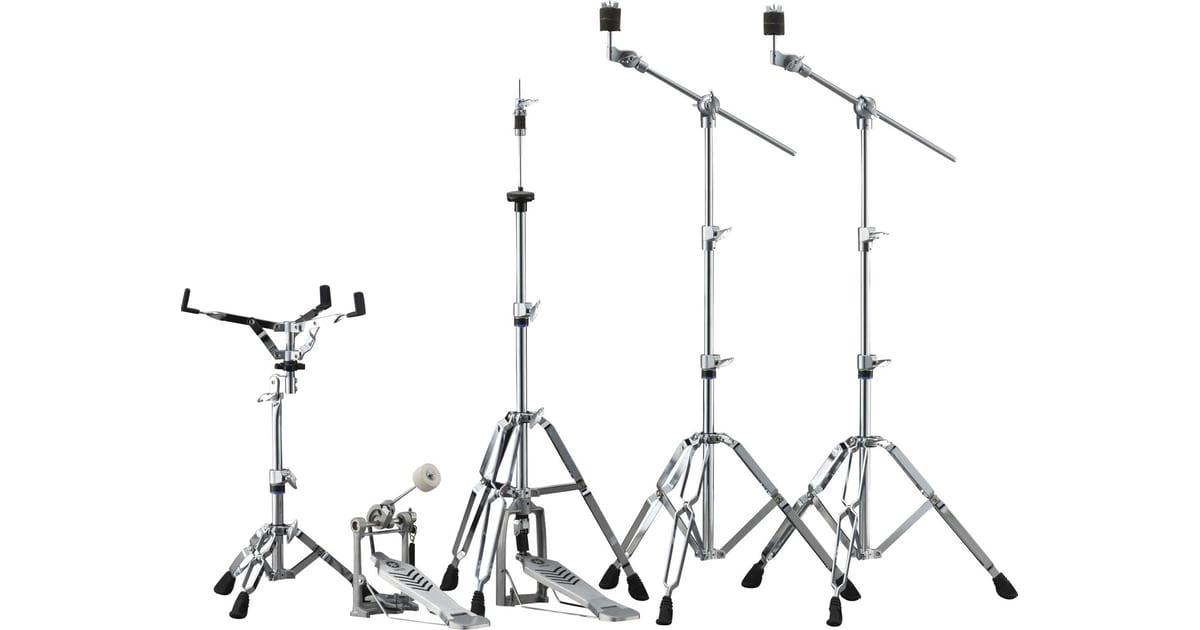
Nobody has ever walked out of a shop excited about a snare stand. Hardware is the part of the kit you notice only when it lets you down — when the basket will not hold the drum flat, when the tilter jumps a tooth past the angle you wanted, when the wingnut disappears into the carpet at load-out.
Yamaha has spent this year rebuilding exactly that stuff. Today it announced a refresh that runs across almost its entire hardware range: three genuinely new products, and upgrades applied to fourteen existing snare and cymbal stands.
It landed on the same day as the EAD20 module, which is quite a Friday. But this is the more interesting of the two announcements, because it is the one about the bits you touch every night. Let’s find out what has changed.
What has Yamaha actually changed?
Two ideas, applied everywhere.
The first is step-free tilters. Traditional cymbal and snare tilters use a toothed gear — you get the angle the teeth allow, not the angle you want. Yamaha is moving the range onto stepless ball-clamp tilters instead, which lock anywhere in their travel.
The second is tone-preserving materials at every contact point. New basket rubber where the drum sits, and a new two-material cymbal washer where the cymbal sits. Both are aimed at the same thing: stopping the stand from stealing resonance out of the instrument bolted to it.
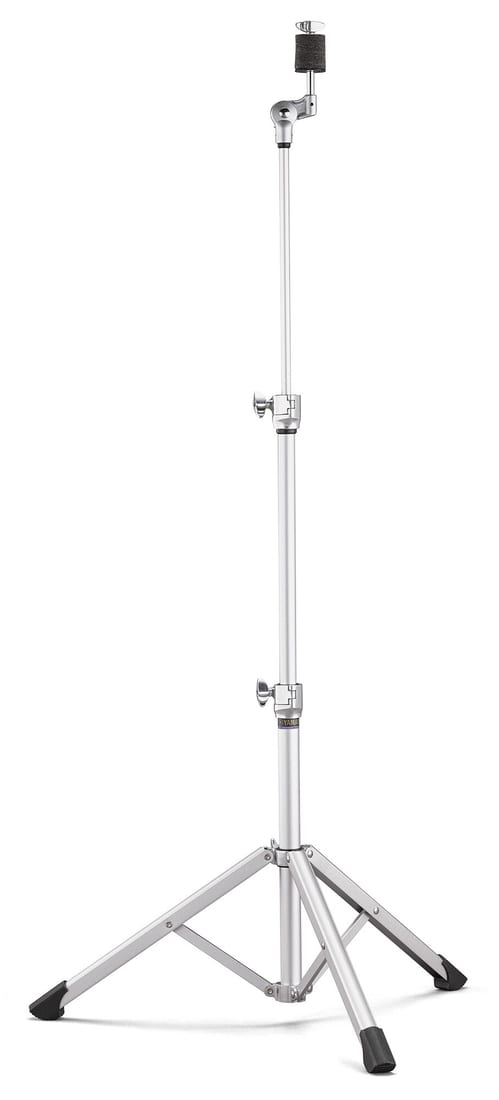
Then there is the new list itself. Six snare stands get the update — SS9WR, SS8W, SS7, SS6W, SS6 and SS62 — along with eight cymbal and boom models: CS8W, CS7, CS6W, CS6T, CS6, CBW8, CH8 and CH8S. Three products are new outright: the SS7S low-positioned snare stand, the QRN8 quick release nut and the SECW8 cymbal washer.
Jeff Shipley, Yamaha’s director of drum marketing, framed it as listening to drummers and making meaningful improvements rather than chasing trends. Marketing copy, obviously — but for once it matches the product, because nothing here is a new category. It is a company going back over the mechanisms it already sells and fixing the annoying ones.
The SS9WR and its Flip Grip basket
The headline is the flagship snare stand.
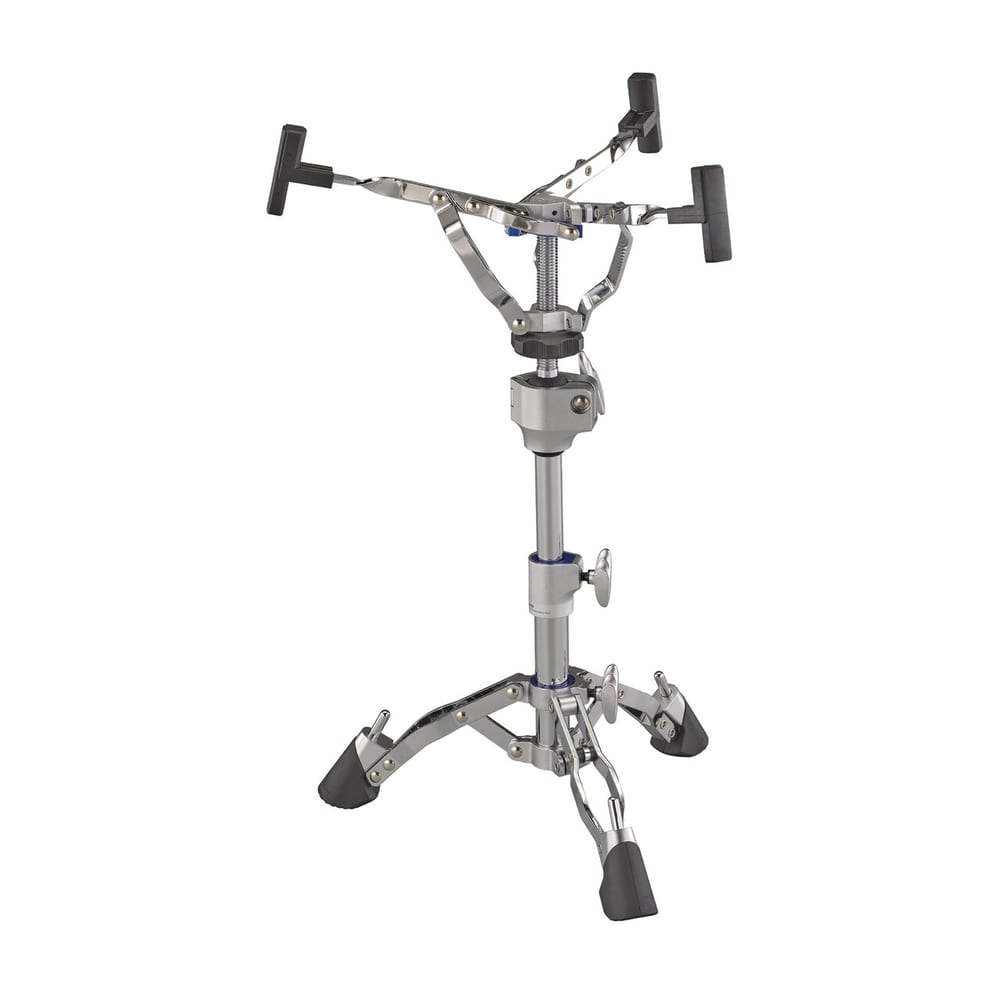
The SS9WR is built around what Yamaha calls the Flip Grip basket — a reversible arrangement that takes drums and percussion from 10in to 14in in diameter without losing stability at either end of that range.
That range is the point. A basket sized for a 14in snare tends to hold a 10in popcorn snare or a timbale at an angle it does not really want to sit at, with two arms doing the work of three. If the Flip Grip does what Yamaha says it does, one stand covers the main snare, the side snare and a hand percussion instrument.
The honest caveat: nobody outside Yamaha has flipped one yet. The press material describes what the basket accommodates, not precisely how the mechanism reverses, and no independent review exists. Treat it as a promising claim rather than a tested one.
The rest of the stand is more concrete. A step-free tilter in place of the old geared one. An ergonomic basket adjustment knob you can actually get a grip on with cold hands. Tone-enhancing basket rubber at the arms. Heavy double-braced legs, and large rubber feet with retractable spikes for when the riser is carpeted and when it is not.
It is $249.99 in the US, which puts it up against the serious stands rather than the ones bundled with a kit.
The small parts nobody photographs
This is my favourite bit of the announcement, because it is the least glamorous.
The QRN8 quick release nut replaces the wingnut ritual. Pinch the moving section, drop the cymbal on or lift it off, then tighten to set how much the cymbal is allowed to swing. No unthreading a nut down eight turns of a post in a dark venue, no dropping it.
Crucially it is not just an accessory. The QRN8 ships as standard on the new CH8 and CH8S boom arms, which means quick release is becoming Yamaha’s default rather than an upgrade you buy. As a spare part it is $11.99.
The SECW8 sound enhancement cymbal washer is the other one. It pairs a soft black outer material with a harder blue inner core, so the cymbal sits on something compliant while the assembly underneath stays solid, and a threaded sleeve stops the usual sleeve rattle. Yamaha’s argument is that this preserves more of the cymbal’s natural voice than a plain felt-and-plastic stack.
Whether you can hear the difference is exactly the kind of claim that needs a real room and two identical cymbals to test. What is not in doubt is the rattle, which is real, which everyone with a microphone near a hi-hat has fought, and which a threaded sleeve genuinely fixes.
Boom arms that hide inside themselves
The CH8 and CH8S are worth pulling out of the updated list.
Both use a retractable boom that stows inside the main pipe, so the same arm works as a boom or as a compact straight arm, and packs down smaller in the bag. Add the stepless tilter and the QRN8, and the CH8 is a fair snapshot of the whole refresh in one part. It is $95.99 in the US; the short-arm CH8S sits below it.
If you like the idea of getting a cymbal into an awkward space, our write-up of the Pearl curved boom arm stand covers the other approach to the same problem.
The SS7S, for anyone who plays low
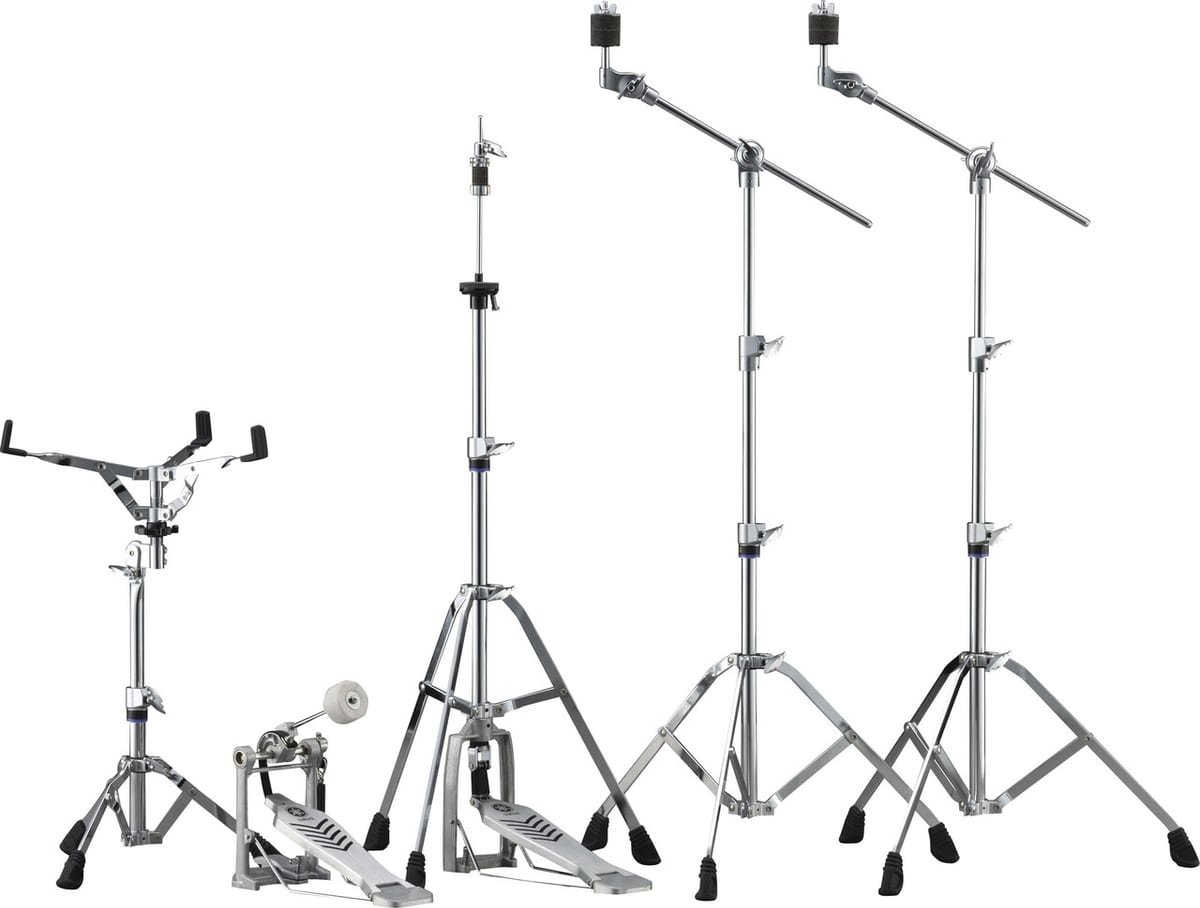
The third new product is the SS7S, a low-positioned version of the 7 Series snare stand for what Yamaha calls specialised positioning needs.
In plain English: a stand whose basket goes lower than a normal one. That matters if you sit low, if you play a snare flat and close, or if you are wedging a second snare or a pad into a hybrid setup where a standard stand simply will not drop far enough. It is a small, specific product for people who have been fighting a height limit for years.
Yamaha has not published a spec sheet or a price for it yet, so that is all anyone can honestly say about it today.
What is not in this refresh
Worth clearing up, because the model numbers overlap confusingly.
Crosstown is untouched. Yamaha’s aluminium lightweight line — the one people mean when they say “the light Yamaha stands” — is not part of this announcement.
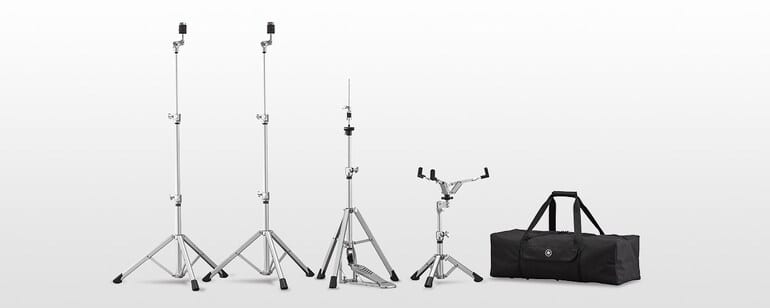
That is a slight shame, because lightweight hardware is where the interesting fight is right now — Tama finished its Spartan line three days ago with a four-stand kit where nothing weighs over 5.1lb. A Crosstown refresh with these tilters in it would have been the obvious answer. Maybe next year.
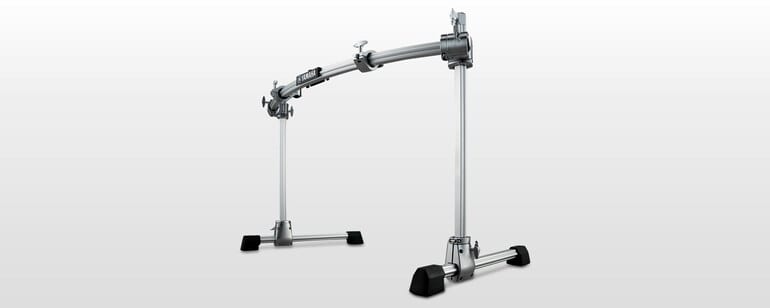
Hexrack II is untouched too.
And the pedals are unchanged — the FP9 range stays as it is. The one pedal story this year was back in January, when Yamaha reissued the FP-720 Classic, a nylon belt-drive single pedal from the 1990s, at $149.99. Different announcement, different month, but if you are shopping the whole Yamaha hardware catalogue it is the piece people keep missing. Our direct drive pedal guide explains why belt, chain and direct drive feel so different underfoot.
About those blue rings
You will have spotted them in the photos. Yamaha is putting blue accents across the refreshed hardware and pointing at Yamaha Motorsports while it does it — same corporate roof, same claimed engineering culture.
Is that a real engineering link or a paint choice with a story attached? Probably mostly the latter. But it does something useful anyway: at a glance, in a dim backline, you can tell the new stands from the old ones. Nice.
How much is it, and can I get one?
US pricing is out and stock is landing: $249.99 for the SS9WR, $95.99 for the CH8 long boom arm, $11.99 for a QRN8. The QRN8 was already showing out of stock at one US dealer on launch day, which is either strong demand or thin initial distribution.
UK and European pricing is the gap. Yamaha has the SS9WR and SS7S live on its UK site, but no GBP prices have appeared and no British retailer had a listing at the time of writing. If you are in the UK, watch rather than buy this week.
When it does land, the right shop depends on where you are: Guitar Center in the Americas, Gear4music in the UK, or Thomann for Europe and the rest of the world.
There is also a decent argument for the used market here. Yamaha hardware is famously hard to kill, and a refresh like this one tends to push perfectly good previous-generation stands onto Reverb at sensible money.
Final thoughts
This is a good refresh, and a boring one, and those two things are related.
Yamaha has not invented a new category. It has gone through fourteen stands replacing geared tilters with stepless ones, put better rubber where the drum touches the stand, and made a cymbal come off its post in one movement instead of eight. Every one of those changes is felt at soundcheck rather than admired in a photo.
The caveats are real: nobody has played one yet, every claim above is Yamaha’s own, there is no demo video, no UK price, and the SS9WR’s Flip Grip basket — the single most interesting thing in the announcement — has not been shown working in anyone’s hands. We will come back to it when it has.
But the direction is right. If you have ever missed the angle you wanted by one tooth of a tilter, this is the announcement for you.
More on the parts that hold a kit together in our hardware section, and the other half of Yamaha’s very busy day is in our EAD20 write-up.
Keep reading
News
Gretsch Catalina EVO | Gretsch's first e-kit
After 143 years of acoustic drums, Gretsch has launched the Catalina EVO e-kit, with full-size shells and Gretsch samples, from £1,839 / $2,199.

News
Nicko McBrain's memoir | Hello Boys and Girls!
Iron Maiden's Nicko McBrain tells his story in Hello Boys and Girls!, out now in the UK, with a European spoken-word tour to follow.

News
Joey Kramer is back | Aerosmith at the Bowl
Aerosmith's rehearsal photos put founding drummer Joey Kramer back behind the kit for the Hollywood Bowl on 29 October and 1 November.