Sabian AA MantaRay Chinese | Ray Luzier's 21in
Sabian has quietly added a 21in AA MantaRay Chinese, built with Korn's Ray Luzier. No press release, no price yet — here is what we know.

Sabian has a new cymbal out, and you would not know it from the noise around it. There has been no press release, no launch video and no retail listing — just an Instagram reel, a link in the bio, and a product page that appeared on sabian.com without ceremony.
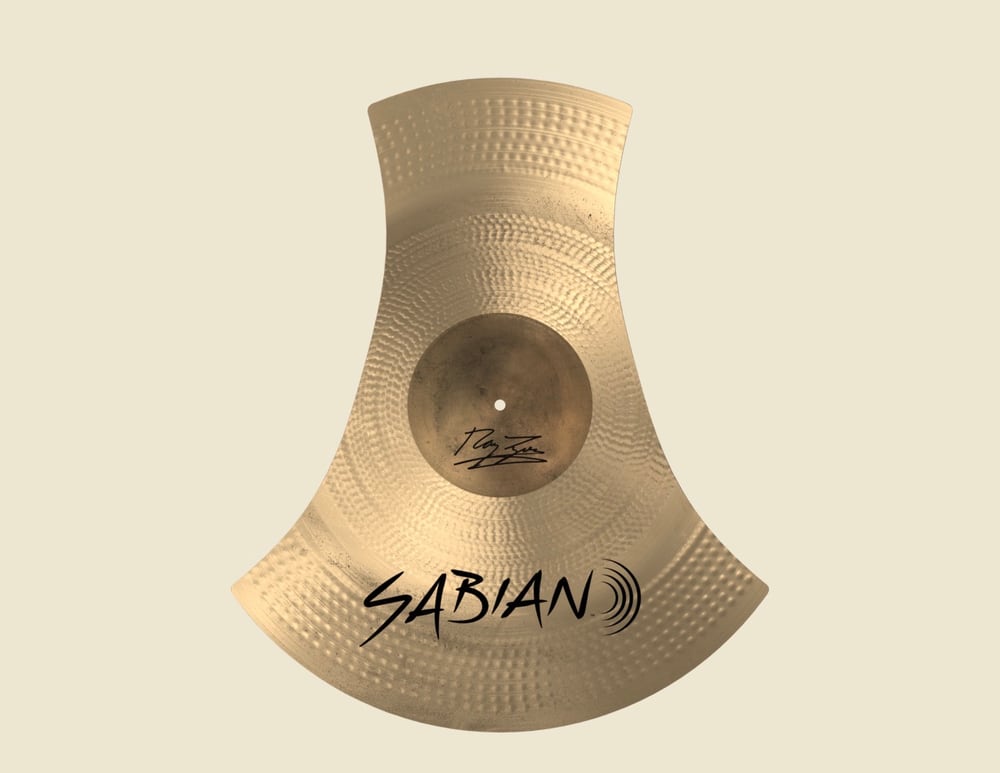
The cymbal is the 21” AA MantaRay Chinese, model 22116RL, and it is the second time Sabian has put the manta ray shape into production. This one was built with Korn’s Ray Luzier over more than a year.
It also looks like nothing else on a cymbal stand. So what is it, what does Sabian claim it does, and why can nobody tell you what it costs? Let’s find out.
What is the AA MantaRay Chinese?
It is a 21” china cymbal in Sabian’s AA line — B20 bronze, 80% copper to 20% tin, machine-hammered, and the same series that has been holding down rock and metal kits since 1981.
Where it stops being a normal china is the shape. A conventional china is a circle with a flanged edge. The MantaRay is not a circle at all: it is an asymmetric fan, pinched in at the top and flaring out to a wide, sweeping bottom edge, with a raw bell sitting off-centre in the middle of it.
Here is the reel Sabian used to announce it:
One thing to clear up before it trips anyone else up. The model number is 22116RL, and the 22 in it is a Sabian catalogue convention, not a diameter. This is a 21” cymbal. The Holy China in the same series is 22116CS and that is 21” too.
The spec sheet
Everything Sabian publishes about it, in one place:
| Model | 22116RL |
| Size | 21” |
| Series | AA |
| Material | B20 bronze |
| Weight | Medium |
| Feel | Articulate |
| Volume | Loud |
| Timbre | Bright |
| Pitch | Lower |
| Decay | Instant |
That bottom row is the interesting one. Lower pitch, instant decay is an unusual pairing to design for, and it tells you exactly what this cymbal is meant to do: drop a big, low, trashy explosion into a bar and then get out of the way before the next one.
Sabian’s own pitch is an accent that cuts through a mix without leaving a wash hanging over it — projection with control. On a modern metal kit, where the guitars occupy every frequency you own, that is a genuinely useful thing for a china to do.
The shape is the whole point
So why bother making a cymbal this awkward to manufacture?
Because a china’s character comes from its edge, and a circular china has the same edge all the way round. Make the edge asymmetric — narrow at one end, wide and sweeping at the other — and different parts of it want to move at different rates. You get more trash, a less tidy fundamental, and a decay that falls apart quickly rather than ringing on.
That is the theory, anyway. It is also why the thing looks like an axe head.
The practical upshot is a china you hit for punctuation rather than for sustain. If you already play the AA Holy China — the hole-punched Chad Smith design from 2010 — this is the same corner of the range, chasing a similar job with a completely different bit of geometry.
Ray Luzier’s part in it
Ray Luzier has been Korn’s drummer since late 2007, which is now the longest tenure anyone has had in that seat. Before that he spent eight years with David Lee Roth from 1997, toured with Jake E. Lee, and played in Army of Anyone alongside members of Stone Temple Pilots and Filter.
He grew up near Pittsburgh, started on piano at four, and went through the Percussion Institute of Technology in Los Angeles in 1994. Rush, AC/DC and Led Zeppelin are the names he tends to cite when asked what got him started.
He is also a long-standing Sabian player, and his listed setup is telling: 19” and 21” AA Holy Chinas, a 19” AAX X-Plosion Crash and a 20” HHX Complex Medium Ride. Two chinas. This is a drummer who was always going to end up with his name on one.
There is a lot more to him than the Korn gig — the eight years with David Lee Roth, the nine years teaching at Musicians Institute — and it is all in our full Ray Luzier feature.
Sabian describes the MantaRay as a collaboration developed with him over more than a year. Worth noting: at the time of writing, his own artist page on sabian.com still lists the Holy Chinas and makes no mention of the MantaRay at all — which is about as clear a sign as you get that this release is still rolling out.
Hang on, wasn’t there a Manta Ray before?
There was, and the two should not be muddled together.
Back in 2012, Sabian’s Cymbal Vote programme — fan-voted concept cymbals made in small batches — produced a 19” AAX Manta Ray. Same shape idea, different alloy treatment, smaller. Luzier demoed it on Sabian’s own channel, and so did Mike Portnoy, so it was a Cymbal Vote curiosity rather than one drummer’s signature model. Used ones still turn up, usually around the $260 mark.
The 2026 cymbal is a different animal on paper: AA rather than AAX, 21” rather than 19”, its own model number, and Sabian’s copy explicitly frames it as a fresh collaboration rather than a reissue.
So: same shape concept, revived and rebuilt. Not a resized reprint of the old one. If you liked the 2012 cymbal but found it thin or too bright, the move to AA at 21” is pointed squarely at you.
How much does it cost?
Nobody knows yet, and we are not going to invent a number.
Sabian’s product page carries no price and no ship date — just a “Find a Dealer” link. We checked Sweetwater, Guitar Center, Reverb, Drum Center NH, Adorama and eBay, and none of them list 22116RL or the MantaRay name at all.
For a rough sense of the territory, comparable 20–21” AA chinas from Sabian sit somewhere around the $300–$400 mark. Treat that as the shelf it will probably land on rather than a price we have been given, because we have not.
Two other things Sabian has not said, both worth knowing before you get attached: whether this is a limited run like the 2012 Cymbal Vote piece, or a standing catalogue item — and when it actually ships.
Where can I buy one?
At the moment, you can’t — not online, anyway. It is dealer-only until stock filters through, so a call to your local Sabian shop will get you further than any website will.
In the meantime, the used market is where the manta ray shape actually lives: the 2012 AAX version turns up on Reverb fairly regularly, and at used prices it is a cheap way to find out whether you get on with a china this odd before the new one has a price tag.
If you are shopping for a china more generally, our cymbal buying guide covers what actually separates the good ones, and the Gear Guru will put options side by side at your budget.
Final thoughts
The MantaRay is the most interesting-looking cymbal Sabian has released in a while, and the spec sheet backs the looks up — low, loud, bright and gone almost immediately is a specific and genuinely useful accent voice, not a marketing adjective salad.
The caveat is the obvious one: nobody outside Sabian and Ray Luzier has played it, there is no independent demo, and there is no price. Every word above about how it sounds comes from the manufacturer, and a spec sheet has never made a cymbal sound good.
What we would say is that the quiet launch is the odd part. A new AA cymbal, built with the drummer from Korn over a year, in a shape Sabian has not made since 2012 — and it arrives via a reel and a link in the bio. Whatever else it is, it deserved a bigger entrance than that.
For the series it belongs to, our Sabian AA page has the rest of the line and who plays what — and every cymbal he has played through the Korn years is on Ray Luzier’s Rig Vault page.
Keep reading

News
Clem Burke's last recordings | Blondie's High Noon
Blondie's 12th album, High Noon, lands on 26 February 2027 with the final recordings of co-founding drummer Clem Burke. Here's what to expect.

News
Rick Beato tours Noble & Cooley's drum factory
Rick Beato visits Noble & Cooley in Granville, Massachusetts, and sees Buffalo Trace 250th Anniversary snares go from barrel staves to finished drums.
News
Roland TD-07KV2 | Bigger pads for the TD-07
Roland has refreshed the TD-07 V-Drums with the TD-07KV2 and TD-07DMK2: a 10-inch snare, 8-inch toms, a second crash and an easier rack setup.