Ray Luzier | Korn's drummer since 2007
Ray Luzier spent eight years with David Lee Roth before taking one of metal's hardest gigs. His story, his playing, his Pearl and Sabian rig, and the MantaRay.
Replacing a band’s original drummer is a thankless job. Replacing the original drummer of a band whose entire sound is built on the drums is worse.
Ray Luzier has now done it for nineteen years, which is longer than the man he replaced was in the band.
He also arrived with a CV nobody expected: eight years with David Lee Roth, a Musicians Institute teaching post, and a decade of Los Angeles session work. Here is how a Pennsylvania kid with a jazz-band background ended up as the engine of Korn — and what he actually plays.
Who is Ray Luzier?
He was born on 14 June 1970 and grew up in West Newton, Pennsylvania, a small town about an hour outside Pittsburgh.
He started drumming young and is largely self-taught, which is a phrase that undersells what he actually did with it — he played jazz band, concert band and marching band all the way through school, which is a far broader grounding than most rock drummers get.
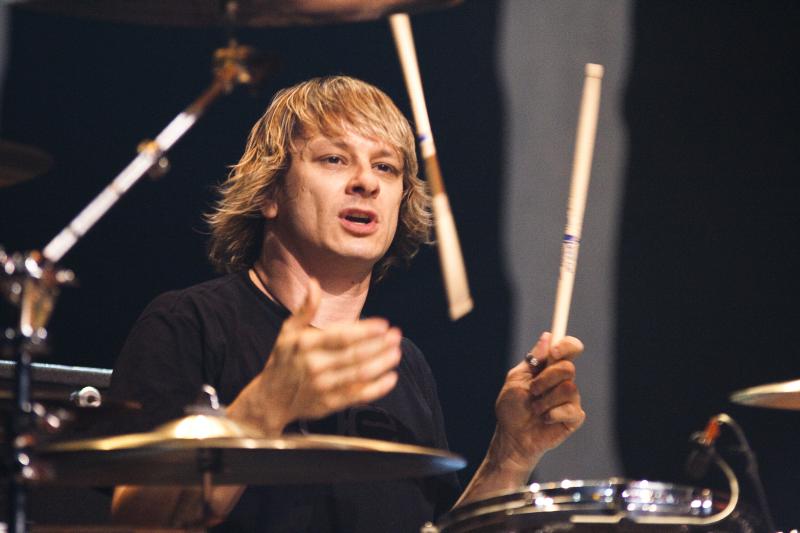
In 1988 he moved to Hollywood for the Musicians Institute, and graduated from its Percussion Institute of Technology in 1989.
Then something more unusual: he went back and taught there from 1992 to 2001, running rock classes and private lessons. Nine years of explaining how drumming works to other people, while trying to build a career of his own.
That teaching background is audible in his playing. Luzier is an exceptionally clear drummer — every note is deliberate and lands where he meant it to.
David Lee Roth, and the eight-year audition
His break came through Jake E. Lee, Ozzy Osbourne’s former guitarist. That led to the gig that made him: David Lee Roth, from 1997 to 2005.
Eight years playing for one of rock’s great showmen is a peculiar apprenticeship. The Roth band was a virtuoso operation — the drummer was expected to be flashy, loud and precise, in front of a frontman who would happily leave a hole in the arrangement and expect you to fill it.
He also spent that period doing session and clinic work, and turned up in Army of Anyone, the 2006 band built from members of Stone Temple Pilots and Filter.
None of which is the obvious route to Korn.
Korn
Original drummer David Silveria left in 2006, and the band spent a stretch working through drummers — including, briefly, Slipknot’s Joey Jordison.
Luzier flew to Seattle to audition in 2007, got the gig, and was made a full official member in April 2009.
That progression matters. He was not handed the job; he played his way into it over roughly two years of touring before the band made it permanent.
Nineteen years on, he has now played on more Korn albums than Silveria did.
Why the gig is harder than it looks
Korn’s music is built on detuned seven-string guitars and a bass sitting in the same register. There is almost no space in the middle of the mix.
The drummer’s job is therefore not to fill space but to carve it: hit hard enough to cut through two down-tuned guitars, but leave the low end alone so the bass can be heard. Play too busy and the whole thing turns to mud.
Silveria’s parts were also famously loose and funky in a way that is easy to imitate badly. Luzier plays them tighter and harder, and does not attempt to be him.
KXM and the side projects
In 2014 he released the first KXM album with George Lynch (Dokken, Lynch Mob) on guitar and dUg Pinnick of King’s X on bass and vocals. The band has continued across several records.
It is the outlet for the busier, more technical playing that Korn does not have room for.
What Ray Luzier actually does behind the kit
He is a power player with clinic-level control. Those two things rarely coexist. Luzier hits as hard as anyone in the genre, but he can also demonstrate exactly what he is doing at half speed to a room full of students — because for nine years, he did.
He is a china cymbal player, and that is his signature. Most drummers own one china and use it sparingly. Luzier builds his setup around them: two Holy Chinas, a trash stack, and now a signature china of his own. His accents are trashy, short and violent rather than clean and ringing.
He leaves the low end alone. No constant double-kick barrage, despite playing in a heavy band with two kick drums in front of him. The bass drum is used deliberately.
He is a genuine showman. The Roth years left a mark — a Luzier drum solo is a performance, not an endurance test.
Ray Luzier’s drum kit
Two brands have stayed constant since long before Korn: Pearl shells and Sabian cymbals. Almost everything else has moved around.
- The kit — Pearl throughout. The 2013 setup was Reference maple with a 24” kick. Around 2017 he switched to acrylic Crystal Beat shells, first in #731 Ruby Red and then the #730 Ultra Clear kit he took out on The Nothing tour from 2019 — the see-through kit most fans picture. For the 2024 European run Pearl built him a custom Reference One kit with his tech Mark Bennett.
- Two kick drums, not a double pedal — the 2024 rig runs a pair of 24x18 bass drums.
- A gong drum — a 20x14 single-headed drum where a third floor tom would sit. No snares, no reso head, just one low boom for the drops.
- Cymbals — Sabian, heavy on chinas. The AA Holy China has been a fixture for years, in both 19” and 21”, alongside an AAX X-Plosion crash and a 20” HHX Complex Medium Ride.
- Sticks — his own Vic Firth signature model, a 5B shaft married to the tip and taper of their Rock stick. In his words, blending his two favourite models into one.
- Heads — Evans, and he has been an Evans artist for a long time.
Every piece, era by era, is on Ray Luzier’s Rig Vault page with buy links.
The MantaRay
In 2026 Sabian released the 21” AA MantaRay Chinese, developed with Luzier over more than a year. It is an asymmetric, fan-shaped china rather than a round one — low, loud and trashy, with the decay falling apart almost immediately.
Sabian had made the shape once before, as a 19” AAX in 2012 under its fan-voted Cymbal Vote programme. The 2026 cymbal is a different series, a different size and a fresh design rather than a reissue. We covered the whole thing in our MantaRay story.
For a drummer who already had two chinas on the kit, a third with his own name on it is entirely in character.
Want the sound without the rig?
The Luzier sound is less about the shells than about how they are tuned and what is over them.
Tune low and dead, hit hard, and spend the money on chinas — that is where his character actually lives. The Sabian AA range is the obvious starting point, and if the budget says used, there are usually used cymbals on Reverb at half the price of new. Our Gear Guru will spec a whole kit to a number if you would rather not guess.
Where to start listening
- Korn — The Path of Totality (2011). His playing against dubstep production, which should not work and largely does.
- Korn — The Serenity of Suffering (2016). The heaviest record of his tenure, and the best argument for what he brought to the band.
- KXM — KXM (2014). The other Ray Luzier — busier, looser and far more exposed.
- David Lee Roth — DLR Band (1998). The showman years, and a reminder of how technical a player he was before metal claimed him.
Final thoughts
Luzier is the rare replacement drummer who stopped being a replacement. Nineteen years in, he is simply Korn’s drummer, and the debate about it ended a long time ago.
He is also proof that the boring virtues win: turn up, play it right, do not overplay, and be pleasant enough that a band keeps you for two decades. The teaching years show in everything he does.
The MantaRay is a fitting thing to have his name on — an odd, ugly, extremely loud cymbal designed to be hit once and then get out of the way.
See Ray Luzier’s full rig in the Rig Vault, read about the MantaRay, or have a look at Chris Slade — another drummer who spent his career being exactly what the band in front of him needed.