Chris Slade | The drummer on AC/DC's Razor's Edge
Chris Slade drummed for Tom Jones, Manfred Mann, The Firm and AC/DC across sixty-three years. His story, his playing, his gear, and his 2026 retirement.
Most drummers get one famous gig. Chris Slade got about six, and the odd thing is that almost nobody can name more than one of them.
Tom Jones at sixteen. Manfred Mann’s Earth Band. Uriah Heep. Gary Numan. David Gilmour. The Firm, with Jimmy Page and Paul Rodgers. Asia. And then, at 43, AC/DC — where he played on one of the biggest hard rock albums ever made and became, to most of the world, “the bald bloke on Thunderstruck”.
He retired in August 2026, at 79. Here is the whole story, what he actually did behind the kit, and the gear. Let’s get into it.
Who is Chris Slade?
Christopher Slade Pearce was born on 30 October 1946 in Pontypridd, south Wales.
That detail matters more than most birthplaces do, because it is also Tom Jones’s part of the world — and it is how a teenager ended up with a professional gig before he had finished growing.
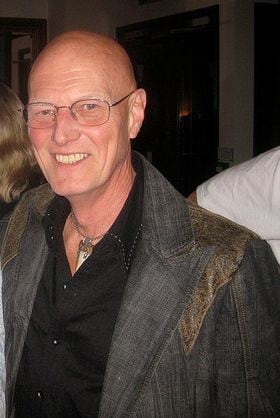
Tom Jones, at sixteen
Slade joined Jones’s backing band, The Squires, in 1963, aged 16. He stayed roughly seven years.
Think about what that apprenticeship actually was. “It’s Not Unusual” was recorded in 1965, when he was 18. From there it was television, Las Vegas, and world tours — night after night of playing for a singer, in front of audiences who had not come to watch the drummer.
That is where the whole career comes from. Slade learned to serve a song before he learned to show off, and he never really unlearned it.
He left in 1969, and his next move was one of the strangest in this entire article: a band called Toomorrow, put together for a film, whose singer was a young Australian named Olivia Newton-John.
Manfred Mann’s Earth Band
In January 1971 he became a founding member of Manfred Mann’s Earth Band, and stayed seven years.
Eight albums, three UK Top Ten singles, and a gig that has nothing whatsoever to do with the AC/DC job people know him for. The Earth Band were a progressive rock outfit who happened to have hits — twitchy, keyboard-driven, arrangement-heavy music that asked for a drummer who could handle odd sections without losing the groove.
Their version of “Blinded by the Light” is the one everyone has heard. It is also a genuinely awkward piece of drumming, and he makes it sound like nothing at all.
The Firm, Gilmour, and the eighties
The eighties are where the CV gets silly.
A spell with Uriah Heep at the turn of the decade. Work with Gary Numan, which is about as far from Uriah Heep as you can get without changing instrument. Then David Gilmour’s solo band in 1984.
And out of that came The Firm — the mid-eighties group with Jimmy Page on guitar and Paul Rodgers singing. Two albums, and a job that meant holding a stage down between a Led Zeppelin guitarist and the voice of Free.
1984 also brought the endorsement that outlasted everything: he became a Paiste artist that April, and was still playing them forty-two years later. Bands came and went. The cymbals did not.
He later spent six years in Asia, leaving in September 2005.
AC/DC, twice
The Razor’s Edge
Slade joined AC/DC in 1989, and the timing was extraordinary.
The band had spent the late eighties losing altitude. The Razor’s Edge, released in 1990, put them back on top of the world — and it is Slade on it, plus the live album that followed in 1992.
“Thunderstruck” and “Moneytalks” both come from that record, which means his playing has been on rock radio continuously for thirty-six years.
He left in 1994 when Phil Rudd returned to the band.
Rock or Bust
Then, in February 2015, AC/DC called him back. Rudd’s legal problems had ruled him out, and Slade — 68 years old — walked into a Grammy Awards performance and then a full stadium tour behind Rock or Bust.
Coming back to a gig twenty-one years later, at that age, at that scale, is not a normal thing for anyone to do.
What Chris Slade actually does behind the kit
Here is the honest assessment: he is not a flashy drummer, and that is the whole point.
He is enormous and he is simple. The AC/DC job is one of the hardest in rock precisely because there is nowhere to hide. No fills to cover a wobble, no dynamics to lean on — just a backbeat that has to sit in exactly the same place for two hours. Slade does it with a heavier hand than Phil Rudd and sits a fraction more on top of the beat, which gives the Slade-era live recordings a slightly more urgent shove.
He is a showman about it, though. The Razor’s Edge kit had two bass drums mounted at head height behind him, purely so an audience could watch him hit the “dum, dum” that had been overdubbed toms on the record. He also played that entire tour open-handed, with three separate sets of hi-hats around the kit. Nobody asked him to do either.
And the range is genuinely unusual. Progressive rock, new wave, blues rock, AOR and stadium rock, all played convincingly by one person. Most drummers who can do the Earth Band cannot do AC/DC, and almost none of the ones who can do AC/DC could have done the Earth Band.
Chris Slade’s drum kit
Two brands of shells across the famous years, and one brand of cymbals across all of them.
- The kit — Pearl through the AC/DC years, then DW from the Rock or Bust tour onwards. The interesting bit is that when he switched, he had DW build to the same sizes as the old Pearl kit. New badge, identical rig.
- The two raised kicks — a pair of bass drums slung high behind him on frames his tech built specially for the 1990 tour. Struck rarely, and entirely for the cameras.
- The snare — a DW Edge, brass and maple, from 2015 on. His verdict: “that snare sounds fantastic.”
- Cymbals — Paiste, since April 1984. The Rock or Bust setup ran a 14in Signature Reflector Heavy Full Hi-Hat, 18in and 20in Signature Full Crashes and a 20in Signature Power Crash.
- The hi-hat moved — he played the Razor’s Edge tour open-handed with hats scattered around the kit, then went back to a conventional hi-hat-on-the-left setup for 2015.
- Pedals and hardware — Pearl, then DW. Single kick, because this is AC/DC.
- Heads and percussion — Remo throughout, with LP percussion in the later rigs.
Every piece, era by era, is on Chris Slade’s Rig Vault page with buy links.
Want the sound without the rig?
You need far less than you think. The Slade sound is a big, dead-simple kit hit hard and tuned low — one kick, one snare, a couple of toms, and cymbals with enough weight to survive being crashed all night.
The cymbals are where the money goes, and the Paiste range is the obvious starting point if you want that bright, cutting classic-rock voice. If your budget says used, the Reverb price guide will tell you what a second-hand Signature crash is actually worth before you bid, and there are usually plenty of used cymbals on Reverb. Our Gear Guru will spec the whole thing to a number if you would rather not guess.
The Chris Slade Timeline
The last chapter was his own band.
The Chris Slade Timeline toured Europe playing music from across his career — which, given that career, is a properly varied setlist. They released their debut album, Timescape, in 2024: a double, one disc of originals and one of covers.
He was still touring it when he announced his retirement. There is also an autobiography in progress, which he has joked may need to run to three volumes.
Given the CV, he is probably underestimating.
Where to start listening
- AC/DC — The Razor’s Edge (1990). Obviously. Listen past “Thunderstruck” to “Fire Your Guns” and “Mistress for Christmas” for the actual drumming.
- AC/DC — Live (1992). The better argument for him. Two hours of a very hard, very steady right hand.
- Manfred Mann’s Earth Band — The Roaring Silence (1976). The opposite drummer, same man.
- The Firm — The Firm (1985). Page and Rodgers, with Slade doing the unglamorous job of making that band swing.
Final thoughts
Chris Slade spent sixty-three years being the right drummer for whoever hired him, which is a less romantic skill than being a genius and a considerably rarer one.
He is also the clearest argument on this site against measuring drummers by chops. Nothing he played on The Razor’s Edge is technically hard. Almost nobody plays it as well as he did.
“I’ve had a good innings” is about right.
See Chris Slade’s full rig in the Rig Vault, read the full retirement story, or have a look at Phil Collins — another British drummer whose career was decided by his body rather than his playing.