Premier Rods | 16 maple dowels or 55 nylon
Premier has quietly added rods to its accessories line: a 16-dowel maple set and a 55-dowel nylon set. No press release, and no price yet.
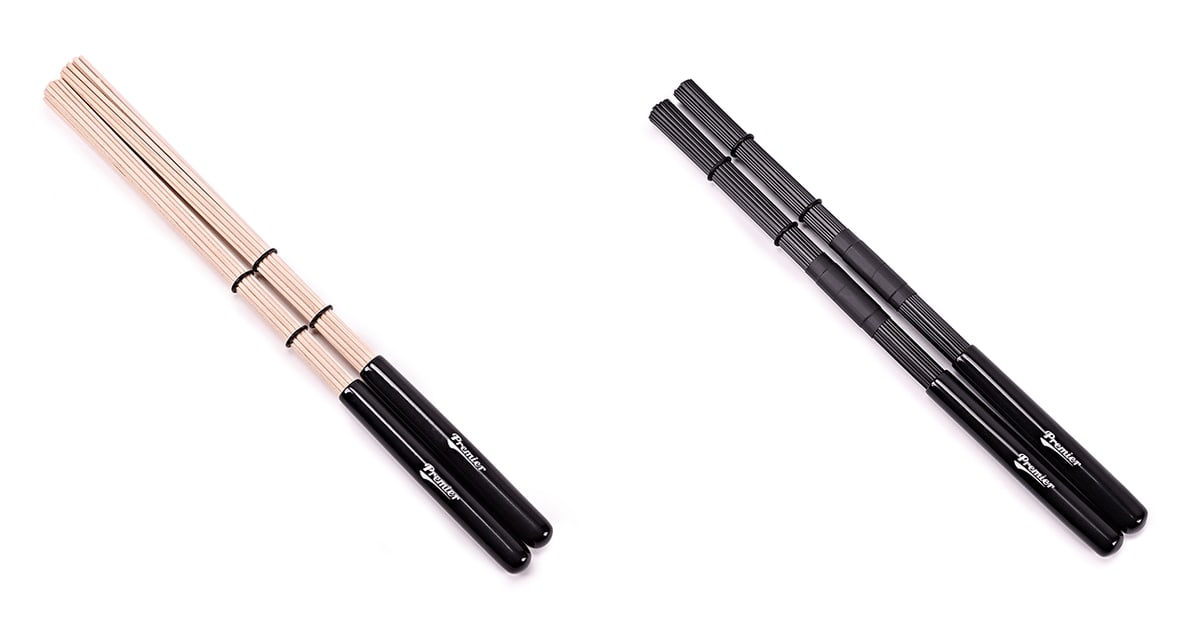
Premier has put rods in the catalogue. There has been no press release, no launch video and no retailer listing — just an Instagram post, a link in the bio, and a product page that turned up on premier-percussion.com without anybody being told.
There are two of them: Maple Rods and Nylon Rods. On the face of it that is a wood option and a plastic option, the way every rod maker splits its line.
Look at the numbers, though, and the gap between the two is much wider than a material swap. Let’s get into it.
What is a rod, anyway?
The thing that sits between a stick and a brush.
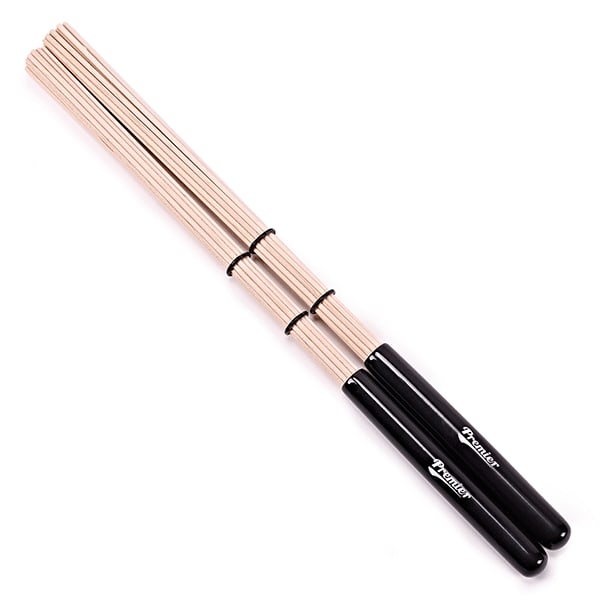
A stick is one lump of wood and it hits like one. A brush is a fan of wires that barely has an attack at all. A rod is a bundle of thin dowels lashed together, so it lands with a bit of spread and a bit of give — quieter than a stick, but with an actual transient at the front of the note that a brush can’t give you.
That is the whole pitch, and Premier’s copy makes it: reduced volume, but “greater clarity and projection than brushes”. It is the accessory you reach for when the room is small, the gig is unplugged, or the singer has asked you nicely.
None of this is new. Rods — also sold as rutes or hot rods — have been a category for decades, with ProMark generally credited for popularising them and Vic Firth, Vater and Meinl all fielding their own. Premier is filling a gap in its own accessories drawer rather than inventing anything.
The two sets
Here is where it gets more interesting than “one wood, one plastic”:
| Maple Rods | Nylon Rods | |
|---|---|---|
| Model | PM-MAPRODS | PM-NYLRODS |
| Material | Natural maple | Black nylon |
| Length | 16.9” (430mm) | 15.6” (395mm) |
| Dowels | 16 | 55 |
| Dowel diameter | 3mm (0.12”) | 2mm (0.08”) |
Sixteen dowels versus fifty-five. That is not a colour choice, that is two different instruments.
Sixteen 3mm maple dowels is a coarse bundle. Fewer, fatter rods mean each one carries more of the hit, so you get a defined, stick-ish attack and a bundle that still behaves a bit like a solid stick when you dig in.
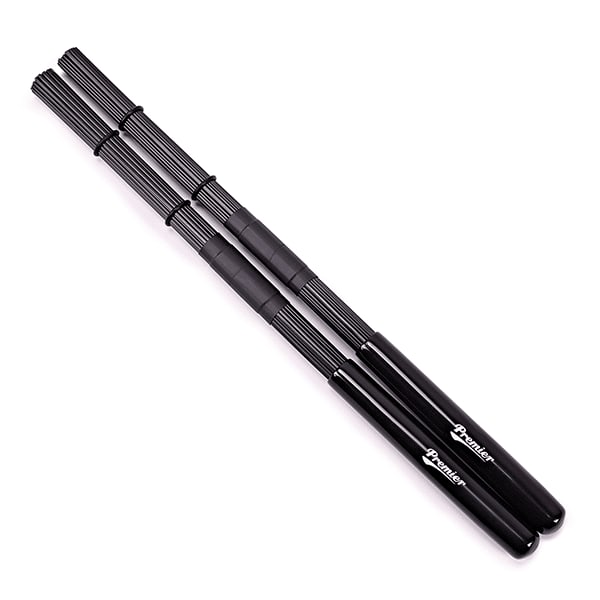
Fifty-five 2mm nylon dowels is something else entirely — a dense, fine bundle that spreads the impact across far more contact points. Expect a softer, wider, more diffuse sound, closer to the brush end of the range than the stick end.
The Nylon Rods are also over an inch shorter, at 15.6” against 16.9”, which is a noticeable difference in reach and balance if you swap between them mid-set.
Maple or nylon — which one do you want?
The material split follows the usual rules of the category.
Wood dowels give you a sharper, more open, more natural attack. They also chip and splinter, and if you play rods hard the wood set is the one you will be replacing. Maple in particular is a light, bright, comparatively soft wood — our drumstick wood guide covers how it behaves against hickory and oak, and the same logic applies here.
Nylon dowels are warmer and lighter-sounding, and they last. Synthetics don’t split the way wood does, so a nylon set will outlive a maple one by a comfortable margin.
Put the dowel counts on top of that and the choice is fairly clear. Maple if you want articulation and something that still feels like a stick. Nylon if you want the quietest, smoothest option Premier makes and you want it to survive the year.
The rings are the volume knob
Both sets carry adjustable rubber rings, and they are the bit worth understanding before you buy any rods at all.
Slide the rings up towards the tips and the bundle tightens. The dowels move as one, and you get more attack, more focus and a shorter note — the closest a rod gets to a stick.
Slide them back towards the handle and the tips are free to spray. Softer, wider, more decay, less definition.
That is your tuning control, and it means one pair covers a decent range rather than a single fixed sound. It is a standard feature across the category, not a Premier innovation, but it is good to see on both models rather than just the expensive one.
One caveat: the handles
Premier has fitted both sets with “easy grip plastic handles”, and this is the spec I would want to try before buying.
Several premium rods use a hickory handle specifically so the thing feels like a drumstick in your fingers — same density, same balance point, same response to being spun. A moulded plastic handle is a different feel and, usually, a different price bracket.
That is not automatically a mark against them. Plastic is grippier with sweaty hands and it doesn’t dent. But if you are coming off a hickory-handled set, expect it to feel unfamiliar.
The announcement
Here is the post Premier used to launch them:
That really is the extent of it. The link in that post carries Premier’s own Instagram tracking tags, so the reel was the launch — and the product page has no archived snapshot at all, which is about as clear a sign as you get that it went up days rather than months ago.
How much do they cost?
Nobody knows, and we are not going to make a number up.
There is no price on Premier’s product page — the site is a brand catalogue with a “where to buy” flow rather than a shop, so its hickory sticks don’t carry prices either. We checked Gear4music, Guitar Center and drumfactorydirect and none of them list PM-MAPRODS or PM-NYLRODS. Nothing has a ship date.
For a rough sense of the shelf, rods from the established brands generally sit somewhere in the £15–£30 bracket, well under what you would pay for a decent pair of specialist brushes. Treat that as the neighbourhood the category lives in, not as a Premier price, because Premier hasn’t given us one.
Where can I buy one?
Today, you can’t. There are no listings anywhere, and until stock filters through to dealers that is unlikely to change.
If you want rods now, the rest of the category is well stocked. The right shop depends on where you are: Guitar Center in the Americas, Gear4music in the UK, or Thomann for Europe and the rest of the world.
And if the actual problem is that your kit is too loud for the room, rods are only half the answer — the cymbals are usually the louder half. Our low volume cymbals guide deals with that end of it, and the Gear Guru will line options up at your budget.
Final thoughts
There is nothing exotic here, and there doesn’t need to be. Rods are a solved problem, and Premier has walked into the category with a sensible pair of options and adjustable rings on both.
The part that shows some thought is the 16-versus-55 split. Plenty of brands offer a wood set and a synthetic set that are otherwise identical bundles. Premier has made the maple one coarse and stick-like and the nylon one fine and brush-like, so the two models actually do different jobs instead of just looking different.
The caveats are the usual ones for a quiet drop, and they are not small: no price, no retail listing, no ship date, and nobody outside Premier has played a pair. Every word above about how they sound is inference from a spec sheet and Premier’s own copy, not from anyone hitting a drum with them. The plastic handles are the one spec I would want in my hands first.
Still — it is a good sign that the company is filling out its accessories line, coming not long after Premier’s new Artist Octobans landed the same quiet way. And a 100-year-old British firm that Phil Collins built a career behind is entitled to a low-key launch or two.
Keep reading

News
Bonham Drumheads is now Kitson Drumheads
The independent UK drumhead maker has finished the rebrand it began in September. The name is new, but the team, heads and pricing are said to be unchanged.
News
Meinl HCS Dark | A dark-finish set for $400
Meinl's entry-level HCS cymbals now come in a dark finish. The 14/16/20 Complete Set is about $400 / €399, aimed at students and rock and pop players.
News
Gretsch Catalina EVO | Gretsch's first e-kit
After 143 years of acoustic drums, Gretsch has launched the Catalina EVO e-kit, with full-size shells and Gretsch samples, from £1,839 / $2,199.