Millenium MPS-1500 Hybrid-X | 8 pads, £1,219
Thomann's house brand has a new flagship e-kit — eight wood-shelled pads, an 18in triple-zone ride and 3,622 sounds for £1,219. Here is what you get.
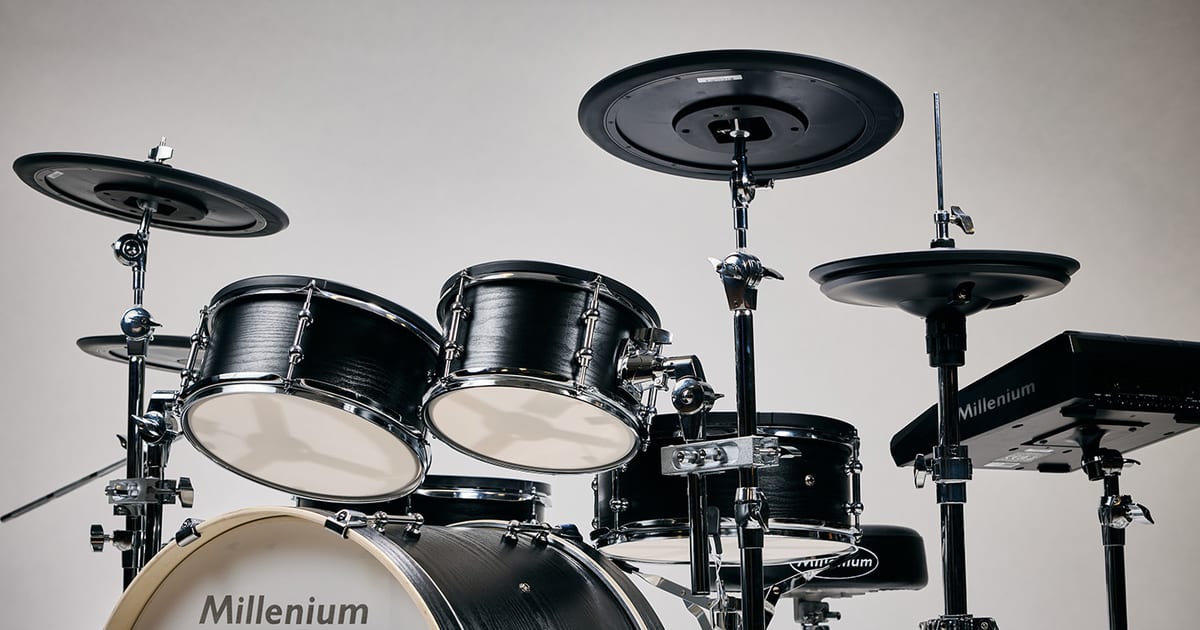
Millenium is Thomann’s own-brand label, and for most of its life that has meant one thing: the kit you buy when the Roland costs three times as much.
Today the brand went somewhere else entirely. The MPS-1500 Hybrid-X launched this morning at €1,398 — £1,219 in the UK — and the spec sheet reads like a kit that should cost considerably more: eight full-size pads on real wood shells, an 18” triple-zone ride, and a module that is really a nine-pad multi-percussion pad in disguise.
So has Thomann’s budget label just built a serious instrument, or is this a spec sheet with nothing behind it? Let’s find out.
What is the MPS-1500 Hybrid-X?
It is Millenium’s new flagship, replacing the MPS-1000 at the top of a range that runs all the way down to the five-pad starter kits we cover in our electronic drum kit buying guide.
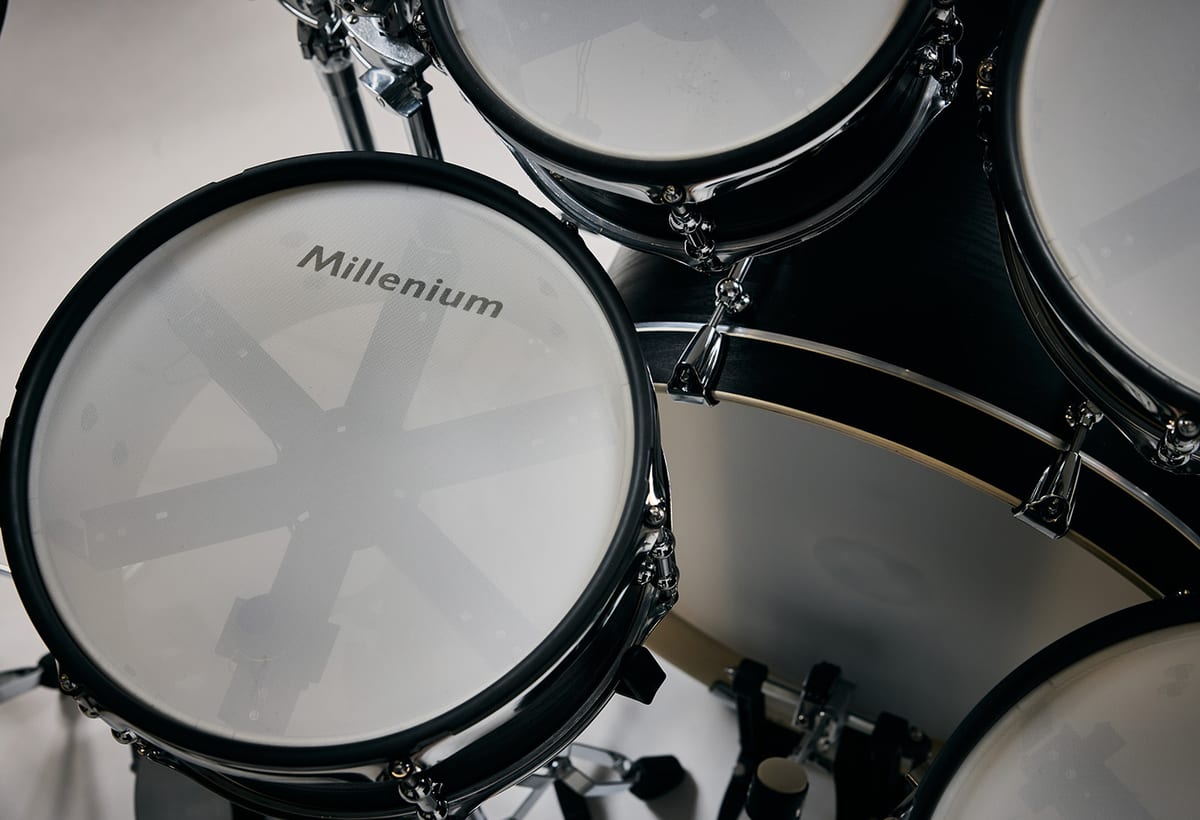
The pitch is an electronic kit that looks like an acoustic one. Every shell is real wood with a mesh head over it, so the thing on your riser reads as a drum kit from ten feet away rather than as a set of pads on a cage.
That idea is not new — Roland has been selling it as the VAD series for years — but it has not previously turned up at this money.
Here is the kit itself, posted to Instagram on launch morning:
The kit: eight pads, and a proper 22” kick
Here is the full configuration:
| Piece | Size | Zones |
|---|---|---|
| Bass drum | 22” x 16” | — |
| Snare | 13” x 5.5” | Dual |
| High tom | 10” x 6” | Dual |
| Mid tom | 12” x 6” | Dual |
| Floor tom | 14” x 14” | Dual |
| Hi-hat | 13” | Dual, with foot controller |
| Crashes (x2) | 15” | Dual, with choke |
| Ride | 18” | Triple — bow, edge, bell |
Two things stand out.
The first is the kick. A 22” x 16” bass drum pad is a full-size acoustic shell, not the shortened 18” or 20” drum that e-kits at this price usually get away with — the outgoing MPS-1000 ran a 20” x 16”. If you have ever set a double pedal up on a shallow e-kick and watched it wander, you will know why the extra depth matters.
The second is the ride. Eighteen inches, three zones, with a choke. Bell definition is the thing budget e-kits get most obviously wrong, and putting a real bell zone on an 18” pad at this price is the single most encouraging line on the spec sheet.
The cymbals all choke, including the two 15” crashes. That sounds like a footnote until you play a song that ends on one.
The Nexus module is the interesting part
Millenium calls the brain the Nexus Multi-Percussion Pad, and the name is doing real work. It is not just a module bolted to a rack — it is a nine-pad sample pad in its own right, the sort of thing you would normally buy separately and clamp on the side of the kit.
The numbers: 3,622 sounds, 160 kits (80 factory, 80 of your own), two sounds layered per pad, and a 4.3” colour screen to find them on.
For your own samples you get 600 slots and 500MB of onboard storage, loaded over USB. Effects run to a four-band EQ, compressor, reverb, chorus and delay.
Then there is the gigging stuff, which is where this stops looking like a practice kit:
- Eight balanced direct outs on 6.3mm jacks, on top of the master and headphone outputs. That is multitrack recording, or a proper in-ear mix, without a laptop in the chain.
- Setlists, so a whole night’s kit changes are in order before you sit down.
- Pad Link, for chaining triggers together.
- Per-pad RGB lighting, 16 colour presets, which is either a gimmick or the difference between hitting the right pad and the wrong one on a dark stage. Probably both.
- Bluetooth audio, a 3.5mm aux in, USB audio and MIDI, and a footswitch input.
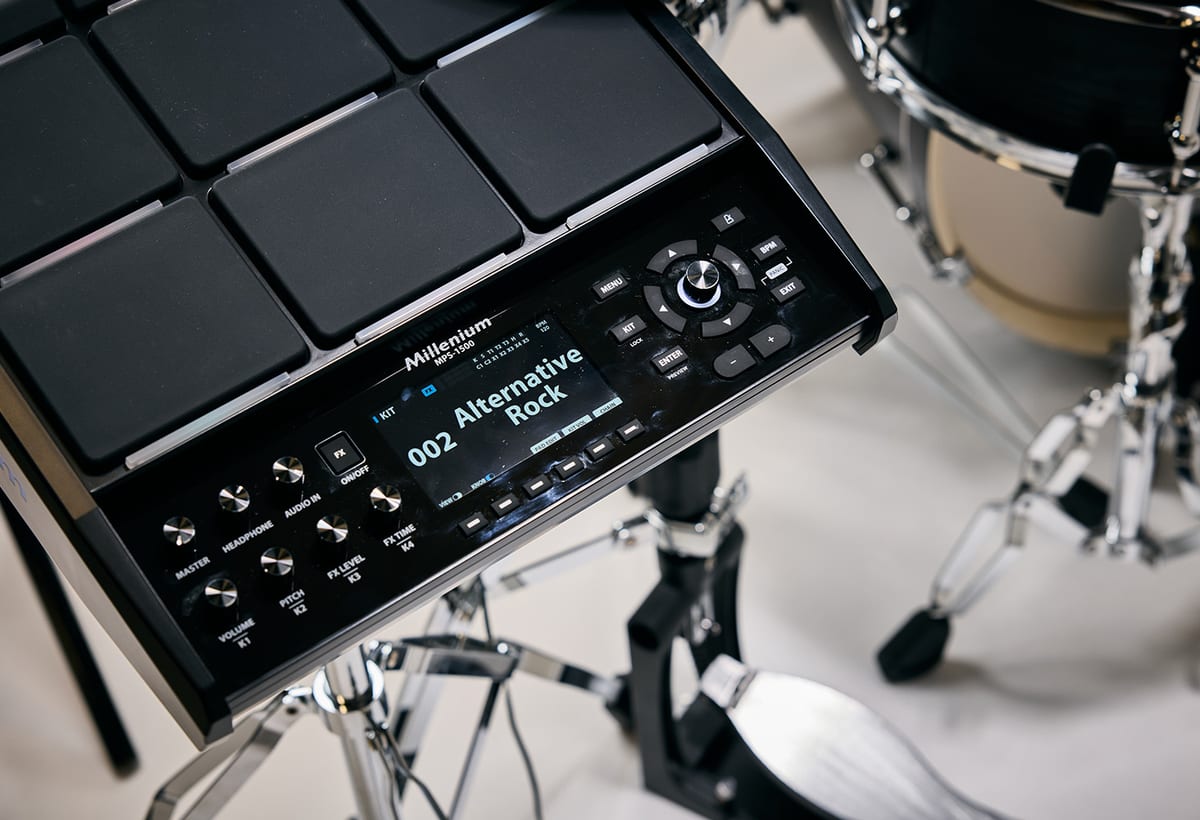
It all runs standalone. No computer required.
Fourteen trigger inputs, and room to grow
The module carries 14 trigger inputs in total — the nine pads on its own surface plus five spare.
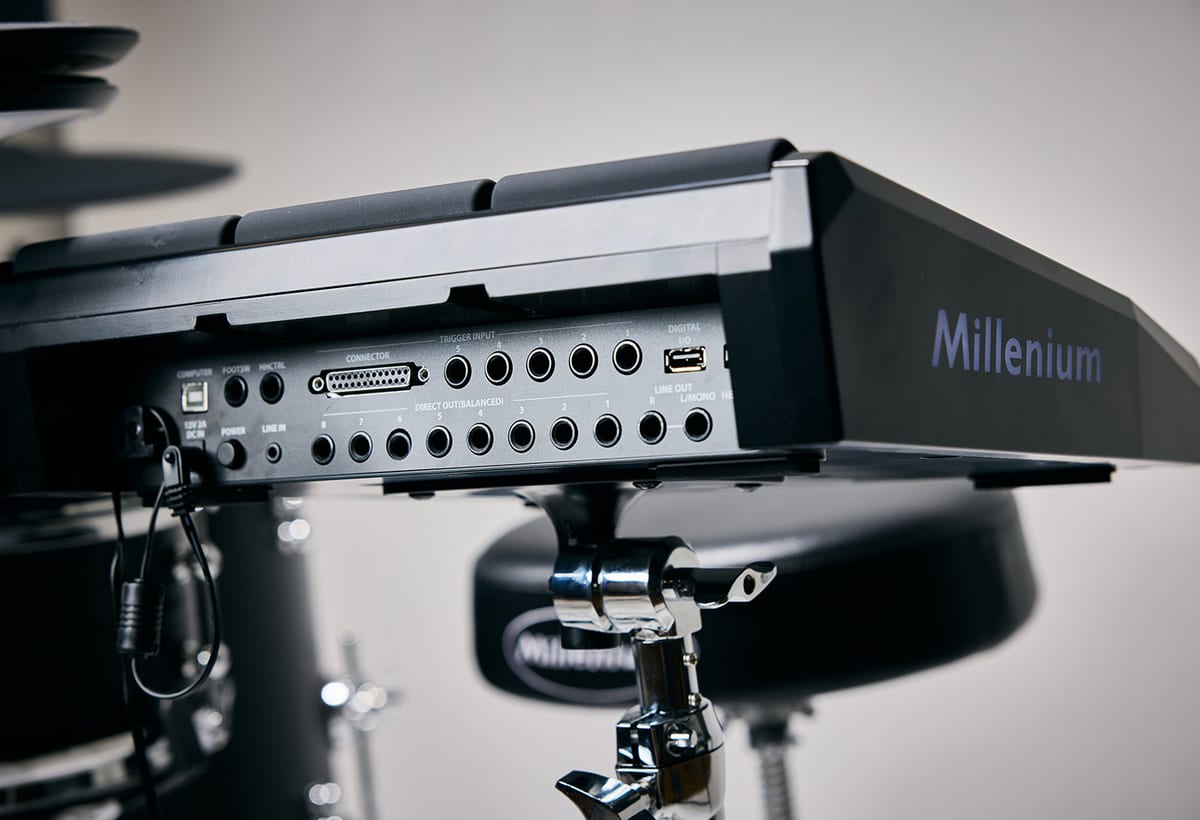
This is the one part of the spec sheet we can check for ourselves rather than take on trust. The eight balanced direct outs and the five spare trigger inputs are right there on the back panel, alongside the multi-pin connector that carries the kit’s own pads.
Bonedo, who ran the most detailed first look at launch, count that as headroom to take the whole instrument up to 23 pads if you keep adding triggers. That is their arithmetic rather than a figure Millenium prints, so treat it as a sensible read of the spec rather than an official claim.
Either way, the five spare inputs are the useful number. Five is enough for a china, a splash, an extra tom and a couple of triggers on an acoustic kit — and our guides to electronic china pads and splash pads cover what to hang off them.
How much, and what is actually in the box
€1,398, or £1,219 on Thomann’s UK store (item #622576). There is also a bundle SKU at £1,299, so £80 buys you the extras.
Included: a bass drum pedal, a hi-hat stand, a snare stand, two tom arms with multiclamps and three cymbal stands.
Not included, and worth reading twice: no rack, no throne, no headphones. For a kit built around wood shells and stands rather than a cage that is a defensible design choice, but check with your dealer exactly how the toms mount before you order, because “two tom arms with multiclamps” needs something to clamp to.
Thomann is also throwing in a 90-day Drumeo trial with purchases between 15 July and 14 October 2026. Nice, but it is a launch promotion rather than part of the instrument — do not let it decide anything.
One gap: we could not find US pricing or availability at the time of writing. Treat this as an EU and UK launch until Thomann says otherwise.
Is this a Roland VAD rival?
On paper, it is aiming squarely at that territory — and at Yamaha’s DTX and EAD end of the market — for meaningfully less money.
But here is the caveat, and it matters more than everything above. Nobody outside Millenium has played this kit yet. It launched today, and every specification in this article comes from the manufacturer and its retailer.
Sound quality, latency, trigger sensitivity, how the mesh heads feel after six months, whether 3,622 sounds includes 3,000 you will never use — none of that is knowable from a spec sheet, and all of it is what actually separates a good e-kit from a long list of features.
There is history here too. MusicRadar’s review of the outgoing MPS-1000 praised the build and the value but found the samples thin, and concluded it worked best as an affordable controller for software like Superior Drummer rather than as a module you would gig. The MPS-1500’s bigger sample set, direct outs and live features read as a direct answer to that — but reading like an answer and being one are different things.
If you want the safe comparison, the Roland TD-50X is what a fully proven flagship costs. The gap in price is enormous. The gap in performance is the open question.
Hear it in action
Here it is being put through its paces:
Worth remembering what a launch video is and is not. It is the kit playing at its best, recorded and mixed by the people who built it — genuinely useful for hearing the sample set and watching the pads respond, and no use at all as a verdict. That still waits for someone independent to sit behind it.
Where can I buy one?
Millenium is Thomann’s house brand, so there is only one shop — you will not find this at Guitar Center or Gear4music. It is available now direct from Thomann, worldwide.
If the MPS-1500 is more kit than you need, the used market is worth a look first — there are usually electronic kits on Reverb at prices that make a two-year-old flagship look very sensible.
Final thoughts
The MPS-1500 Hybrid-X is the most ambitious thing Millenium has built, and the ambition is in the right places: a full-size kick, a triple-zone ride, choke on everything, and eight direct outs on a kit costing four figures rather than five.
It is also entirely unproven, on a launch day with no independent test anywhere in the world. Both of those things are true at once, and anyone telling you today whether it sounds good is guessing.
Our advice is the same as it always is with a brand-new e-kit: wait for someone to hit it. If you are shopping now, read up on mesh heads before you commit to a feel, or ask the Gear Guru what it would put against this at your budget.
Keep reading
News
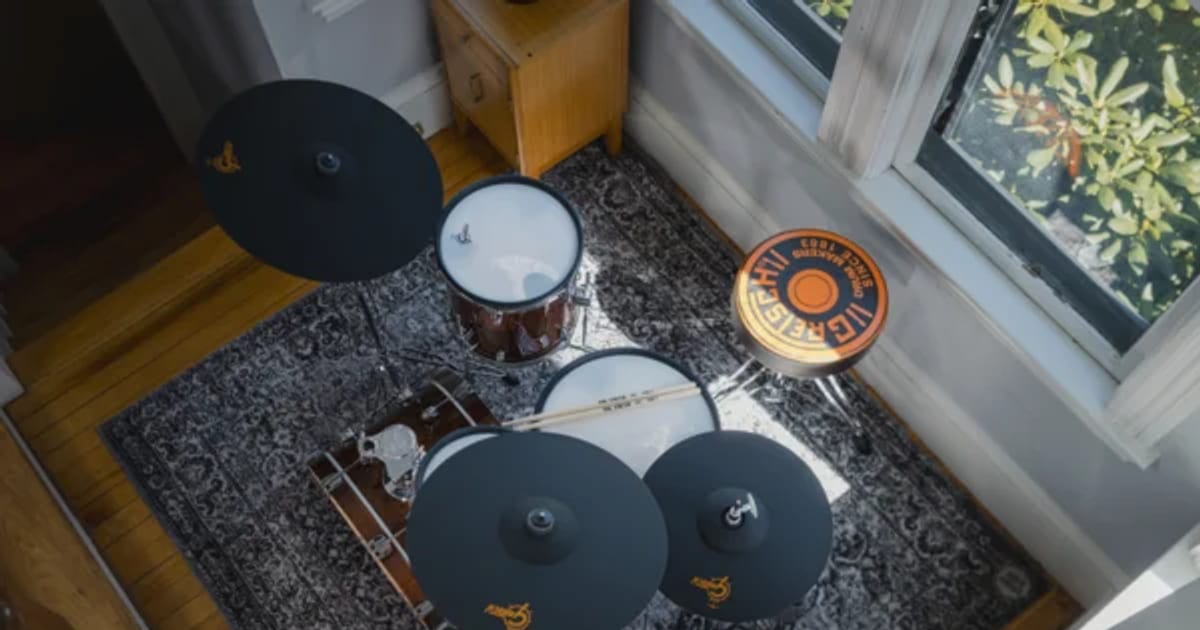
Gretsch Catalina EVO | Gretsch's first e-kit
After 143 years of acoustic drums, Gretsch has launched the Catalina EVO e-kit, with full-size shells and Gretsch samples, from £1,839 / $2,199.

News
Nicko McBrain's memoir | Hello Boys and Girls!
Iron Maiden's Nicko McBrain tells his story in Hello Boys and Girls!, out now in the UK, with a European spoken-word tour to follow.

News
Joey Kramer is back | Aerosmith at the Bowl
Aerosmith's rehearsal photos put founding drummer Joey Kramer back behind the kit for the Hollywood Bowl on 29 October and 1 November.