Evans Hybrid puts sensors on real cymbals
Evans and Sunhouse have built cymbal and hi-hat sensors that trigger from real low-volume bronze. Proper rebound, 80% quieter, and no rubber pad in sight.
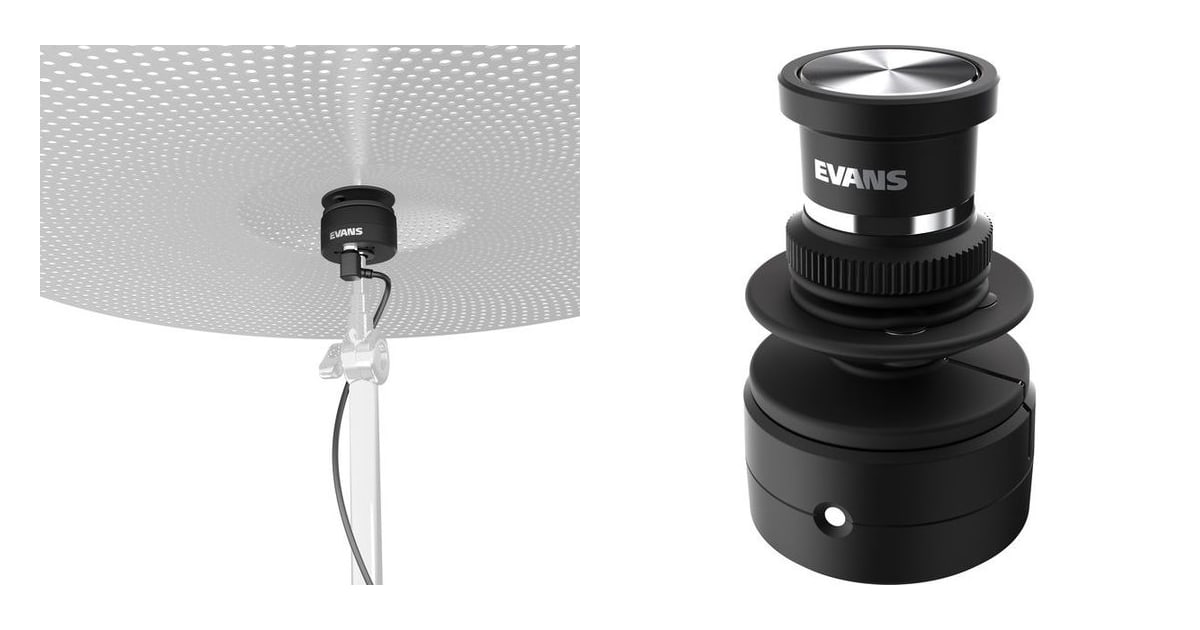
Every electronic drummer makes the same trade. You get silence, and you give up cymbals.
Not the sound of cymbals — that problem is being solved, and we wrote about Zildjian’s samples landing on Alesis kits a fortnight ago. The feel. A rubber pad does not rebound like bronze, does not choke like bronze, and does not do that thing where you catch the edge at an angle and get a completely different noise.
Evans and Sunhouse have gone at it from the other end. Instead of making a pad that behaves more like a cymbal, they have put a sensor on an actual cymbal.
How does it work?
Sensory Percussion has been doing this for drums for years. You stick a sensor on the shell, it listens to the drum, and the software works out not just that you hit it but where — centre, edge, rimshot, cross-stick — and fires a different sound accordingly.
The new bit is that the same idea now covers cymbals. There is a Cymbal Sensor and a separate Hi-Hat Sensor, and they mount on real cymbals.
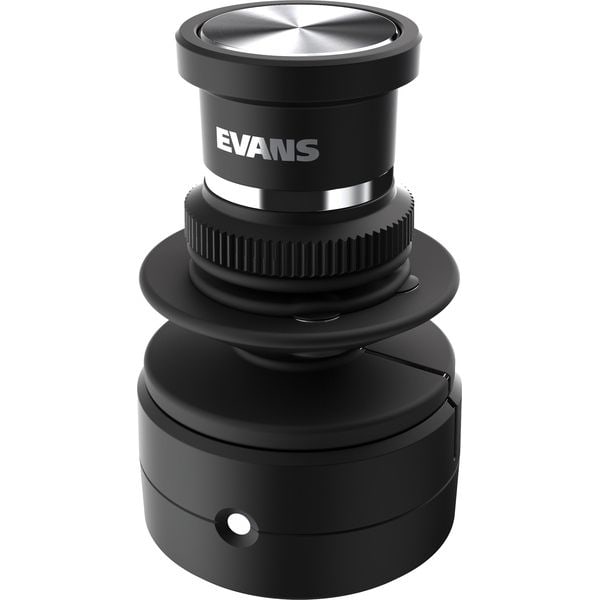
That knurled collar is the mounting clamp. The sensor sits on the stand underneath the cymbal, so there is nothing sitting on top of the bronze getting in the way of your stick.
Specifically, they are built around Evans’ own dB One low-volume cymbals, which is the clever part of the whole design. dB One cymbals are real bronze with the volume engineered out of them, so you get genuine cymbal rebound, genuine stick response and genuine choke — at around 80% quieter than a normal cymbal.
Put a sensor on one of those and you have solved both halves at once. Your ears get quiet. Your hands get a cymbal.
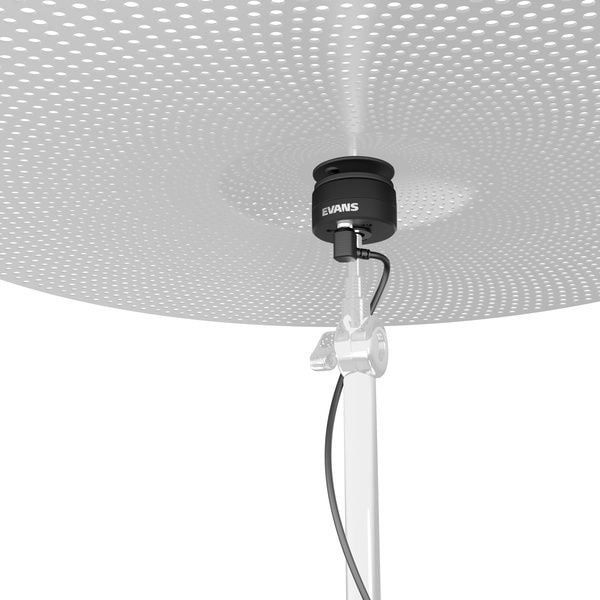
Look at all those holes. That is where the volume went.
What is in the bundle?
The full Hybrid Sensory E-Kit Bundle is the whole system in a box:
- 4 drum sensors
- 2 cymbal sensors
- 1 hi-hat sensor
- A 20” dB One ride, an 18” dB One crash and 14” dB One hi-hats
- The Portal audio interface
- Sensory Percussion 2 software
Bought separately, the Cymbal Sensor is $249.99 and the Hi-Hat Sensor $349.99, so if you already own a Sensory Percussion rig and some dB Ones, you can add cymbals to what you have rather than starting again.
The catch
There is a significant one, and it deserves to be right here rather than buried.
The sensors only work with the Evans Portal interface and Sunhouse’s Sensory Percussion software. They will not talk to a Roland module, an Alesis module, or anything else with a trigger input on the back. This is a closed system.
That means a computer is part of your kit. For a studio, that is nothing — the computer was already there. For a pub gig on a wet Tuesday, it is one more thing that can decide not to boot.
The second catch is money. Add up a full bundle and you are in the same territory as a serious electronic kit, and comfortably past what a good acoustic kit and a set of low-volume cymbals would cost you.
Who is this actually for?
Not the person who wants to practise quietly at eleven at night. A mesh-head kit does that for a fraction of the price — our mesh head guide covers that route properly.
This is for the drummer who plays an acoustic kit, records at home, and wants their own kit triggering their own sounds without swapping instruments to do it. You keep your snare, your shells and your technique, and the electronics come to you.
If that is you, it is a rather elegant answer. If it is not, it is an expensive one.
Hear it in action
This is one of those things you have to hear rather than read about — the whole claim rests on whether the response feels and sounds like a cymbal. Here it is being demonstrated:
Watch the hi-hat playing in particular. Half-open positions are where most electronic hi-hats give themselves away.
Where can I buy one?
The right shop depends on where you are: Guitar Center in the Americas, Gear4music in the UK, or Thomann for Europe and the rest of the world.
Final thoughts
For years the interesting work in electronic drums has been about making fake things feel real. This is the opposite bet — keep the real thing, and make it quiet enough and smart enough to behave like a fake one.
We think that is the better bet, and the cymbals are where it pays off most obviously. Nobody has ever put a rubber cymbal pad in front of a drummer and had them say “oh, that is exactly right”.
Start with our low volume cymbals guide if the quiet-bronze idea is new to you — it explains what the holes actually do and which sets are worth your money. Then have a look at the Yamaha EAD10 for the cheapest way to get an acoustic kit talking to a computer, and the Roland TD-50X for what the traditional route costs at the top end.
Keep reading

News
Craviotto | Nashville showroom now open
Craviotto's showroom at its Nashville HQ opened to the public on 1 October, so you can now play the solid-shell drums before you buy.

News
Neil Peart doc | How to watch No One's Disciple
Neil Peart: No One's Disciple has Carey, Copeland, Harrison and Chad Smith playing Rush with Lee and Lifeson. Here's where to watch it properly.

News
Journey's drum tech | Steve Toomey saves Tulsa
Deen Castronovo was helped off stage two songs into Journey's Tulsa show. His drum tech, Steve Toomey, sat down and played the rest of the set.