Tommy Lee | Rock's greatest showman behind a kit
Tommy Lee is the most-searched drummer on the planet. His story, why the simple parts work, the flying drum kits, his gear, and the latest Tommy Lee news.
There is a particular kind of drummer who makes you want to play, and it is almost never the most technical one in the room. It is the one having the most fun.
Tommy Lee has spent forty-five years being that drummer. He is also, according to the Google data, the most-searched drummer on the planet — which will annoy a certain kind of purist, and shouldn’t.
Here you will find his story, why parts that look simple on paper are harder than they seem, every flying kit he has strapped himself into, and the latest Tommy Lee news. Let’s get into it.
Who is Tommy Lee?
Thomas Lee Bass was born on 3 October 1962 in Athens, Greece, to an American serviceman father and a Greek mother. The family moved to California when he was two, and he grew up in the San Gabriel Valley.
His dad handed him a pair of drumsticks when he was four. That is the whole origin story, and it is a good reminder that the cheapest thing you can give a kid is a set of sticks.
He learned the way most rock drummers of his generation did — records, headphones, and relentless repetition. His influences were the heavy hitters: John Bonham, Tommy Aldridge, Alex Van Halen and Terry Bozzio.
You can hear all four in what he does. Bonham’s weight, Aldridge’s showmanship, Van Halen’s swing, and Bozzio’s willingness to make the drum kit a piece of theatre.
Mötley Crüe, 1981
In 1981, in Los Angeles, bassist Nikki Sixx was assembling a band. He recruited Tommy, and with Mick Mars and Vince Neil, Mötley Crüe existed.
They were not the best musicians on the Sunset Strip. They were, by an enormous margin, the most watchable.
Tommy has been the drummer ever since, apart from a spell away in the late 1990s and early 2000s. He has been open about why he left and why he came back — he described the creative side as “dying slowly” before the return.
Why Tommy Lee’s drumming works
Here is the thing people get wrong about Tommy Lee: they look at a transcription, see quarter notes and a cowbell, and assume it is easy.
Go and try to play “Kickstart My Heart” at tempo for four minutes without the groove sagging. Then do it standing up, upside down, or while a hydraulic rig rotates you through 360 degrees.
He plays for the song, at volume
The Crüe catalogue is built on enormous, immovable backbeats. Tommy’s job is to make a stadium move, and everything in his playing serves that.
The kick patterns are direct. The snare lands exactly where you expect it. The fills are big, obvious and singable — the kind you air-drum in the car.
That restraint is a choice, not a limit. Listen to the double-kick work on “Kickstart My Heart” or the tom breaks on “Live Wire” and it is clear he has plenty in reserve.
The cowbell is a real instrument
You cannot write about Tommy Lee without the cowbell.
It appears constantly across the catalogue, and it does actual work — it puts a hard, dry pulse over the top of a mix full of guitars and reverb, so the tempo is never in doubt at the back of an arena.
It is also, not coincidentally, one of the two things he now sells to fans off the stage each night.
Showmanship counts as technique
Twirls, stick tricks, playing standing, playing one-handed while the other arm is in the air. Most drummers who try this drop time.
Tommy does not. Holding a steady tempo while your body is doing something theatrical is a genuine skill, and it is the hardest part of what he does.
If your own time falls apart the moment you stop concentrating, our free tempo trainer is an honest place to find out.
The flying drum kits
Three eras of spectacle, each more ridiculous than the last, and all of them real engineering problems.
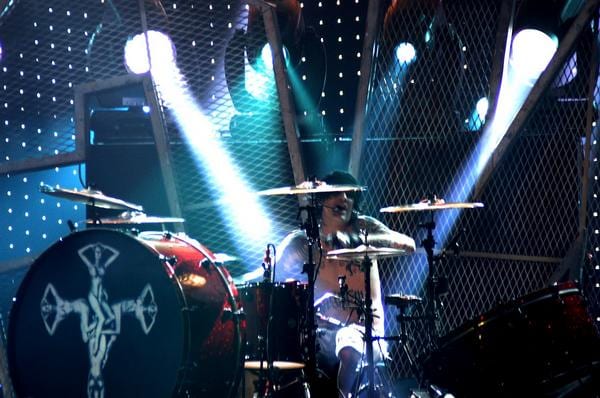
The cage (late 1980s). The Dr. Feelgood era rig put Tommy in a rotating cage that inverted him mid-solo. Twin 24” kicks, banks of toms, and gravity as a special guest.
The Crüecial rollercoaster (2005). For the original Carnival of Sins tour, the entire kit rode a rail out over the crowd on a 360-degree loop. Not a riser that tilts — a rollercoaster.
The Pop Disaster co-headline (2002). Worth noting because the other drummer on that bill was Travis Barker, whose kit also left the ground and rotated mid-solo. An arms race, essentially, and everyone won.
Tommy Lee’s drum kit
Tommy’s setup has always been big, loud and built for sightlines.
The constant is the double 24” kick configuration, banks of toms, and Zildjian cymbals angled high enough to be seen from the back of a shed.
The eras, in short:
- Tama (1980s) — Artstar II double-bass kits, a bell brass 14” snare, Titan hardware, and the infamous rotating cage.
- DW (2000s onwards) — Collector’s Series maple, twin 24” kicks, a 14” x 6.5” Edge snare with its brass-and-maple hybrid shell, DW 9000 double pedal.
Cymbals have been Zildjian throughout — A and A Custom hi-hats at 15”, 19” crashes, a 22” ride, and a Swish Knocker or China High for the trashy accents.
Sticks are his own Ahead signature model. Ahead’s aluminium-core sticks were built for exactly this: players who hit hard enough to snap wood every night. He helped put the brand on the map.
See Tommy Lee’s full rig, era by era, in the Rig Vault →
Want the sound without the rig?
The Crüe drum sound is mostly tuning and commitment rather than exotic gear. A big kick, a bright cranked snare, a cowbell that is actually loud enough, and the confidence to play simply.
The 1980s bell brass snares are long discontinued, so Reverb is the route if you want the real thing — and the Reverb price guide will tell you what one is genuinely worth. Our Gear Guru will happily spec a modern equivalent for your budget.
Beyond Mötley Crüe
Tommy has never sat still. Methods of Mayhem, formed in 1999, mixed rap, rock and electronics well before that was a commercial formula. There have been solo records — Never a Dull Moment, Tommyland: The Ride, and 2026’s Tommyland Rides Again — plus a long stretch of DJ and electronic work.
None of it has the reach of the Crüe. All of it explains why he keeps going.
Where to start listening
- “Kickstart My Heart” (1989) — the double-kick drive, and a masterclass in not slowing down.
- “Live Wire” (1981) — young, fast and barely under control.
- “Dr. Feelgood” (1989) — the biggest drum sound the band ever committed to tape.
- “Girls, Girls, Girls” (1987) — the cowbell, doing its job.
- “Same Ol’ Situation” (1989) — the fills you already know by heart.
Find more Tommy Lee
Final thoughts
Tommy Lee is not the drummer to study if you want to learn odd time signatures. He is the drummer to study if you want to learn how to make four thousand people move in the same direction.
Is the playing simple? Often, yes — and that is the point. Simple parts played with total conviction, dead in time, at volume, for four decades. Ask any working drummer how hard that actually is.
At sixty-three he is back out on a rollercoaster of a tour, selling the snare off his own stage. When there is more, you will read about it in the news section at the top of this page.
And if you want the full gear picture, Tommy Lee’s rig is in the Rig Vault, era by era.