Zak Starkey | Ringo's son, Keith Moon's godson
Zak Starkey drummed for The Who for nearly thirty years, was fired twice, and is back. His story, his gear, the Oasis years, and the latest news.
Being a famous drummer’s son is a difficult starting position. Being a famous drummer’s son who takes over from an even more famous drummer, in the band that drummer defined, is close to unfair.
Zak Starkey has done that job for thirty years, and he has done it well enough that most people have stopped mentioning his father.
Here you will find his story, what he actually does behind the kit, the gear, and the latest Zak Starkey news. Let’s get into it.
Who is Zak Starkey?
Zak Richard Starkey was born on 13 September 1965 in London, to Ringo Starr and Maureen Starkey.
He wanted to play guitar first. Then, around the age of ten, he heard Meaty Beaty Big and Bouncy — a Who compilation — and changed his mind about which end of the stage he wanted to be at.
Uncle Keith
The reason he had a drum kit to change his mind on was Keith Moon.
Moon was one of Ringo’s closest friends, a regular presence in the house, and Zak’s godfather. He bought Zak his first kit — the white and cream Premier he had given Ringo — when Zak was around eight, and gave him what little formal instruction he ever received.
Ringo, famously, did not teach him. By most accounts the extent of the paternal drum tuition was a single lesson, and Zak has been open about being essentially self-taught after that.
So the man who taught The Who’s drummer to play the drums was The Who’s drummer. There is no cleaner line of succession in rock, and no heavier one to carry.
The Who, 1996 to 2025 — and back
Moon died in 1978. Kenney Jones took the chair, then Simon Phillips on the 1989 tour, and by the mid-1990s the seat was effectively open again.
Zak got it in 1996, for the Quadrophenia tour, and held it for nearly thirty years — every major Who tour, the Super Bowl, the Olympics, the studio work, the lot.
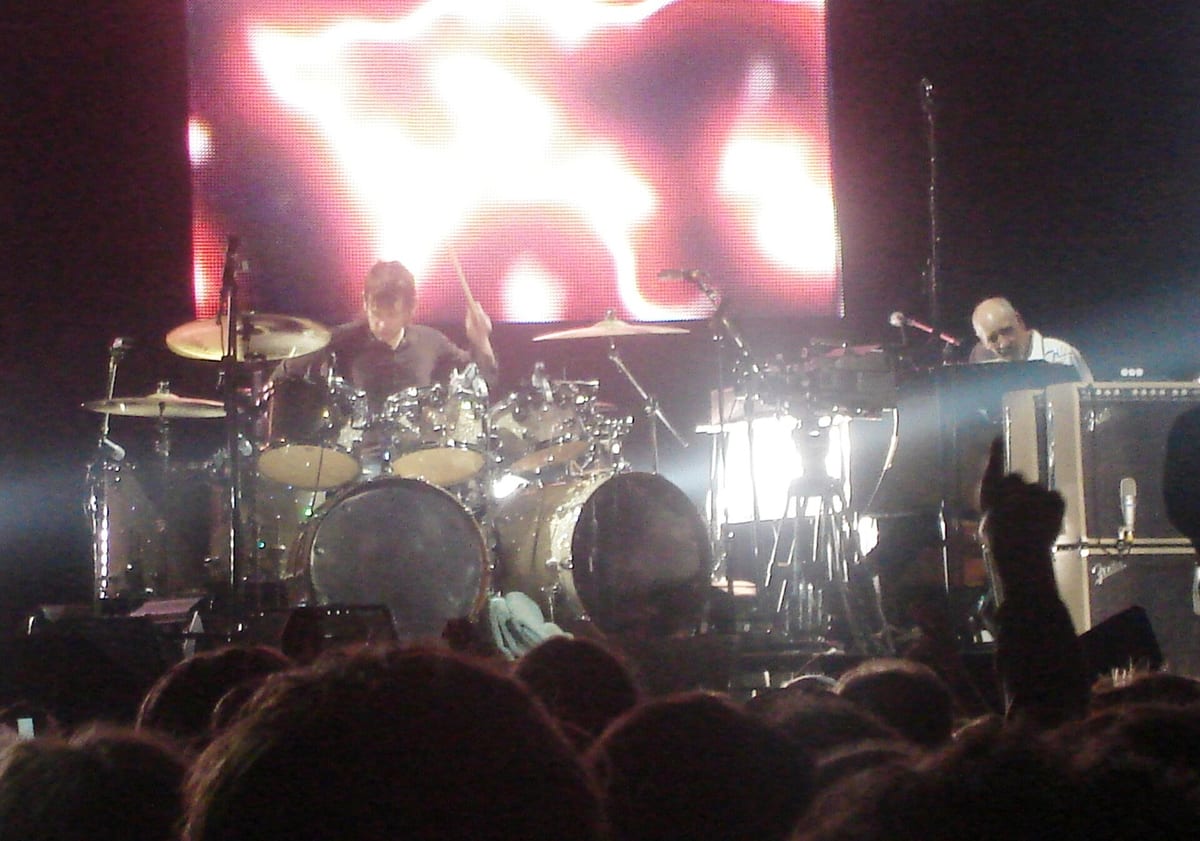
Then came 2025. A wobble at the Royal Albert Hall in March, a sacking in April, a reinstatement three days later, a second sacking in May, and a farewell tour played by Scott Devours. In August 2026 the band rehearsed with Zak again and both sides said the warm thing in public.
See Zak Starkey’s full rig, era by era, in the Rig Vault →
The Oasis years
Between 2004 and 2008 he was also Oasis’s drummer — their third, after Tony McCarroll and Alan White.
He played on Don’t Believe the Truth (2005) and Dig Out Your Soul (2008), and the Oasis job cost him Who studio time: he was on the road with the Gallaghers for most of the sessions for The Who’s Endless Wire, and made it onto only one track.
Two of the most demanding legacy gigs in British rock, at the same time, for four years. That is the part of the CV people skip.
What Zak Starkey actually does behind the kit
He plays Moon without impersonating him
This is the whole trick, and it is harder than it sounds.
Moon’s playing is mostly refusal — he refuses to keep simple time, refuses to leave a bar unfilled, refuses to play the hi-hat when a tom will do. Copy that literally and you get noise. Ignore it entirely and you are not playing The Who.
Zak’s answer is to keep Moon’s density and add a spine. The fills tumble in the right places, the toms do most of the talking, but there is a backbeat underneath holding it together in a way Moon’s never quite did.
The kit is enormous, and that is a choice
Twin 24in kicks, three rack toms, four floor toms. On paper that is a 1970s excess. In practice it is the only way to have that many drums available at that speed — a Moon-style fill needs somewhere to go.
The Oasis job proves the other half
Oasis needs the opposite of all that: heavy, straight, unhurried, no showing off. He was very good at that too, which is the evidence that the Who playing is a decision rather than a limitation.
Zak Starkey’s drum kit
DW for essentially the whole Who run, in a series of increasingly theatrical finishes, and the shape of it barely moves.
- The kit — twin 24in kicks, three rack toms (12in, 13in, 14in) and four 18in floor toms, in the documented Whotabs spec. Finishes tell the eras apart: white with brass hardware for the 1996 Quadrophenia tour, DW’s Broken Glass wrap by 2007, clear acrylic lit from inside for the Super Bowl, and Olympic-coloured acrylic for the 2012 closing ceremony.
- Snares — the odd one out, twice. The Who kit is documented with a 15in x 10in DW, which is enormous for a snare drum. Then for the 2012–13 Quadrophenia tour he put a Ludwig 402 in the middle of a custom acrylic kit — the plainest, most ordinary snare in rock, and the correct choice.
- Cymbals — Zildjian, and mostly huge. A pair of K 21in crash/rides, a pair of A 24in crash/rides, 16in A hi-hats, and custom 22in crash/rides made for him from at least 1996 — Zildjian eventually sold a Zak-inspired K Crash Ride in 21in and 22in off the back of them. For the broadcasts they got painted: RAF roundels at the Super Bowl, Olympic ring colours in 2012.
- Pedals and hardware — DW, with two single 9000 pedals rather than a double, one per kick.
- Sticks — his own Zildjian Artist Series model, roughly 5A weight with an oval bead, carrying The Who’s target logo. The one constant across thirty years.
- Heads — Remo. Coated Ambassadors on snare and toms, Powerstroke 3 on the kicks.
- The electronic years — playing in front of a symphony orchestra took the acoustic kit off the table, so 2019’s Moving On! run used a custom DW-built Roland V-Drums kit in gold, laid out to look normal from the stalls, with a Porter & Davies throne putting the kick through the seat instead of the wedges.
Zak Starkey’s Oasis rig is the interesting counterpoint: a chrome DW cut down to four drums, which is a different drummer’s kit entirely.
Every piece, era by era, is in Zak Starkey’s Rig Vault page with buy links.
Want the sound without the rig?
You do not need seven toms. The Moon-adjacent sound is mostly about tom-heavy voicing and coated heads, not shell count — a standard kit with an extra floor tom gets you most of the way.
The acrylic shells are the harder part, and the vintage ones live on Reverb now; the Reverb price guide will tell you what one is actually worth before you get carried away. Our Gear Guru will spec a modern equivalent to your budget if you would rather not gamble.
Beyond the day jobs
The two big gigs are only part of it. He has drummed for The Icicle Works, The Lightning Seeds, The Waterboys, Paul Weller, Johnny Marr and the Healers (Boomslang, 2003), Casbah Club, and his father’s All-Starr Band.
He also runs a reggae label. Trojan Jamaica, founded with his wife Sharna “Sshh” Liguz, is a genuine second career rather than a rock-star hobby, and the two of them record together as SSHH.
Most recently there is Mantra of the Cosmos — a properly unlikely group with Shaun Ryder and Bez of Happy Mondays and Andy Bell of Ride and Oasis, who managed to get Noel Gallagher onto a single called “Domino Bones (Gets Dangerous)”.
Where to start listening
- Oasis — Don’t Believe the Truth (2005). The cleanest recorded example of him playing heavy and straight.
- Oasis — Dig Out Your Soul (2008). Groovier, murkier, more interesting drumming.
- Johnny Marr and the Healers — Boomslang (2003). Nothing like either day job.
- Any decent Who live recording from 1996 onwards. The studio catalogue is Moon’s; the last thirty years of Who concerts are Zak’s, and that is where the playing lives.
Final thoughts
The nepotism charge was always lazy. Nobody keeps a seat like that for thirty years on a surname, and nobody is asked back after a public falling-out as ugly as 2025 unless the band genuinely misses what they lost.
What makes him worth studying is the balancing act: enough Moon to be The Who, enough discipline to be a modern drummer, and enough range to hold down Oasis at the same time.
See Zak Starkey’s full rig in the Rig Vault, read how the 2025 saga ended, or have a look at Ringo Starr’s rig while you are here.